Crowe comments on recent insolvency trends
Our services range from advisory and informal solutions through to the formal insolvency procedures.

Source: Insolvency Service*
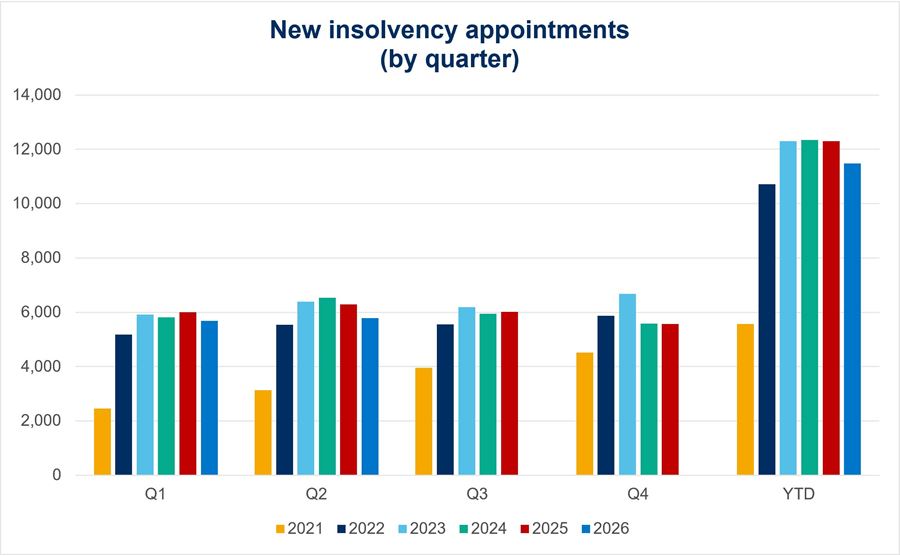
The latest corporate insolvency statistics provide some welcome encouragement. After several years of elevated business distress, the total number of insolvency appointments in England and Wales fell during the second quarter of 2026 for the second consecutive year. With Q1 also down on the prior year, this suggests that the peak of the current insolvency cycle may now be behind us.
Between April and June 2026, there were 5,790 corporate insolvency appointments, compared with the same period in 2025, total appointments fell by approximately 8%. The year-to-date total reflects a similar position, with the first half of 2026 recording 11,476 new appointments, c.7% down on any of the last three years.
While this reduction is encouraging, it would be premature to conclude that business distress has disappeared. Insolvency levels remain significantly above those seen before the pandemic and continue to exceed the long-term averages experienced throughout much of the 2010s. The current environment is perhaps best characterised not as a crisis, but as a period of sustained vulnerability in which weaker businesses are finding it increasingly difficult to absorb even modest financial shocks.
The broader economic backdrop is certainly more favourable than it was 12 months ago. The UK economy continues to grow, with GDP increasing by 0.7% over the three months to April 2026, supported by expansion in both the services and construction sectors. Inflation has also fallen markedly from the double-digit levels experienced during 2022 and 2023, with CPI standing at 2.8% in May 2026.
However, beneath the headline economic indicators, many businesses continue to experience significant pressure. Higher wage costs, increased employment taxes, refinancing challenges, stretched working capital and weaker consumer demand are all affecting profitability. For businesses carrying historic debt or operating with limited cash reserves, the reduction in inflation does not automatically translate into financial resilience.
The weather is also likely to play a factor in both the medium and long term, the extended period of drought and high temperatures in the UK, which is expected to be followed by a potentially wet and turbulent winter due to El Niño effects, will cause significant challenges for those in food production. Whether due to higher UK production costs or importing costs, the impact is likely to drive price increases for both domestic consumers and downstream producers in the food industry.
While the latest figures show easing in formal appointments, the pressures remain, and it is important to remember that insolvency rarely arrives without warning. In our experience, formal insolvency is often preceded by a combination of familiar indicators:
These issues are particularly relevant for advisors acting for owner-managed businesses and corporate clients where financial stress may not yet be apparent from the headline numbers alone.
The most successful restructurings are invariably those where action is taken early. Once creditor pressure intensifies or liquidity becomes exhausted, the range of available options narrows considerably. By contrast, businesses that identify concerns early often retain access to a much broader toolkit, including refinancing, restructuring, consensual settlements and, where necessary, formal restructuring procedures.
The message from the Q2 statistics is clear: insolvency numbers may be easing, but the underlying risk environment remains elevated.
If you are a director who has identified any of the warning signs above, or an advisor who has concerns regarding a client, now is the time to seek advice.
Crowe's Insolvency and Restructuring team works with directors, shareholders, lenders and professional advisors to identify issues early, evaluate available options and protect value wherever possible. Early conversations come at little cost, but delaying difficult decisions can prove extremely expensive.
Contact Steven Edwards or Mark Holborow for more information.
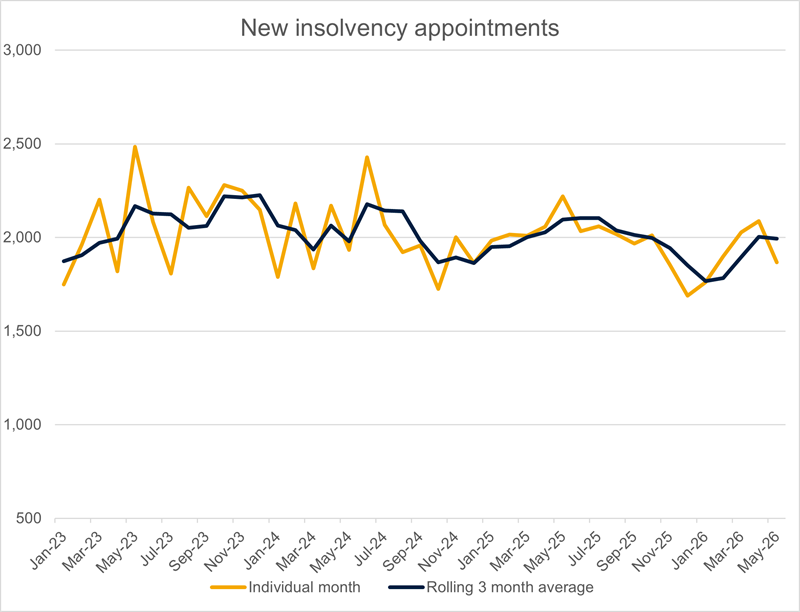
The latest May 2026 insolvency statistics show 1,868 company insolvencies in England and Wales, down 10% month‑on‑month and 16% year‑on‑year. The rolling three-month average dipped back just below 2,000, halting the recent steep increase.
While the headline suggests stabilisation, activity remains high by historical standards and continues to reflect SME distress. Director‑led closures remain prevalent, indicating ongoing pressure on smaller businesses despite falling volumes.
The drivers are well understood. Economically, businesses continue to contend with weak growth, lingering inflation effects and the lagged impact of higher borrowing costs. Politically, rising employment costs and a firm HMRC enforcement stance are sustaining creditor pressure. Globally, energy price volatility, supply chain disruption and trade tensions continue to affect margins and working capital.
Where there are concerns about future prospects for a business, management teams should take advice early while problems can be solved and stakeholders managed rather than waiting until a crisis develops. The sooner professional support is taken the more likely a better outcome can be achieved, saving businesses, jobs and mitigating personal liability for directors.
If you need support our initial consultation is free of charge and allows us to understand your business and the challenges being faced. We will discuss the options available, empowering you to make informed decisions on how best to proceed. We will work with you to manage the difficulties affecting the business and its stakeholders with empathy.
Contact Steven Edwards or Mark Holborow for more information.
*Note: the Insolvency Service reviews and revises historically published statistics each month. Our commentary is based on the latest available published data which may differ to previous periods.
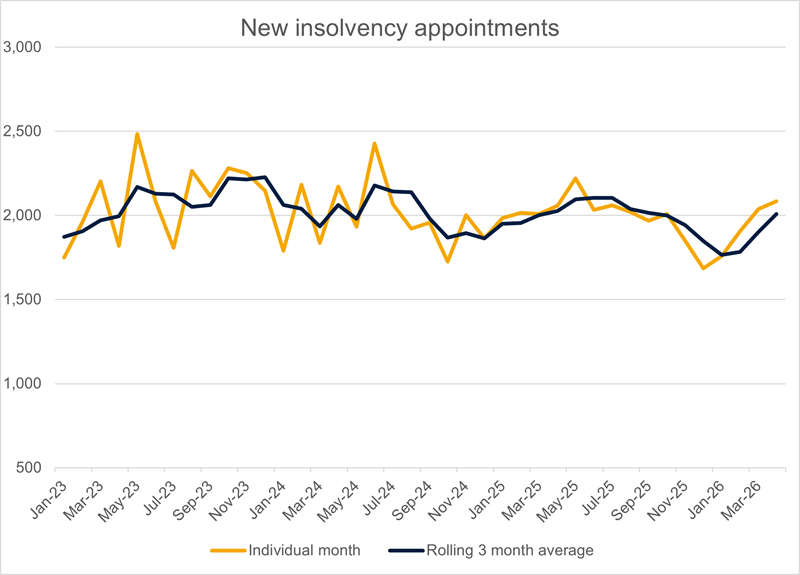
There were 2,085 new insolvency appointments in April 2026, 1.3% higher than the same month last year, and 2.4% higher than March 2026. The increase in April also pushed the rolling quarterly average up to 2,010 per month.
Source: Insolvency Service*
The increases are a result of cost pressures, supply chain disruption and consumer nervousness fuelled by the ongoing conflict in Iran. As predicted in our comment on the February statistics, where businesses are already vulnerable due to high operating costs and inflation pressures, the stresses resulting from the conflict are causing many to fall into formal insolvency.
Where there are concerns about future prospects for a business, management teams should take advice early, while problems can be solved and stakeholders managed rather than waiting until a crisis develops. The sooner professional support is taken, the more likely a better outcome can be achieved, saving businesses, jobs and mitigating personal liability for directors.
If you need support, our initial consultation is free of charge and allows us to understand your business and the challenges being faced. We will discuss the options available, empowering you to make informed decisions on how best to proceed. We will work with you to manage the difficulties affecting the business and its stakeholders with empathy.
Please contact Steven Edwards or Mark Holborow at Crowe UK for more information.
*Note: the Insolvency Service reviews and revises historically published statistics each month. Our commentary is based on the latest available published data which may differ to previous periods.
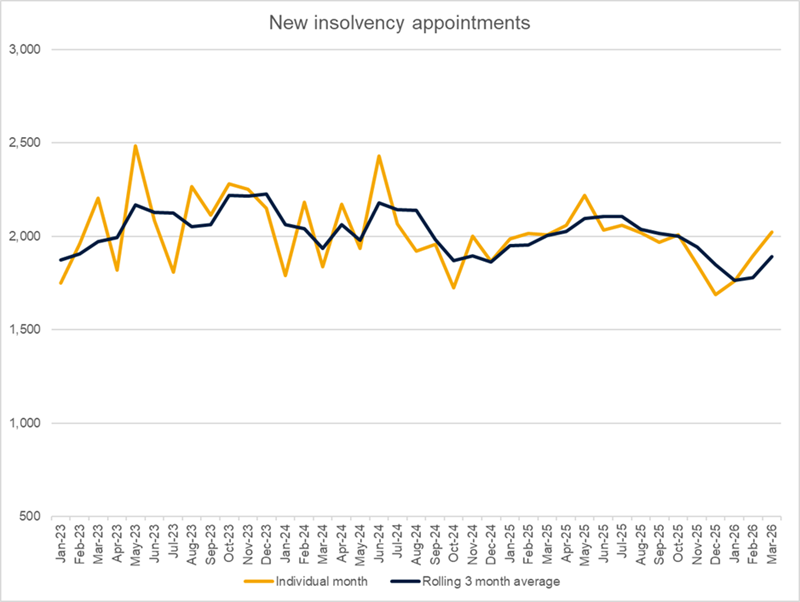
The Insolvency Service’s latest statistics for March 2026 point to a renewed uptick in formal insolvency appointments across England and Wales, following several comparatively subdued months. 2,022 company insolvencies were registered during the period, representing a 7% increase on February 2026 (1,895) and a level broadly in line with March 2025 (1,995).
Source: Insolvency Service*
While the headline year‑on‑year comparison appears stable, the composition of appointments has shifted markedly, with administrations driving much of the month‑on‑month increase.
Administrations rose 52% compared to February and 82% year‑on‑year, largely due to a single real‑estate‑related corporate group, where more than 100 connected companies entered administration simultaneously. This is likely a one‑off event, but it nevertheless highlights the persistent vulnerability of highly leveraged, asset‑intensive structures in the current environment.
Construction continues to feature prominently in insolvency statistics, remaining the highest‑volume sector over the last 12 months, followed closely by wholesale, retail, accommodation and food services.
For the network of businesses who support the construction sector, the key risks are delayed project pipelines, rising materials costs and tight funding conditions. The spike in real estate administrations during March, reinforces how quickly cash‑negative property vehicles can unravel once refinancing options diminish.
Creditors' Voluntary Liquidations (CVLs) remain dominant, accounting for 73% of all insolvencies, and this continues to reflect stress among SMEs in consumer‑facing sectors. Although CVL numbers were slightly lower than both February 2026 and March 2025, underlying pressures persist as businesses contend with weak discretionary demand and rising input costs.
A high exposure to energy costs and reliance on discretionary consumer spending means the industry, which has already been substantially struggling over the last couple of years, is likely to see further declines and failures over the next six months.
Across all sectors, the conflict involving Iran has disrupted oil and gas flows through the Strait of Hormuz, contributing to a sharp rise in global energy prices and renewed inflationary pressure. The UK is particularly exposed as a net energy importer, with higher fuel and transport costs now feeding directly into margins and working capital requirements.
The level of uncertainty and cost pressures also contributes to growing uncertainty with consumers and is likely to directly impact on the level of discretionary spend. The current situation has strong echoes of the 2022 inflationary spikes and cost of living crisis, which we have yet to recover from. Even if peace is once again achieved in the near term, the disruptions and price impacts are likely to still be felt by businesses and consumers alike for some time to come.
For directors and advisers, the takeaway is clear: geopolitical risk is now a direct insolvency risk factor. Higher energy prices, constrained supply chains and interest rates remaining “higher for longer” are eroding headroom even in otherwise viable businesses. While March’s headline numbers were skewed by exceptional events, the underlying environment remains fragile.
Early engagement remains critical. Timely advice on cash flow, funding options and formal restructuring tools can significantly improve outcomes.
If you have concerns about solvency or emerging financial distress, please contact Mark Holborow or Steven Edwards at Crowe UK for a confidential discussion.
There were 1,878 new insolvency appointments in February 2026, 6.8% lower than the same month last year, but 7.4% higher than January 2026. The current month increase also meant the rolling quarterly average plateaued at 1,771 insolvencies per month.
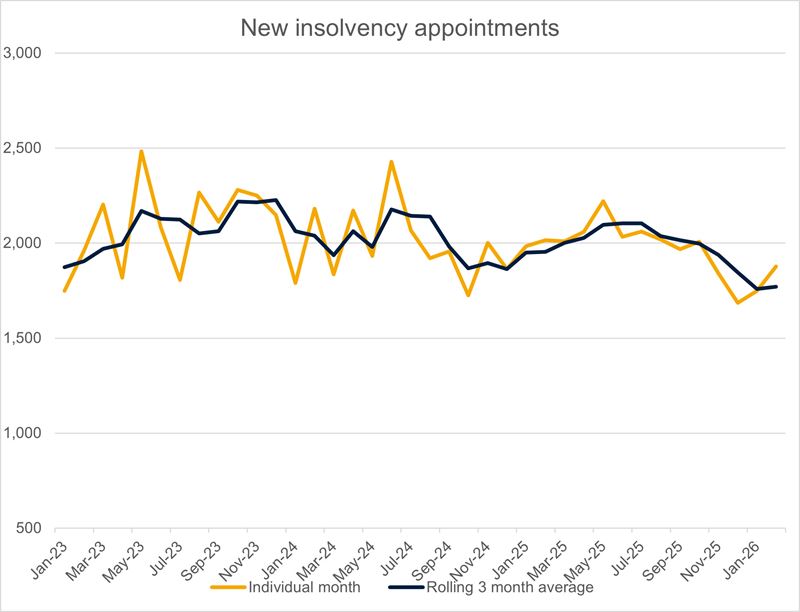
Source: Insolvency Service*
The latest published figures cover the period up to 28 February, the same day that military action was launched on Iran. The consequences of this action and broader geopolitical unrest are likely to result in further insolvencies over the coming months. Brent crude oil prices have increased from $70 per barrel on 3 February to $94 a barrel on 9 March. This will drive substantial inflationary cost pressures that we expect will directly or indirectly impact all sectors.
Where there are concerns about future prospects for a business, management teams should take advice early, while problems can be solved and stakeholders managed rather than waiting until a crisis develops. The sooner professional support is taken, the more likely a better outcome can be achieved, saving businesses, jobs and mitigating personal liability for directors.
If you need support, our initial consultation is free of charge and allows us to understand your business and the challenges being faced. We will discuss the options available, empowering you to make informed decisions on how best to proceed. We will work with you to manage the difficulties affecting the business and its stakeholders with empathy.
For further information, please get in touch with Steven Edwards.
*Note: the Insolvency Service reviews and revises historically published statistics each month. Our commentary is based on the latest available published data which may differ to previous periods.
There were 1,744 new insolvency appointments in January 2026, 12% lower than the same month last year. The rolling quarterly average also fell further to 1,756 insolvencies per month, the lowest we’ve seen since early 2022.
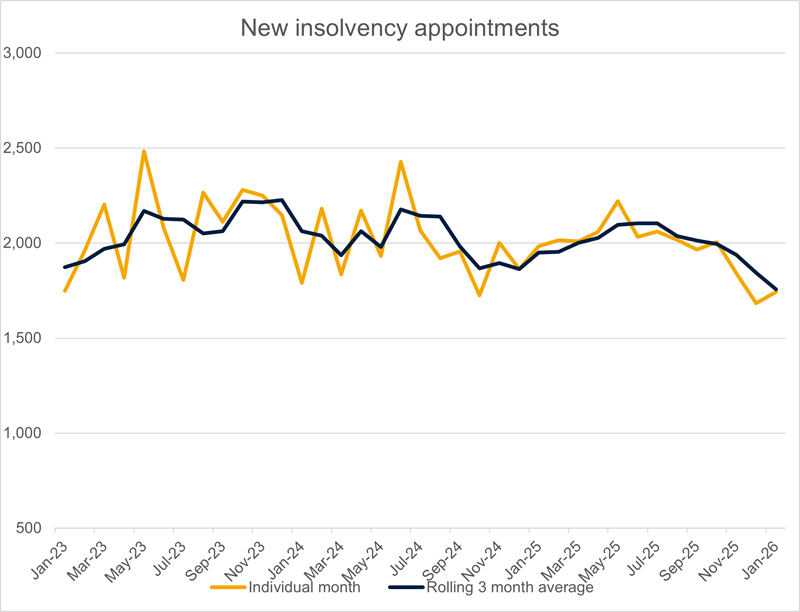
Source: Insolvency Service*
There were 151 administration appointments in January 2026, 9% of the total new appointments, which is notably higher than the long-term average of 6%. The powers granted as part of an administration are intended to support the rescue of trading businesses, including via pre-pack sales, as such a spike in their usage can be an indication of a more positive outcome for employees and creditors alike compared to a liquidation process.
Where there are concerns about future prospects for a business, management teams should take advice early, while problems can be solved and stakeholders managed, rather than waiting until a crisis develops. The sooner professional support is taken, the more likely a better outcome can be achieved, saving businesses, jobs and mitigating personal liability for directors.
If you need support, our initial consultation is free of charge and allows us to understand your business and the challenges being faced. We will discuss the options available, empowering you to make informed decisions on how best to proceed. We will work with you to manage the difficulties affecting the business and its stakeholders with empathy.
*Note: The Insolvency Service reviews and revises historically published statistics each month. Our commentary is based on the latest available published data, which may differ from previous periods.
Contact Steven Edwards or Mark Holborow for more information.
There were 1,671 new insolvency appointments in December 2025, 10.4% lower than the same month last year and 10.5% lower than November 2025. The rolling quarterly average continued to trend downwards over the second half of 2025, falling to 1,857 in December 2025.
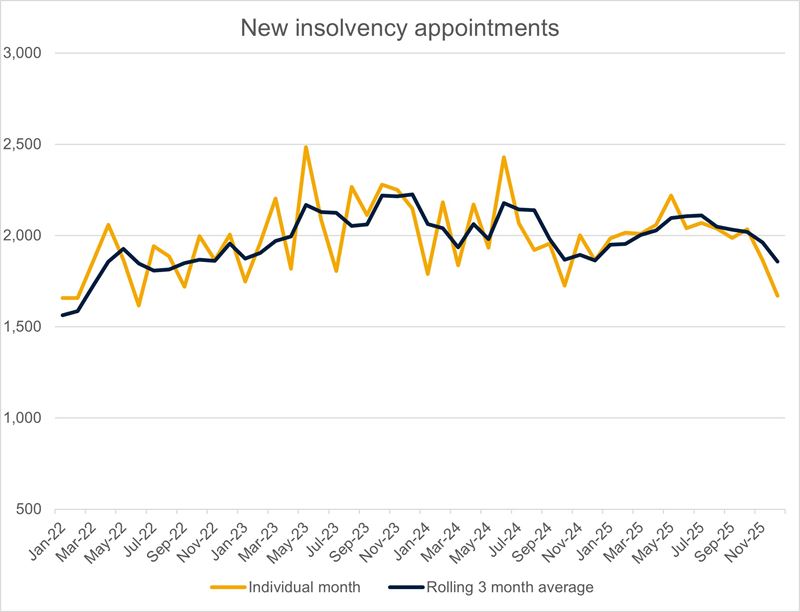
In total, there were 23,993 insolvency appointments in 2025, 117 more than in 2024. Across the last four years (2022 – 2025), there has been an average of 23,791 appointments per year, 40% higher than the average of the decade prior to COVID-19.
As we commented at the end of Q3, the economic indicators don’t show any overt signs of distress, but equally, there are no significant positive signs. Far from being in reaction to a crisis or a reason for headlines, appointments of around 24,000 a year appear to be the new normal.
The new year is unlikely to bring any marked improvement to the cost pressures which firms have been managing over several years. Where there are concerns about future prospects for a business, management teams should take advice early, while problems can be solved and stakeholders managed, rather than waiting until a crisis develops. The sooner professional support is taken, the more likely a better outcome can be achieved, saving businesses, jobs and mitigating personal liability for directors.
*Note: The Insolvency Service reviews and revises historically published statistics each month. Our commentary is based on the latest available published data, which may differ from previous periods.
When considering a year-to-date basis, 2025 has had 20,479 appointments over ten months, 434 higher than the same period in 2024.
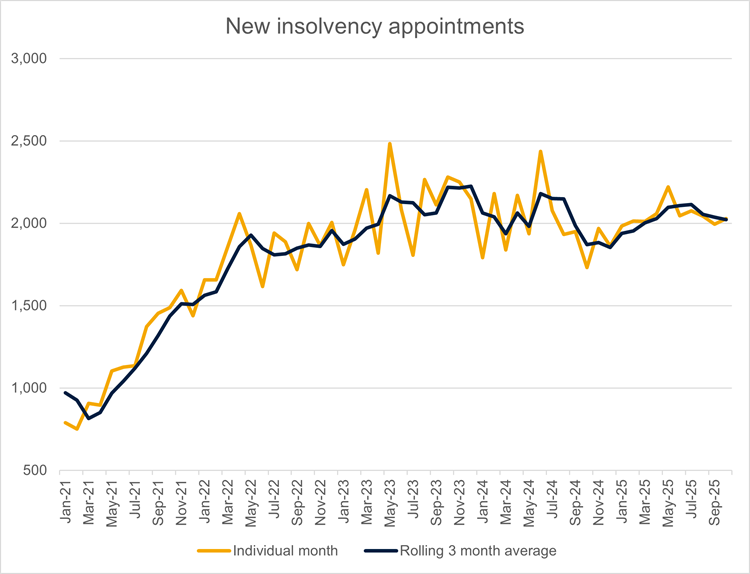
2025 continues the trend of the last three years, with persistently high insolvency rates. From 2000 to 2020, there were, on average, 4,485 insolvency appointments per quarter. Since 1 April 2022, when the Corporate Insolvency and Governance Act 2020 (CIGA) temporary restriction on creditor action lapsed, the UK has averaged 6,047 insolvencies per quarter.
Other than the high rate of insolvency, the usual economic indicators in the UK do not show similar levels of distress over the first three quarters of 2025. Inflation has averaged 3.3%, real wage growth is approximately 1.5%, GDP growth is around 1.1% and interest rates have fallen by 0.75% during the year.
The figures don’t indicate a booming economy, with inflation slightly above target, GDP growth minimal, and interest rates, though reduced, remain at 4.0%. These metrics, though sluggish, wouldn’t typically be expected to produce the insolvency rates seen this year. This is further supported by the fact that the ratio of corporate debt to GDP is the lowest it has been in 30 years, suggesting that larger corporates could potentially extend themselves further, if they had the appetite to invest or acquire. The conclusion this builds to is that the main factor holding back larger businesses (and potentially economic growth as a whole) is a lack of confidence. The shocks of the COVID-19 pandemic remain fresh. More immediately, we have seen government change, substantial budget and taxation announcements, and global tariff wars, all within the last 12 to 18 months, with further tax increases expected in the budget at the end of November.
While the big picture suggests a benign economy held in check by a lack of confidence, this view from 30,000 feet doesn’t hold true across the board when you start looking in more detail. In the SME marketplace, the situation is far more challenging. In smaller businesses, margin squeezes from operating cost inflation are harder to swallow, pass on or mitigate through cost cutting. Access to debt is also more difficult, with more than half of applications being declined.
SMEs contribute over 50% of turnover, 60% of employment and 99% of registered companies in the UK. It is predominantly from this ocean of smaller businesses that the insolvency statistics are being fed and driving the high rates currently seen. This may also be why the record beating statistics have remained largely under the radar for most press outlets.
While the big picture suggests a benign economy held in check by a lack of confidence, this view from 30,000 feet doesn’t hold true across the board when you start looking in more detail. In the SME marketplace, the situation is far more challenging. In smaller businesses, margin squeezes from operating cost inflation are harder to swallow, pass on or mitigate through cost cutting. Access to debt is also more difficult, with more than half of applications being declined.
SMEs contribute over 50% of turnover, 60% of employment and 99% of registered companies in the UK. It is predominantly from this ocean of smaller businesses that the insolvency statistics are being fed and driving the high rates currently seen. This may also be why the record beating statistics have remained largely under the radar for most press outlets.
For many years, the construction sector has had the most insolvency appointments in absolute terms. In part, this is due to it being the largest proportion of the business population (16% of legal entities), but also due to systemic issues in the sector with substantial input cost inflation and weather disruption combined with fixed price contracts. However, over the last three quarters, the rate of construction insolvencies has been falling markedly and, in Q3 2025, for the first time in over five years, the retail sector had the highest number of insolvency appointments.
In recent years, the sector has faced substantial challenges from energy price rises, national insurance hikes, and consumer spending squeezes. All of these have resulted in increasing insolvency rates over the last 18 months. The retail sector has been overly active in the insolvency statistics, with 16% of insolvency appointments in the last quarter, while comprising only 10% of the business population.
Facing similar pressures to the retail sector, hospitality has been hit the hardest recently. In Q3 2025, the sector resulted in 14% of insolvency appointments from less than 4% of the business population. The biggest challenges recently have been the tax changes, which came into effect in April 2025, combined with consumers left uncertain about potential tax raids to come and choosing to prioritise saving rather than spending.
While the macro-economic factors appear relatively benign, the tax rises, lack of confidence and uncertainty driven by tariff wars and the late UK budget continue to result in high levels of stress across many sectors. For SME businesses, this is particularly stark, with many facing low cash reserves and little option but to seek insolvency advice in the near term.
Where there are concerns about future prospects for a business, management teams should take advice early, while problems can be solved and stakeholders managed, rather than waiting until a crisis develops. The sooner professional support is taken, the more likely a better outcome can be achieved, saving businesses, jobs and mitigating personal liability for Directors.
If you need support, our initial consultation is free of charge and allows us to understand your business and the challenges you might be facing. We will discuss the options available, empowering you to make informed decisions on how best to proceed. We will work with you to manage the difficulties affecting the business and its stakeholders with empathy.
Contact Steven Edwards or Mark Holborow for more information.
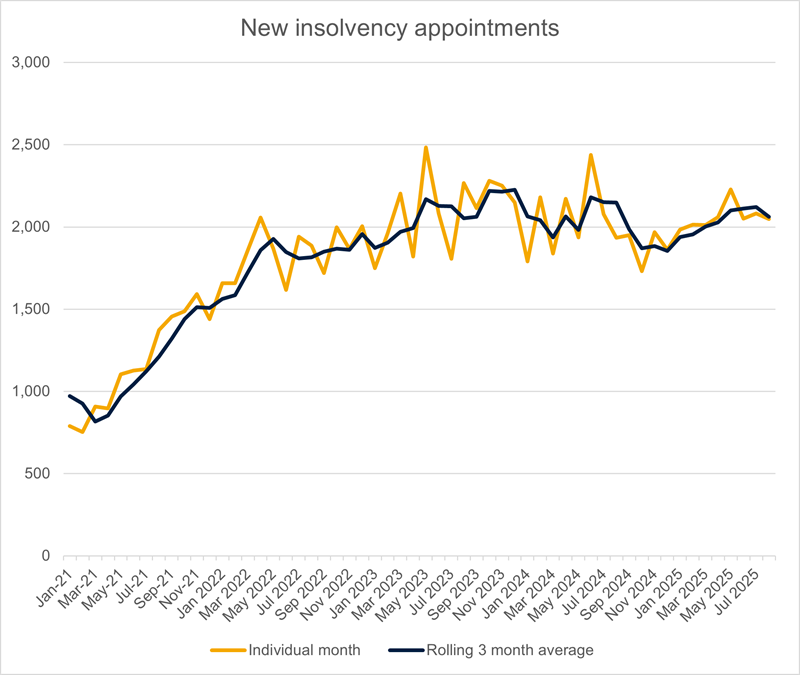
When considering the year-to-date basis 2025 has now edged slightly ahead with 16,479 in the current year compared to 16,365 over the first eight months of 2024.
Source: Insolvency Service*
With the Autumn Budget now delayed until late November, businesses will have to continue operating with substantial uncertainty for some time. This can potentially dampen investment, reduce available finance and increase pressure in sectors that may already be faltering.
When there are concerns about prospects for a business’s future, management should seek advice early. Acting at this stage means challenges can still be addressed and stakeholders reassured. Waiting until a crisis to develops makes it much harder to find a way forward. The sooner professional support is taken, the more likely a better outcome can be achieved, saving businesses, jobs and mitigating personal liability for directors.
If you need support, our initial consultation is free of charge and allows us to understand your business and the challenges you might be facing. We will discuss the options available, empowering you to make informed decisions on how best to proceed. We will work with you to manage the difficulties affecting the business and its stakeholders with empathy.
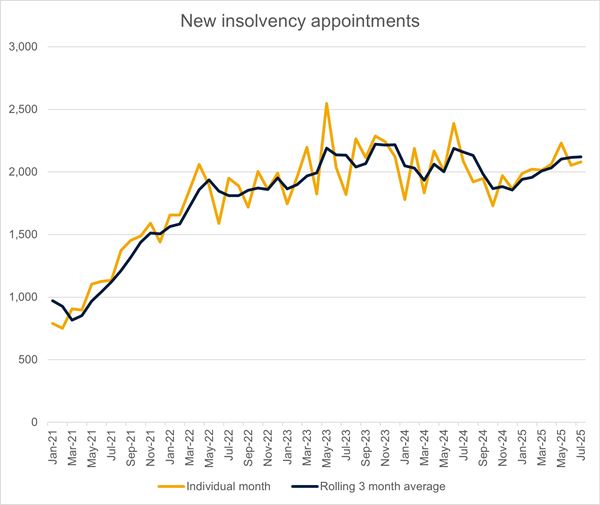
There were 2,081 new insolvency appointments in July 2025, broadly equal to the same month last year (2,085 appointments) but 1.4% above the previous month.
The rolling quarterly average has continued to rise steadily since last autumn, the most recent figures show an average of 2,122 appointments per month.
Source: Insolvency Service*
According to various headlines, inflation has ‘jumped’ to 3.8% this month. In my view, an increase of 0.2ppt from the previous month feels more like a small step than a somewhat sensationalist ‘jump’. However, the overall position is that inflation is and remains well above the Bank of England target.
Food price inflation was one of the largest contributors to the latest figures, which suggests a further squeeze on consumer wallets as households adjust to these unavoidable price rises. With inflation remaining high, the base rate is also unlikely to be further reduced in the near term, which will keep corporate debt, personal mortgages (and by extension rents) relatively high.
When considered alongside GDP figures that show little to no real growth, the UK economy appears to be in the doldrums. Consumer confidence and demand for goods and services are likely to continue to be cautious, and business investment plans may remain subdued, both due to a lack of confidence in the economy and anticipation of further government policy and taxation disruption being announced in the Autumn.
Where there are concerns about future prospects for a business, management teams should take advice early, while problems can be solved and stakeholders managed, rather than waiting until a crisis develops. The sooner professional support is taken, the more likely a better outcome can be achieved, saving businesses, jobs and mitigating personal liability for directors.
If you need support, our initial consultation is free of charge and allows us to understand your business and the challenges being faced. We will discuss the options available, empowering you to make informed decisions on how best to proceed. We will work with you to manage the difficulties affecting the business and its stakeholders with empathy.
Contact Steven Edwards or Mark Holborow for more information.
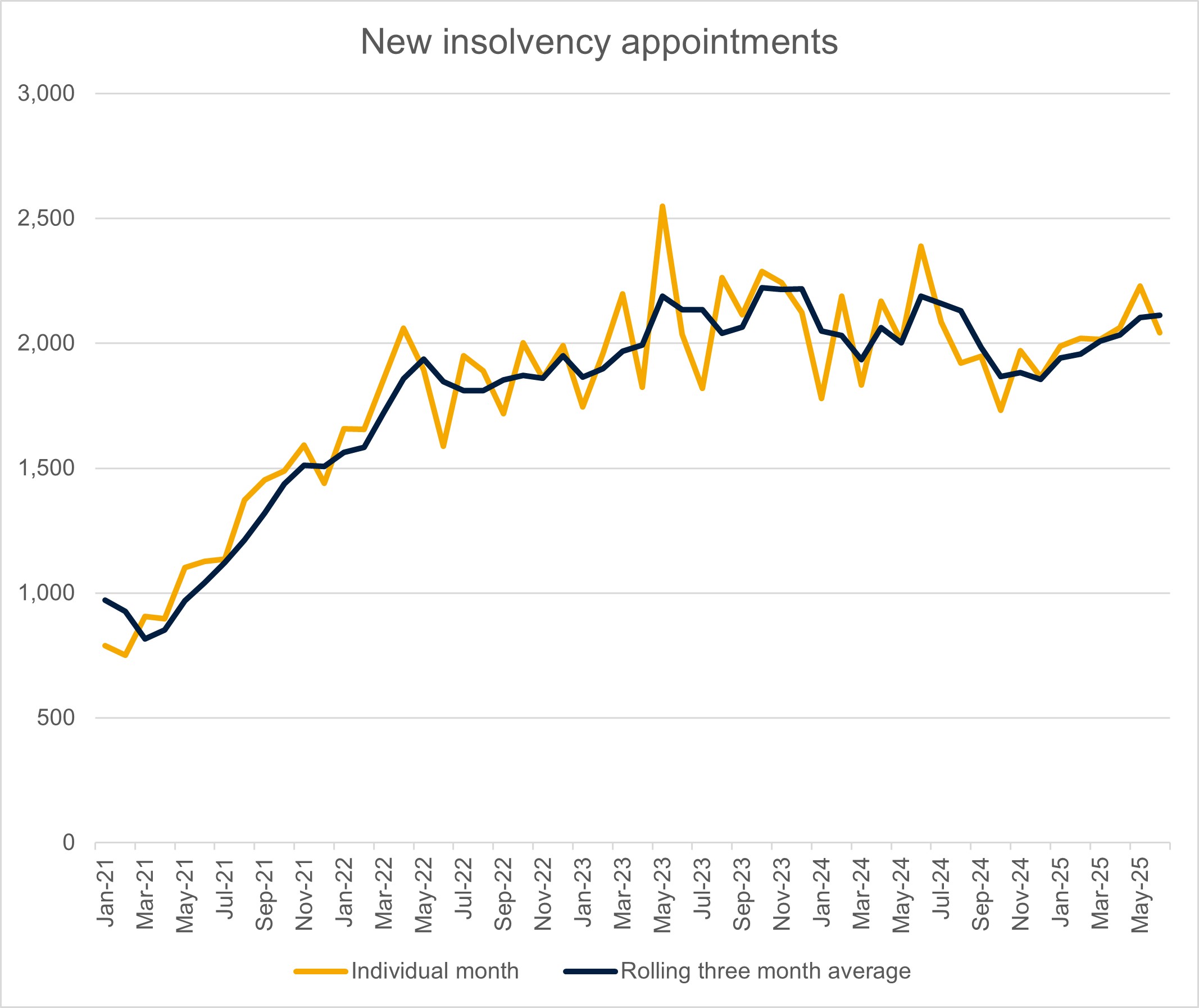
As we near the end of the summer months, we often see a lower rate of appointments as key decision makers are less available. So simply due to an element of seasonality, we would anticipate the rate of new appointments to stabilise or reduce slightly over the next few months.
Source: Insolvency Service
In the wider economy, inflation has crept back up to 3.6%, persistently higher than the Bank of England target of 2%. This means there is a limited prospect of further base rate reductions in the near term. GDP also declined marginally in both April and May 2025.
According to recent headlines, we should also be bracing ourselves for potentially substantial tax rises in the Autumn budget, in part required due to the economy not growing as the government hoped, and also due to Westminster’s reversing planned cost-cutting policies. Whether or not Labour maintains its election pledge not to levy these taxes on ‘working people’ remains to be seen. Regardless of whether the public is targeted directly or a further rise in corporate tax rates is made, the knock-on impact is likely to make trade more challenging. either by reducing consumer disposable income or further squeezing profit margins.
There is also recent evidence that the April 2025 tax increases have not delivered the boom that Labour anticipated, as businesses, particularly those in retail and hospitality, have reacted to the increase in NI by reducing staff numbers rather than paying additional tax income to HMRC.
With more tax rises likely in the Autumn, management teams need to be cautious in forecasting the future and, if necessary, take advice early while problems can be solved and stakeholders managed rather than waiting until a crisis develops. The sooner professional support is taken, the more likely a better outcome can be achieved, saving businesses, jobs, and mitigating personal liability for Directors.
If you need support, our initial consultation is free of charge and allows us to understand your business and the challenges being faced. We will discuss the options available, empowering you to make informed decisions on how best to proceed. We will work with you to manage the difficulties affecting the business and its stakeholders with empathy.
Contact Steven Edwards or Mark Holborow for more information.
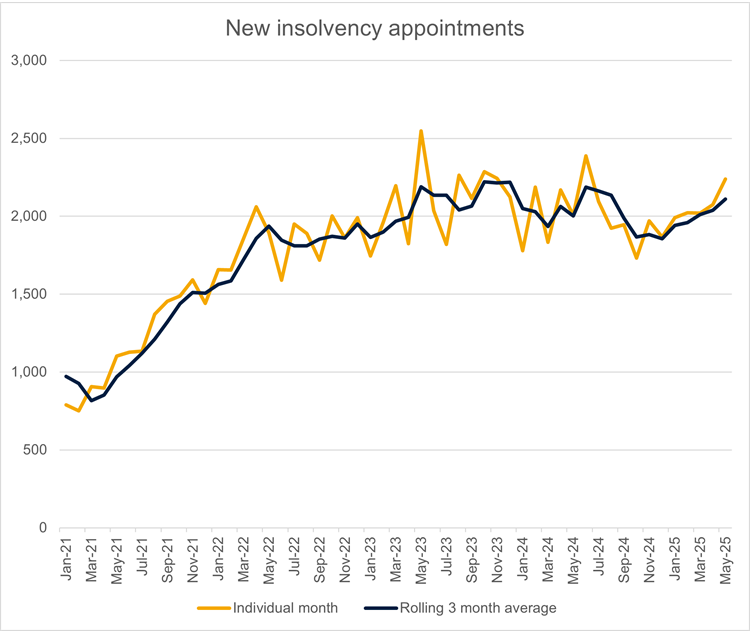
On the surface, a continuation of a steady, approximately six-month-long trend isn’t surprising. However, in some ways, this month’s result is an oddity precisely because, economically, there were no big surprises.
The US-UK tariff deal was agreed at the start of May, inflation continued relatively flat at 3.4% (higher than the 2% target but at least stable), and the Bank of England Base Rate was cut slightly to 4.25% mid-month, which was exactly as expected. Looking more broadly, real wage growth was 2.6% up year on year and has been consistently positive since late 2023, suggesting consumers should be feeling relatively comfortable with their level of disposable income.
The only recent additional pressure was the impact of tax changes, particularly National Insurance, and minimum wage increases, which were introduced in early April – albeit they were announced back in October 2024, so again, there were no shocks to the business world.
So, in a relatively passive economic environment, why are we seeing consistently high and rising levels of insolvency appointments?
In my view, the rising rates we see today aren’t businesses suddenly put under pressure and failing to react to a change in the last few months. These are businesses that have been clawing their way along tooth and nail under constant pressure for years, struggling to keep their heads just above the water. With reserves and investment whittled away by Covid-19, they have then risen and reacted to the challenges of spiking energy prices, high inflation, and the cost-of-living crisis. Brexit challenges tightening labour markets and recent increases in tax burden.
At some point, these pressures become insurmountable, and no matter how resilient the management team may be, there are only so many cost-cutting exercises, marketing ideas, restructuring plans, and personal investments that can be made.
My heart goes out to the directors who have been facing down these challenges for many years and may now be finding themselves reaching into their bag of tricks and coming up empty. If you or a client find yourself in this position, we are here to help you.
Taking advice early, where challenges and cash pressures are identified, can result in a much better outcome, saving businesses and mitigating personal liability for Directors. If you need support, our initial consultation is free of charge and allows us to understand your business and the challenges being faced. We will discuss the options available, empowering you to make informed decisions on how best to proceed. We will work with you to manage the difficulties affecting the business and its stakeholders with empathy.
Contact Steven Edwards or Mark Holborow for more information.
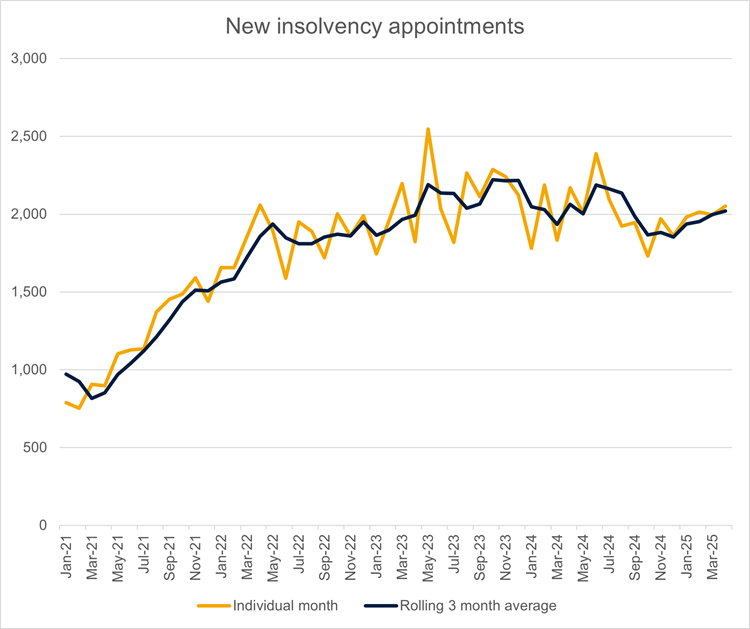
Source: Insolvency Service
Inflation has also pushed back up to 3.6%, continuing the general trend of rising inflation since September 2024. The rises in April 2025, were largely driven by higher power costs and annual rent and council tax increases.
The retail industry in particular continues to be highly active in April 2025, comprising 16% of total insolvency appointments.
The latest retailer sentiment survey undertaken by CBI showed the sharpest rate of decline in five years during May. Year on year, retail sales declined 27%, reflecting lower consumer confidence in recent months. Price inflation has also increased and is expected to accelerate further through the next few months.
Many retailers are reacting to the challenges, including the impact of recent tax changes, by reducing staff headcount and planned investment over the next 12 months. Actions which, in the short term, will retain cash in the business to cover increased operating costs but may result in a longer term stagnation.
If you or one of your clients operates in the retail, consumer, and leisure sector, it is critical that they are regularly creating and updating cash flow forecasts based on the most recent available data.
Taking advice early, where challenges are identified, can result in a much better outcome, saving businesses and mitigating personal liability for Directors. If you need support, our initial consultation is free of charge and allows us to understand your business and the challenges faced. We will discuss the options available, empowering you to make informed decisions on how best to proceed. We will work with you to manage the difficulties affecting the business and its stakeholders with empathy.
For more information, contact our insolvency and restructuring team of Steven Edwards or Mark Holborow.
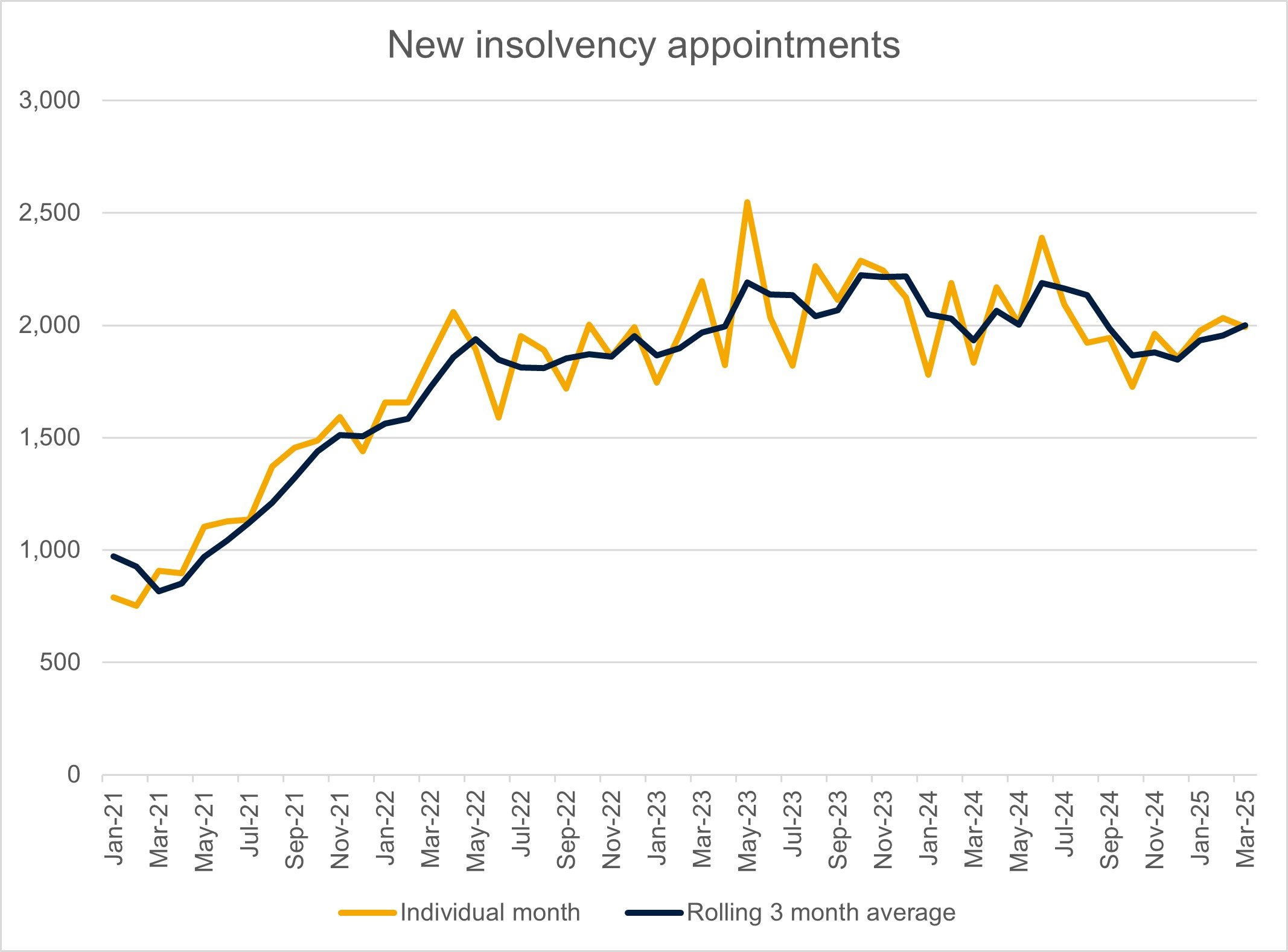
Source: Insolvency Service
While press headlines suggest that the cost-of-living crisis and soaring inflation were left firmly behind in 2022/23, the reality on the ground is quite different. Many companies are still coming to terms with the high-cost base and reduced profit margins. The persistently high appointment rate speaks to the ongoing challenging and disrupted business environment as the result of ongoing wars, political uncertainty, and tariffs we continue to observe.
Inflation tapered slightly in March to 2.6%, down from 3% in January. However, it remains higher than the Bank of England target at 2.0% and is likely to drive a more cautious approach from the Monetary Policy Committee when reducing interest rates over the coming months.
Although the start of the year has been challenging, unfortunately, further difficulties are likely ahead. Insolvency figures are released a month in arrears, because of this, the figures we are reporting on today do not factor in the impact of minimum wage and tax rises from the start of April, nor the major disruption to global markets and input prices that Trump’s tariff wars have caused.
Management teams must be alert and reforecast their cash flows on a regular basis in a highly fluid economic situation. Input prices for goods and materials are likely to rise in the near-term, squeezing margins at a time when businesses are also adjusting to the higher NICs and minimum wage.
If you or one of your clients suspect that struggles with cash might be imminent in the coming months, then the best course of action is to seek advice early. Directors may be personally liable for losses caused by wrongful trading or pursuing an overly optimistic strategy. It is important to be fully informed and have contingency plans prepared rather than ploughing ahead, hoping for the best.
If you need support, we will discuss the options available, empowering you to make informed decisions on how best to proceed. We will work with you to manage the difficulties affecting the business and its stakeholders with empathy.
For more information, contact our insolvency and restructuring team of Steven Edwards or Mark Holborow.
The rise in February is partially driven by a high number of compulsory liquidations. 393 new compulsory liquidation appointments during the month is the highest we have seen since monthly records began in January 2019.
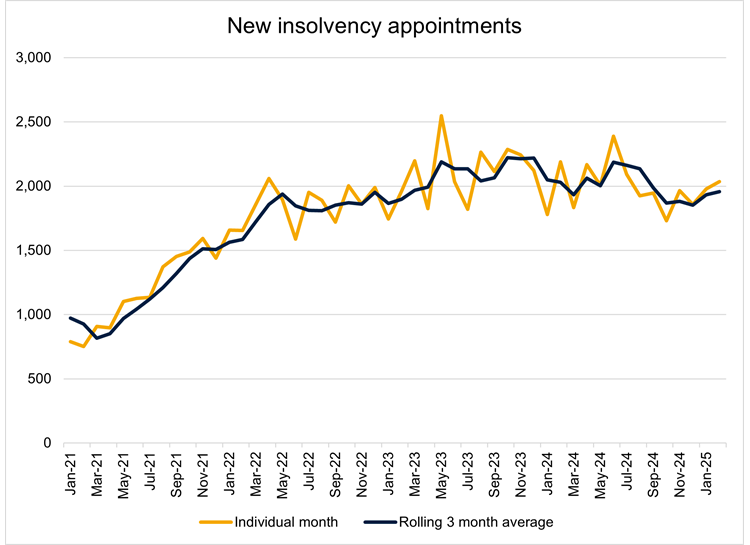
Source: Insolvency Service
The rise in February is partially driven by a high number of compulsory liquidations. 393 new compulsory liquidation appointments during the month is the highest we have seen since monthly records began in January 2019.
Compulsory liquidations are often the result of HMRC enforcement actions and show the toughening stance that is being taken around outstanding debts. This is, in part, a reflection of the government’s statement of intent and election promises to narrow the tax gap.
After several years of challenging trading conditions many business owners are starting to feel fatigued by the seemingly never ending but always varying list of pressures that they are contending with. So far 2025 does not appears to be providing any light at the end of tunnel for management teams, and next month will include the cash impact of tax rises and minimum wage increases that were announced in the Autumn Budget.
As always, if your business needs support to manage cash shortages, high debt burdens, stakeholder pressure or any other concerns, please contact our restructuring and insolvency team of Steven Edwards and Mark Holborow. The earlier advice is sought, the more options for rescue exist and the higher likelihood of a better outcome.
However, overall, the rate remains in line with the 2024 average of 1,990 appointments per month.
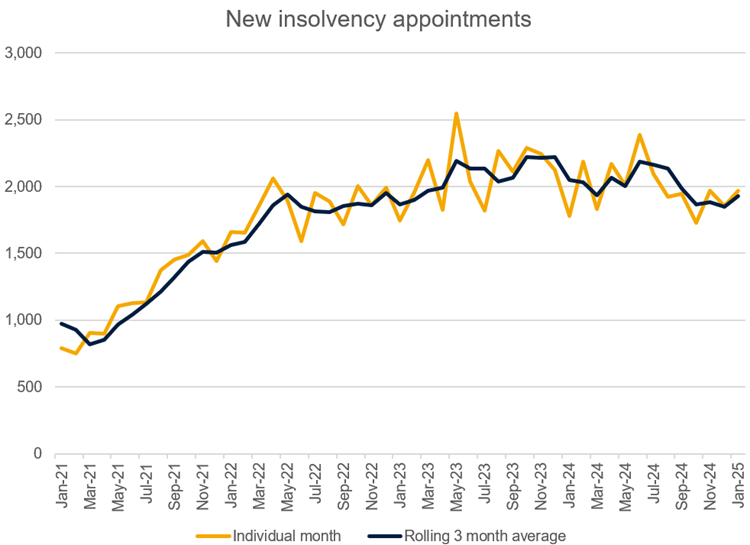
Source: Insolvency Service
The imminent impact of PAYE and other tax changes, as well as minimum wage increases from April 2025, has led many businesses to review their financial position and assess whether they can manage or mitigate these substantial cost increases.
At the same time, CPI rates increased to 3% in January 2025, having been relatively stable around 2% for the six months prior to the autumn Budget. The rise was driven substantially by prices in transport, groceries, and recreation. However, average pay in real terms (i.e. adjusted for CPI) grew by 2.5% in Q4 2024, therefore while inflation is creeping back up it may not have a material impact on consumer spending habits in the immediate future.
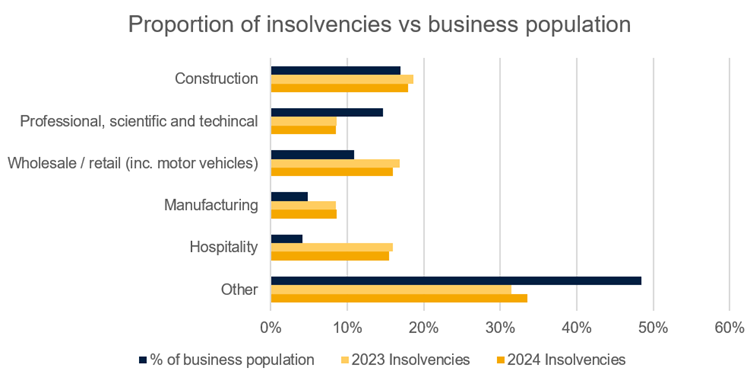
As teased in our previous commentary, we’ve delved into the sector trends for 2024 to highlight key stress points.
Source: Department for Business and Trade
The hospitality, manufacturing, and wholesale / retail sectors have experienced substantially higher rates of insolvency appointments than would be expected based on the number of active businesses.
In 2024, the hospitality sector recorded 15.5% of all insolvencies, despite comprising just over 4% of the total business population, resulting in a delta of 11.3 ppt. The next largest delta was the retail sector, with 15.9% of appointments from 10.9% of the business population.
Both sectors are heavily reliant on consumer spending. Whilst real pay has been growing in recent history, the cost-of-living crisis is still acting as a burden on consumer wallets. Behavioural changes will also impact on when and where consumers are spending. We will make no comment on the hybrid / return to office debate per se, but the shifting commuter population does have a material impact on both hospitality and retail businesses – limiting those with physical footprints, while providing a bonus to online and delivery led operations.
Apart from the challenges of accessing their share of the consumer wallet, these sectors also operate on narrow profit margins. The inflationary increases in cost of goods which occurred through 2022 and early 2023 have stabilised but not eased through 2024 and are a contributory factor to squeezed margins and a high rate of insolvencies.
Looking forward for both these sectors, we expect to see the challenges continue. While real wage growth should increase disposable income, for the most part, hybrid working policies seem set to stay and new pressures are arriving from April, with implementation of the autumn Budget. Both sectors have a high staff cost base and substantial reliance on workers who are currently paid minimum wage.
Separate to the direct impact of the consumer wallet, the manufacturing sector has also continued to face substantial challenges throughout 2024.
Although the energy crisis no longer makes headline news, the impact on high energy use sectors, such as most manufacturing industries, continues to be substantial. Industrial energy prices in 2024 were on average 86% higher than in 2021. Whilst the peak was in 2023 (103% higher than 2021) this nevertheless is a sustained and substantial cost pressure for manufacturing businesses to bear.
Those smaller or less financially resilient manufacturers will now find themselves potentially caught in a catch 22. The increases to PAYE costs and minimum wage from April 2025 will inevitably eat into margins. The obvious way to mitigate this is through increasing automation and upgrading plant and machinery to reduce staff headcount and deliver higher efficiency. However, the initial investment required is substantial and those businesses that are already struggling with high costs over the last few years are unlikely to have the reserves available to allow them to benefit from technological advances.
The current landscape appears to substantially favour the larger global businesses who have the financial reserves and resilience to invest in technology and mitigate cost increases where possible. In the meantime, small and mid-market operators who are reliant on manual labour and can not afford to modernise their plant and procedures may find themselves falling by the wayside.
As we continue into 2025, the substantial cost pressures that businesses have faced over the last two years show no sign of abating. With new staff cost pressures from increased PAYE and minimum wage from April, it seems clear that 2025 will continue to be an active year for the restructuring and insolvency profession with a high rate of insolvency appointments.
The key for any directors who are concerned about the current position or what the future looks like is to take advice early. With time and support, a stressed business can be rescued, restructured and return to success without requiring an insolvency appointment. The longer those conversations are left before help is sought, the less options available and, unfortunately, the less control management has over the eventual outcome.
for more information, please contact our restructuring and insolvency team of Steven Edwards, Vince Green, and Mark Holborow.