Autumn Budget 2026
Predictions and analysis

The Autumn Budget on 28 October 2026 will be the first Budget delivered by Chancellor John Healey and comes at a pivotal moment for the new government.
As businesses and individuals look for clarity and stability, questions remain over how the government will balance growth ambitions with the need to raise revenue.
Our specialists will be analysing the latest developments and sharing their predictions to help businesses and individuals understand the implications and plan with confidence.
Events
Autumn Budget 2026: Expert analysis and insights
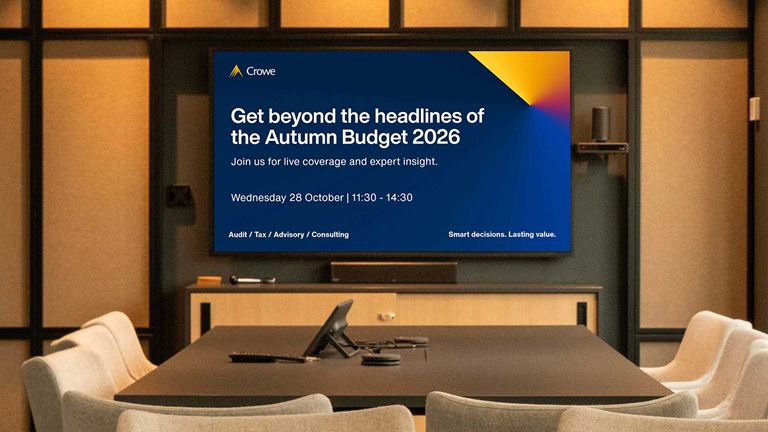
Autumn Budget 2026: Live watch-along and expert discussion
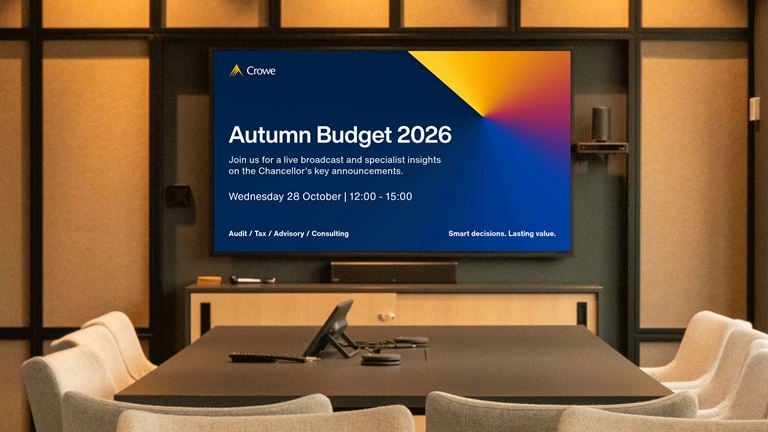
Autumn Budget 2026: Live watch-along
Autumn Budget 2026
What we understand so far
The government is expected to maintain its commitment not to increase Income Tax, VAT or National Insurance rates during this Parliament.
However, as these taxes account for a significant proportion of government revenue, the Chancellor has limited options for raising additional funds. Combined with the government's fiscal rules, this raises questions about how future spending commitments and policy priorities will be funded and whether further tax rises will be needed to plug the gap.
While no increase to Capital Gains Tax (CGT) has been confirmed, it remains one of the taxes most frequently cited as a potential source of additional revenue in the Autumn Budget. Speculation has been fuelled by previous comments from senior politicians about taxing wealth more effectively, although CGT rates were only increased in October 2024. Any further changes would need to balance revenue-raising ambitions against concerns about their impact on entrepreneurship, investment and the UK's attractiveness as a place to do business.
Business rates reform remains an area to watch ahead of the Autumn Budget. The government has already confirmed a 20% business rates discount for eligible pubs, social clubs and live music venues in England from April 2027, alongside a freeze in real-terms bills for qualifying venues.
However, key details are awaited, including which larger venues will be excluded. Hotels, restaurants and cafes are not currently covered, while wider reforms to the business rates system, including potential changes to Small Business Rates Relief, are expected to be announced at the Budget.
Corporation Tax is currently not widely expected to increase in the Autumn Budget. The Labour 2024 manifesto committed to maintaining the main rate of Corporation Tax at 25%, alongside retaining permanent full expensing and the Annual Investment Allowance. While there is little indication these commitments will change, an early election could bring forward the prospect of a different approach.
Video
'Six to fix' ahead of Autumn Budget 2026
With the Autumn Budget approaching, there is plenty of speculation about what the Chancellor may announce.
In this video, Pete Fairchild, Head of Private Clients at Crowe UK, and Phil Smithyes, Managing Director of Crowe Financial Planning UK Limited, discuss some of the predictions and what potential changes could mean for individuals and their financial plans.
Our Partners' latest thinking

Robert Marchant, Partner, Head of Tax
The Chancellor should prioritise tax simplification, investment and sustainable revenue raising, while avoiding measures that could undermine business confidence. We would welcome a focus on modernising the UK’s tax administration, making tax compliance more efficient and measures to unlock economic growth.
A key priority should be further simplifying HMRC processes and reducing the complexity of tax administration. Too many interactions with HMRC remain unnecessarily complex, while recent years have seen the introduction of new taxes and levies that add further compliance requirements. The result is that many spend what could be argued as a disproportionate amount of time on tax administration, rather than focusing on growing their business.
The government should also strengthen incentives for business investment by protecting valuable corporate tax reliefs and maintaining a competitive environment for innovation and growth. Any reforms should provide certainty and stability, enabling businesses to make long-term investment decisions.
Finally, the Budget should continue efforts to modernise the tax framework through clearer reporting requirements, proportionate penalties and improved dispute resolution processes, helping to increase tax revenues through better compliance and tax collections rather than the current trends of introducing new taxes, the freezing of thresholds or the removal of reliefs.

Pete Fairchild, Partner, National Head of Private Clients
The new Chancellor is encouraged to calm the troubled waters of the UK economy by introducing measures that bring certainty to taxpayers, over several years, enabling them to plan effectively, rather than forcing individuals to keep chopping and changing arrangements. Individuals and businesses are pleading for stability after a series of knee-jerk reactions on tax legislation.
There are widespread calls for measures that stimulate productivity and investment in the private sector. Businesses are seeking certainty regarding corporate taxation and enhanced incentives for innovation, particularly in green technology and digital infrastructure.
Furthermore, hard working taxpayers would welcome targeted measures that alleviate pressure on household budgets, without fuelling inflationary risks.
Simplification around tax compliance and administration is also seriously overdue.
Ultimately, the budget must strike a careful balance between fiscal responsibility and ambitious growth.

Caroline Fleet, Partner, Head of Real Estate
The real estate sector will be looking to the Autumn Budget for measures that support investment, improve market confidence and simplify an increasingly complex property tax landscape.
The UK already has one of the highest property tax burdens among major economies, and businesses will be hoping to avoid any further taxes or levies that deter investment and development, particularly following the High Value Council Tax Surcharge and Residential Property Developer Tax. Instead, there is a strong case for a broader review and reform of how real estate is taxed, creating a more stable and competitive environment for long-term growth.
Particular attention will be on reform of council tax and business rates. Both are widely seen as outdated and in need of modernisation to better reflect current property values and usage. There are also concerns that the current business rates regime discourages investment and regeneration.
The sector will welcome measures that help unlock activity across the housing market. Building on initiatives such as the government's proposed ‘Your Home’ scheme could improve affordability for first-time buyers, while supporting housing delivery.
Finally, targeted tax incentives for sustainable buildings would be well received, helping to accelerate investment in energy efficiency improvements and meet evolving EPC requirements.

Nicky Owen, Partner, Head of Professional Practices
With the Autumn Budget approaching and continued speculation around taxes on wealth and capital, partners in LLPs and professional practices may wish to review their affairs sooner rather than later. Where appropriate, making pension contributions can help secure higher-rate tax relief under current rules, while crystallising capital gains before any potential changes could provide certainty at today’s rates. Making full use of ISA allowances is also sensible financial planning and benefits from the tax-free status.
Beyond personal tax planning, many professional practices will be hoping the Chancellor resists changes to the salaried members regime. While the rules are complex, they are broadly understood by firms and their advisors. Any tightening of the conditions, or measures that extend employer National Insurance obligations to a greater number of LLP members, could increase costs and administrative burdens and have widespread implications at a time when firms are already facing higher employment costs and pressure on margins.
We may also see increased momentum to complete private equity transactions ahead of the Budget. The professional services sector has attracted significant investor interest in recent years, and any increase in Capital Gains Tax could influence the timing of deals. While the potential tax take may be tempting, the Chancellor will need to balance short-term revenue generation against the need to encourage investment and long-term growth.

Laurence Field, Partner, Corporate Tax
With manifesto pledges protecting Income Tax, VAT and National Insurance, the Chancellor has limited room for manoeuvre. The challenge will be supporting growth and investment while maintaining sustainable public finances.
Businesses would welcome a clear growth agenda. Greater tax certainty, business rates reform and stronger incentives for digital transformation could help unlock investment and improve the UK's competitiveness. However, a cautious, low-key approach is likely to be taken.
There is an opportunity to support manufacturing through defence spending. Progress towards the government's ambition of spending 3% of GDP on defence would benefit aerospace, technology and engineering supply chains, although with significant announcements kicked down the road, significant measures in the Budget may be limited.
At the same time, many will be hoping the Chancellor resists short-term tax grabs on capital and investment. Maintaining CGT rates and investment incentives could shield entrepreneurial momentum. However, with limited options available to raise revenue without breaching existing commitments, speculation remains around potential changes to CGT, targeted wealth taxes and continued windfall taxes on certain sectors.
Ultimately, the Autumn Budget will reveal how the government intends to reconcile its growth ambitions with the realities of a constrained fiscal environment.

Stuart Weekes, Partner, Head of Manufacturing
The government says it backs UK manufacturing, but businesses need tangible measures that give them the confidence to invest, innovate and grow.
Manufacturers continue to face high and volatile energy costs, alongside growing skills shortages and an ageing workforce. Greater support for energy-intensive industries, combined with investment in training and apprenticeships, would help businesses remain competitive and develop the skilled workforce needed for the future.
Innovation must also be encouraged. Since 2023, the financial benefit of R&D tax relief for profitable SMEs has fallen significantly, reducing incentives to invest. The government should strengthen R&D support and make the UK patent box more competitive internationally, including considering a reduction in the corporation tax rate applied to patent box profits from 10% to 5%.
The government has committed significant investment to defence and aerospace, while automotive manufacturers continue to face high costs, tariffs and global competition. Many automotive suppliers are keen to diversify into defence, but need practical support to make that transition successfully.
Finally, the UK manufacturing ecosystem depends on effective collaboration between large businesses and SMEs. Although there is strong willingness to work together, barriers remain. Government action to remove or reduce these obstacles would help strengthen supply chains, unlock investment and support long-term economic growth.
For further insight, read our article on Autumn Budget 2026: What manufacturers want to see

Andrew Hawley, Partner, Corporate Tax
For large corporates and international groups, the key request ahead of the Autumn Budget is certainty. The government’s existing Corporate Tax Roadmap commits to maintaining the 25% corporation tax rate and predictability for investment. Businesses will be hoping the Chancellor maintains this approach and avoids introducing major changes.
From an international perspective, HMRC remains focused on ensuring that profits associated with UK activity are appropriately taxed to protect the Exchequer’s tax base. The Budget could therefore include further measures to improve transparency and increase compliance among multinational groups. However, with businesses already navigating significant change, including the 2026 modernisation of the UK’s transfer pricing and permanent establishment rules, the repeal of the Diverted Profits Tax and recent Pillar Two reporting obligations, many will be hoping for simplification and administrative easements to reduce compliance costs.
Many large businesses would welcome greater certainty around capital investment incentives. A permanent, simplified full expensing regime, alongside enhanced incentives for digital transformation, AI adoption and productivity-enhancing investment, would support long-term investment decisions.
Above all, businesses will be looking for stability, certainty and a reduced administrative burden. Frequent policy changes can delay investment, even when headline corporation tax rates remain unchanged.
Frequently asked questions: Budget 2026
The UK Budget sets out the government’s plans for taxation, public spending and the economy, informed by independent forecasts from the Office for Budget Responsibility (OBR). The government has committed to one annual Budget, usually in the autumn, alongside a Spring Statement, giving businesses greater certainty and time to prepare for changes.
What the Budget does:
- Taxation: Announces changes to income tax, national insurance, business taxes, and duty rates.
-
Public Spending: Allocates funding for major public services, including the NHS, schools, and defence. - Economic Forecasts: Publishes independent economic and fiscal growth forecasts from the Office for Budget Responsibility.
It has not yet been announced, but in previous years most fiscal statements to Parliament are made at approximately 12:30pm, straight after the Prime Minister’s questions.
Government ministers use red boxes to carry official briefing papers, but the Chancellor’s has become an enduring symbol of Budget day. The tradition dates back to 1860, when William Gladstone carried his speech from Downing Street to the House of Commons. Today, the Chancellor holding up the red box outside Downing Street remains one of the day’s defining images. Fittingly, the word ‘Budget’ comes from the French ‘bougette’, meaning ‘little bag’.
The OBR stands for the Office for Budget Responsibility, which is the official independent economic and fiscal forecaster for the United Kingdom.
They have five main roles:
- Economic Forecasting: providing independent forecasts for the UK economy, including predictions for GDP growth, inflation, employment, and wages.
- Public Finances Analysis: tracks and forecasts government tax receipts, public spending, borrowing, and national debt levels.
- Scrutiny of Policy: evaluates government tax and welfare policy costings for each official Budget and Spring Statement.
- Checking Fiscal Targets: independently assesses how well the government is performing against its own self-imposed fiscal rules and targets.
- Long-Term Sustainability: publishes periodic reports analysing long-term pressures on public finances, such as an ageing population or climate costs.
Sign up and get all the Crowe UK announcements
Complete the form below, and join our mailing list.