
Capital Goods Scheme, a year on
Accounting implications for independent schools: Part two
Last year, in part one, we explored the accounting implications of the Capital Goods Scheme (CGS) for independent schools following the introduction on VAT on tuition fees.
For many independent schools, the introduction of VAT on tuition fees has significantly increased the proportion of taxable supplies, potentially leading to substantially greater CGS recovery. In the financial statements to 2025, those schools eligible to claim under the scheme may have recognised an asset within debtors reflecting anticipated future CGS recoveries.*
As schools prepare their 2026 financial statements, the focus moves away from the initial recognition of those balances and towards their ongoing measurement, presentation and recoverability.
*Suggested accounting treatment for the inclusion of a deferred VAT asset within debtors was set out in part one (Appendix 1 provides an example of the calculations needed to recognise a deferred VAT asset for the first time).
Reviewing deferred VAT assets
In this year’s financial statements, the calculation of the deferred VAT asset will need to be reviewed. For most schools, this will be the first complete year in which tuition fees have been treated as taxable supplies, and so for many schools there will be an increase in the annual partial exemption recovery rate as the amount of taxable supplies increase. In addition, a reduction of exempt fees in advance for many schools will lead to higher partial exemption recovery rates and therefore increased recovery.
Depending how the deferred VAT asset was calculated in the previous year, there may be a need to recalculate it at the new rate of recovery. If the school estimated its deferred VAT asset using an estimated partial exemption recovery rate for future years, considering the increase in taxable supplies and drop-off in exempt fees in advance, any adjustments are likely to be marginal.
To calculate the CGS adjustment, the total VAT incurred is divided by the 10-year interval and then multiplied by the partial exemption recovery rate for the year less the baseline recovery rate. The baseline recovery rate is the rate that should have been recovered in the year the asset was bought in to use. For schools that were not VAT registered and had no entitlement to recover input tax when the asset first came into use, the baseline percentage will normally be nil.
Example
A school that was not already registered for VAT pre-January 2025 builds a classroom extension for £1 million + £200,000 VAT. Works start in June 2022, and the first use is in March 2023. It is used 100% for school use. The school has a standard VAT year-end of 31 August and is using the Standard method of partial exemption. In the financial year to 2025, the recovery rate was 49%; the recovery in the year to 2026 will be 88%.
- CGS calculation
VAT incurred x (Revised%- Baseline%) = CGS Adj.
10 - FY25
200,000 x (49% - 0%) = £9,800
10
Dr Deferred VAT Asset 9,800
CR Fixed Assets (9,800) - FY26
200,000 x (88% - 0%) = £17,600
10
Therefore, the increase in the deferred VAT asset is £17,600 - £9,800= £7,800
Dr deferred VAT Asset 7,800
CR fixed assets (7,800)
Schools should note that the above illustration assumes that future partial exemption recovery rates are achieved as expected. In practice, the annual CGS adjustment is based on the actual use of the asset. Changes in the level of taxable use in future may increase or decrease the amount ultimately recoverable. Schools operating a partial exemption special method should use the recovery percentage applicable under their approved methodology when calculating CGS adjustments.
Impact on depreciation
In addition to this, the depreciation charge will need to be recalculated as the amount of the fixed asset has now reduced. Detailed guidance on the accounting treatment and depreciation implications of CGS claims is available in part one.
Other considerations
Depending on when a school’s VAT year end falls, the impact on partial exemption recovery rates may differ.
Schools that have already claimed three terms of taxable supply may find that the impact on their partial exemption recovery rate will be minimal. Schools with coterminous VAT year ends with their financial year, will find the adjustment more impactful.
Schools should also consider the proportion of the deferred VAT asset expected to be recovered within one year and after more than one year. This is relevant to whether the asset is presented as a current asset or as a long-term debtor within the financial statements.
If schools have recognised very large, deferred VAT assets in 2025 based on expected future recoveries, they should consider whether those estimates remain recoverable. Where future recovery assumptions have changed adversely, consideration should be given to whether any element of the deferred VAT asset requires impairment.
Threshold changes for new projects
Schools should also note that the threshold for eligible projects to qualify under the CGS increased to £600,000 with effect from the 29 July 2026. Existing CGS assets already within the scheme continue under the previous rules and are not removed from the scheme simply because the threshold has increased.
Appendix one
CGS Calculation in Year One
Example
School A spent £1.2 million on a sports hall on 1 January 2020, with a useful life of 50 years and was fully used for the delivery of education. It capitalised £1.2 million at the time, including 20% VAT (£200,000). On 1 January 2025, School A will now need to register for VAT and is eligible to claim under the Capital Goods Scheme.
In this example, there have been five years when education was an exempt supply (1 January 2020 - 31 December 2024) and five years which follow where it will be a taxable supply under the scheme.
Initial recovery (2020-2024): 0% taxable use and VAT recovery £0, as education was an exempt supply.
Adjustment period (2025-2030): 100% taxable use from 2025 onwards. The school can reclaim VAT for each remaining adjustment year based on the taxable use of the asset.
Therefore, School A can reclaim five years of the eligible ten years under the scheme (i.e. 5/10 of the £200,000 VAT incurred on eligible capital expenditure - £100,000). Assuming taxable use remains the same, this £100,000 will be reclaimed over the next five years at £20,000 per year through the VAT return.
Initial recognition
- Dr VAT asset £100,000
- Cr Fixed assets £100,000
Year one – five
- CR VAT asset £20,000
- Dr VAT control account £20,000
Depreciation
- Original depreciation (£1.2 million/50) = £24,000
- Revised cost (£1.2 million - £100,000) = £1.1 million
- Accumulated depreciation to year of CGS claim (£24,000 x 5) = £120,000
- NBV immediately prior to CGS claim (£1.2 million - £120,000) = £1,080,000
- Revised NBV immediately after claim (£1,080,000 - £120,000) = £960,000)
- Revised annual depreciation over remaining useful life (£960,000/(50-5)) = £21,333
Note: This example assumes a 100% recovery percentage for illustrative purposes. Actual recovery is likely to be restricted by the school's partial exemption position.
The table below shows how depreciation might change depending on how many eligible years of the claim period are remaining:
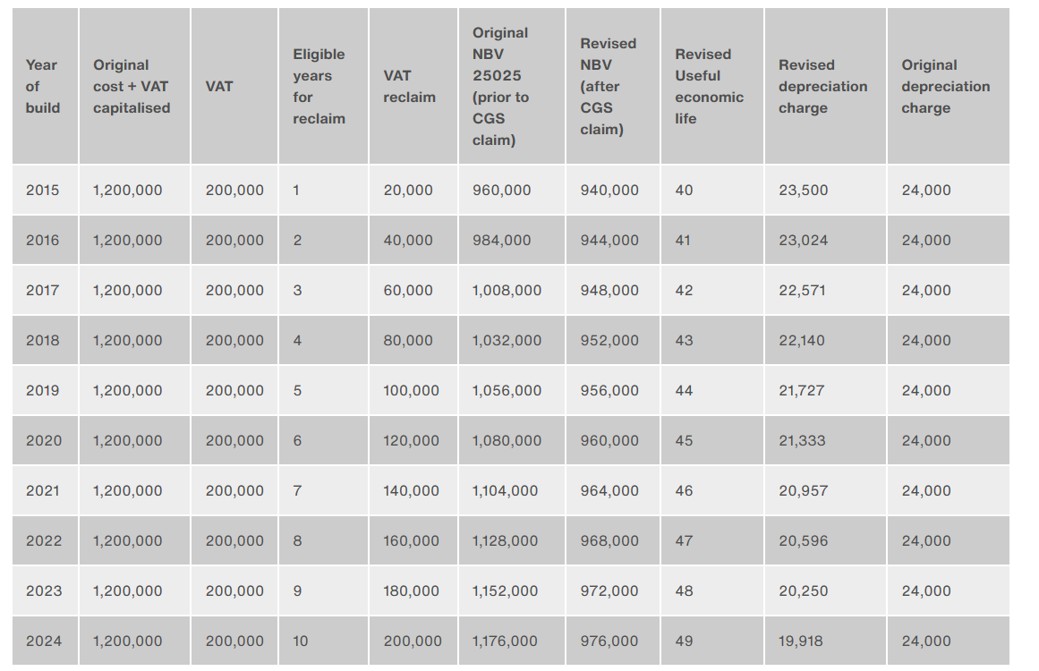
Note: As the original asset cost is retrospectively reduced by the recoverable VAT element, accumulated depreciation should be restated as if the lower asset cost had existed from the date the asset entered use.
The proportion of taxable use should be reassessed annually, and necessary adjustments made through the VAT return where required each period.
Further guidance
For more detailed guidance on the initial accounting treatment of CGS claims, including initial recognition of the deferred VAT asset, please refer to part one.
If you have any further questions regarding the Capital Goods Scheme, please contact your usual Crowe contact.
Contact us