
Accounting for EV salary sacrifice schemes
Electric vehicle (EV) salary sacrifice schemes have rapidly gained popularity, giving employees a tax-efficient way to access a new EV.
Favourable Benefit-in-Kind (BiK) rates have supported this growth. Employees typically fund the arrangement through a reduction in gross salary, lowering income tax and employee National Insurance contributions (NICs). Many schemes also include servicing, maintenance, insurance and home charger installation, making an EV more affordable and convenient than buying or leasing one privately.
Employers may also benefit from lower NICs as salary sacrifice reduces gross payroll costs. The schemes can enhance the employee benefits package, support recruitment and retention, and contribute to wider sustainability objectives.
The FRS 102 Periodic Review 2024 makes the accounting treatment of these arrangements a popular talking point, raising a key question: what should employers recognise in their financial statements?
Why the accounting matters
Under the existing requirements of FRS 102, practice has varied. Some entities recognised lease rentals as an expense in profit or loss. Others omitted the lease payments from their financial statements because they viewed the employer solely as a payment intermediary, collecting amounts from employees through salary sacrifice and remitting them to the leasing provider.
The amended FRS 102 introduces a new lessee accounting model under which most leases are recognised on the balance sheet through a right-of-use asset and a corresponding lease liability. Limited recognition exemptions are available, but bringing leases onto the balance sheet is the default position.
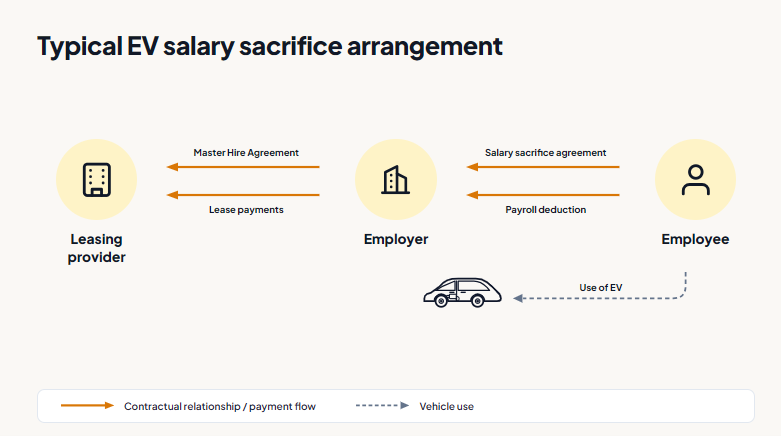
EV salary sacrifice schemes add a further layer of complexity as the employee uses the vehicle, while the contractual lease is typically between the employer and the leasing provider. Preparers must assess whether the employer acts as principal, leasing the vehicle and providing it to the employee as part of their remuneration package, or as agent, facilitating an arrangement between the employee and the leasing provider. This conclusion determines the accounting outcome.
Assessing whether the employer is principal or agent
The assessment should consider the substance of the arrangement as a whole. No single factor is determinative, and the relevant considerations include the following:
| Consideration | Principal indicators | Agent indicators |
| Vehicle selection | Employer controls or restricts vehicle choice. | Employees choose the vehicle and specification. |
| Control of vehicle use | Employer can require return of the vehicle, substitute it or restrict its use. | Employee controls use of the vehicle, with limited employer involvement. |
| Economic risks | Employer bears risks arising from resignation, absence, default, damage, excess mileage or early termination. | Risks and costs are substantially passed on to the employee. |
| Pricing | Employer has discretion over salary sacrifice deductions, charges or fees. | Employer passes through amounts charged by the leasing company. |
| Primary obligation | Employer remains primarily liable to the leasing company. | Employer acts mainly as a payment intermediary. |
| Role in the arrangement | Employer provides and manages the vehicle benefit. | Employer facilitates access to the lease and processes payroll deductions. |
Where the employer acts as principal, it recognises:
- a right-of-use asset representing its right to use the vehicle
- a lease liability representing its obligation to make lease payments.
After initial recognition:
- the right-of-use asset is depreciated over the shorter of its useful life and the lease term, unless ownership transfers to the employer or the employer is reasonably certain to exercise a purchase option
- lease payments reduce the lease liability, while interest is recognised in profit or loss.
The associated staff cost should reflect the employee’s contractual remuneration after the salary sacrifice, taking account of the specific terms of the arrangement.
Where the employer acts as agent, it does not recognise a right-of-use asset or lease liability.
Amounts deducted from employees’ salaries and paid to the leasing provider are accounted for as amounts collected and remitted on the employees’ behalf. The distinction is significant as principal accounting brings the lease onto the employer’s balance sheet, whereas agent accounting generally results in no right-of-use asset or lease liability.
Key action for preparers
The label ‘salary sacrifice scheme’ does not determine the accounting treatment; the substance of the arrangement does. Establishing whether the employer acts as principal or agent is therefore critical to determining whether a right-of-use asset and lease liability should be recognised under the amended FRS 102 lease accounting requirements. Preparers should obtain and review:
- the Master Hire Agreement between the employer and the leasing provider
- the salary sacrifice agreement between the employer and the employee; and
- any agreements between the employee and the leasing provider.
Acting early will help preparers apply the appropriate treatment for the first reporting period and ensure that the necessary data and processes are in place. If you would like to explore how these factors may affect your organisation, our team would be happy to help.
Contact us