
Nature underpins the global economy. From fertile soils to pollution, ecosystem services form the foundation on which organisations operate. Yet these services are deteriorating at an unprecedented pace. Every sector, from financial services to real estate, will feel the consequences of nature degradation.
Nature-related financial risks are becoming impossible to ignore and are deeply interconnected with climate risks. However, without structured analysis, these risks remain unmanaged and organisations remain exposed. This is where nature scenario analysis comes in.
Future-looking scenario analysis enables organisations to understand how uncertain futures could impact their business models, operations, value chains and financial outcomes. While climate scenario analysis is increasingly standard, nature scenarios are far less developed; yet they are arguably even more essential due to the complexity of ecosystems and the multiple, interacting risks involved.
As there are currently no easily accessible ‘off the shelf’ quantitative nature scenarios, organisations need to begin with qualitative, exploratory story lines. This is not a limitation; it is an opportunity to build understanding, identify data gaps and develop proportionate, decision-useful insights.
Three principles to support developing effective nature scenario analysis
Purpose-driven analysis
Purpose determines the scope, methods and outputs. Without it, organisations risk producing complex analyses that fail to support decision-making.
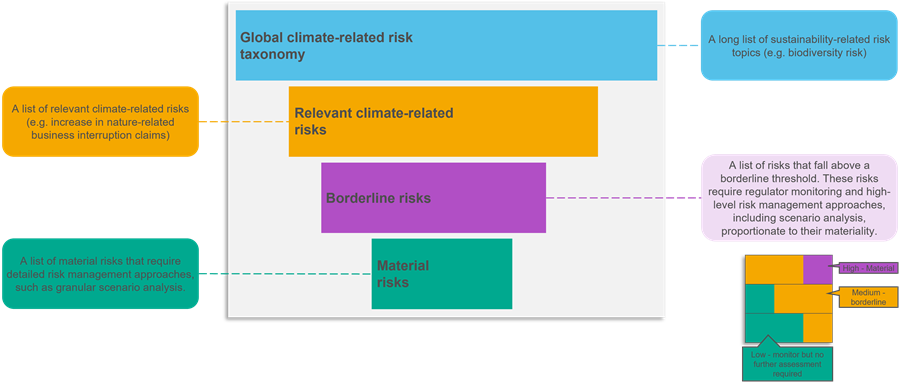
Proportionate to materiality
A proportionate strategy ensures effort is directed to the areas that matter most. Beginning with a high-level qualitative exploration helps to understand exposure and justify where to focus.
Firms should only invest in detailed modelling where the risks are material and the insights are actionable.
Integrated with climate
Adopt dual pathways: both standalone nature scenario analysis, focusing on ecosystem dynamics and integrated analysis, embedding nature within climate scenarios wherever feasible. This reflects the fact that nature and climate are inseparable, but that nature risks also have features that extend beyond climate alone. Many organisations may already be using climate scenarios that incorporate elements of nature without fully realising it. As an example, the land use modules within Network of Central Banks and Supervisors for Greening the Financial System (NGFS ) scenarios.
A practical approach to building nature scenarios
This iterative process mirrors the early evolution of climate scenario analysis.

1. Set the nature scenario analysis strategy
Create the purpose statements, which set out the questions to be answered, what data is required and how the outputs will be used. As part of this, begin to identify the hazards (e.g. pollution) and driving forces (e.g. global regulatory shifts).
2. Design the scenario analysis
Construct the narratives and design how you will run the scenario analysis. Frameworks such as the Taskforce on Nature-related Financial Disclosures (TNFD) four exploratory scenarios can serve as starting points. The design of the scenario should include determining whether a qualitative, quantitative or blended approach is most appropriate.
3. Execute the scenario, iterate, and refine
Run the scenario to test how it works. The first analyses will likely reveal data gaps, structural issues, or additional questions. This is to be expected and means that organisations should expect to revisit assumptions and refine methodologies as their understanding matures. It is unlikely that the first run of the analysis will give the required outcomes.
4. Integrate the scenario outcomes
Nature isn’t bringing anything new to the table; the outputs of the scenario analysis should be integrated into existing risk management strategies and frameworks. However, interpretation is critical; results are rarely definitive and must be understood in the context of the business.
Common challenges
- Complexity - Unlike climate, nature does not have a single unifying metric like CO₂e or degrees of warming. Nature risk involves multiple metrics and ecosystem components.
- Data requirements – Organisations will be required to locate and assess a different set of data compared to climate – for example, the geographical location of assets.
- Perceived lack of urgency – Many organisations still underestimate nature-related risks, leading to slow adoption and underinvestment.
- Interconnected drivers – Nature risks interact in complex ways, with each other and with non-climate and nature risks. Nature risk pathways are often non-linear, complicating analysis and straightforward interpretation.
- Lack of monetary translation tools – We know nature loss results in large financial consequences. However, there are no accessible, robust, universal tools to quantify these impacts.
- Skills and expertise – Understanding different ecosystem components, metrics, and the associated risks requires specialist knowledge.
However, these challenges should not be viewed as limitations but as reasons to start early. Qualitative work is low‑cost and accessible, and helps organisations identify the nature of risks that truly matter, or, in some rare cases, justify the fact that it is not material. It also clarifies where to invest in data and more detailed modelling, ensuring firms are ready as nature scenario analysis becomes standard practice.
Summary
Nature scenario analysis offers organisations a structured, forward-looking way to assess nature-related impacts and embed them into decision-making. Starting simple, early and with a clear purpose enables firms to focus their efforts, build capability and prepare for a regulatory landscape where nature becomes as prominent as climate.
Those who act now will be better positioned, strategically, financially and reputationally, as nature-related expectations accelerate.
Our Consulting team brings practical experience to support clients in setting their own agenda to address rapidly changing sustainability and climate-related requirements. Please get in touch with your usual Crowe contact for more information.
Contact us


