The hidden cost of ‘easy global hiring'
Global hiring through an EOR can seem like the perfect solution - fast, flexible, and fully ‘compliant’.
But here’s the catch: when it’s time to terminate an employee, the same simplicity disappears.
We’re seeing more global companies hit with unexpected costs, legal disputes, and brand damage when ending employment through an EOR.
As a strategic HR leader at a venture-backed technology company, you’re under pressure to scale fast, new markets, new teams, new talent. EOR services promise to make that easy: hire anyone, anywhere, without setting up a local entity. It sounds like the perfect solution, until you need to part ways with someone. That’s when the ‘easy’ model can turn into a costly compliance trap.
Why EOR terminations are riskier than they seem
Here’s the reality: even though the EOR is the ‘legal employer,’ your company directs the employee’s work.
In the eyes of many courts, that makes you the de facto employer, and therefore liable for any gaps in compliance (annual leave, overtime, parental benefits etc) and also the main defendant in an unfair dismissal claim.
In countries like France, Italy, Japan, Brazil, and Mexico, labour laws make involuntary terminations complex, procedural, and expensive. When you employ through an EOR you’re not at the wheel and can’t control the process applied to a termination, in the event of a unfair dismissal claim you could be on the hook for a six figure pay-out as the actual employer.
The true cost of EOR terminations
Our global research shows that in cases where an employee has claimed unfair dismissal, the costs are typically 20%–70% of annual salary and sometimes as much as 100% in higher-risk countries.
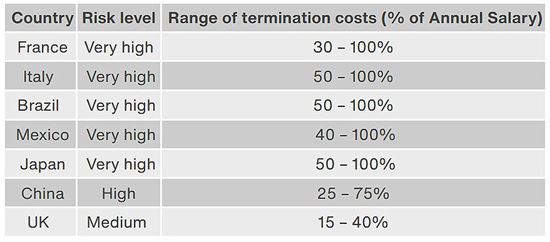
These figures include severance, notice, legal fees, and negotiated settlements.
Given the stringent termination procedures that must be followed and the significant financial implications of an unfair dismissal claim, maintaining control over the dismissal process is essential for any international organisation. However, the EOR model inherently reduces this control and heightens the associated risks, typical issues include weaknesses in selection and consultation processes, failing to execute termination notices correctly, and given a lack of day to day proximity a failure to identify higher risk cases where additional protections may apply.
It’s not just terminations
It’s not just unfair dismissal claims that are of concern. Procedural omissions by an EOR can generate other employment claims leading to increased costs.
Common examples include:
- A failure to apply specific procedural requirements around working time can lead to increased overtime claims.
- Indiscriminately applying non competes or failing to waive them prior to termination will often generate payment requirements during the term of their restriction.
- Annual leave is not calculated in accordance with statutory formulas and usage is not actively managed to avoid carry forward claims.
- Sick leave is not reported to the appropriate government agencies making capability terminations very difficult.
Clients using an EOR are typically unaware of these procedural vulnerabilities, and any additional employment costs that flow from them tend to be obscured within monthly invoicing and payroll, making them difficult to identify or address.
It’s also worth noting that statutes of limitation in most countries allow for back claims stretching back a number of years and therefore liabilities can accumulate to sizeable amounts.
How strategic HR leaders can protect their companies
- Understand the terms of your EOR contract, who will ultimately pay for procedural irregularities.
- Understand the local requirements for a termination, working time and other employment standards, take an interest.
- Don’t just rely on your EOR to terminate employees, involve a local legal advisor.
- Budget realistically, assume 50% of annual salary in high-risk countries.
- Use mutual separation agreements whenever possible.
- Keep records, interactions with employees on contentious matters (performance, grievances, sickness, etc) should be handled with care and carefully recorded.
By taking control of your global employment risk strategy, you can turn the EOR model from a potential liability into a genuinely scalable tool.
How we help HR leaders stay ahead
We partner with fast-growing technology companies to:
- Audit EOR agreements for hidden liabilities.
- Provide local legal and HR guidance before termination decisions.
- Estimate global severance and settlement exposure.
- Determine when to move away from EOR to your own local presence.
- Deliver integrated payroll, tax, and compliance support worldwide.
We help HR leaders protect what matters most: your people, your reputation, and your investors’ capital.
Final thoughts
Global expansion should enable growth, not risk.
Before your next offboarding decision, make sure your EOR partner and your internal processes, can stand up to local scrutiny. Because when things go wrong internationally, it’s rarely the EOR who pays the price, it’s you.
For more information, get in touch with your usual Crowe contact.
Contact us