Taking care of Global Mobility professionals
AI and automation industry pulse check
Our 2024 research highlighted the need for global mobility (GM) functions to mature – moving beyond firefighting and fragmented processes towards structured, strategic delivery.
If they did this, they would be able to find the headspace to reduce complexity and pressure by focusing time on educating the business. This year, the focus has shifted from what maturity looks like to how it is achieved in practice.
We believe the answer, based on our 2025 survey on Artificial Intelligence (AI) and automation in collaboration with Santa Fe Relocation, The Cozm and a workshop we conducted with mobility leaders in July 2025, lies in the operational engine of global mobility.
Professionals agree that time is the most limited resource, and repetitive transactional work is the biggest barrier to impact. AI and automation are not about replacing human expertise – they are about creating the space for professionals to do the work that only humans can and should do; these are empathy, judgement, and trust. At the same time, our survey responses clarify that blue-sky solutions are not what people see as the priority but rather better processes and more automation to make the transactional work easier.
The operational challenge – why time is the real scarcity
Our 2025 survey found that 72% of mobility leaders see transactional work as the main obstacle preventing them from being more strategic. These tasks range from data entry and compliance monitoring to invoice reconciliation and vendor coordination.
At the same time, 47% cited lack of time as the single biggest barrier to delivering a better employee experience. This shortage of capacity is directly linked to employee well-being – 69% of respondents worry about burnout in their teams due to constant operational overload.
These findings underline a central truth that mobility professionals do not lack insight, skill, or ambition. What they lack is time.
What leaders told us – AI and automation in context
In July 2025, we hosted a live workshop with mobility leaders to discuss the ‘Future of Global Mobility’. Inevitably, much discussion centred on the role of AI and automation. The discussion made three points clear:
- Human skills remain central. Leaders emphasised that empathy, communication, and the ability to influence stakeholders are what give mobility professionals their unique value. 81% of survey respondents agreed these skills will only become more important as technology adoption increases.
- Hybrid is the future. AI and automation are seen as tools to handle the “noise” of mobility – data-heavy, repetitive, or rules-based tasks. This frees time for professionals to focus on complex cases, employee experience, and advising leadership.
- Well-being matters. Beyond efficiency, leaders linked automation directly to sustainability. Reducing manual load is not just about cost savings; it is about keeping teams engaged, resilient, and able to bring their best selves to work.
In short, professionals do not see themselves being replaced by technology. They want technology to give them back the hours they need to focus on the people matters in the business and their critical role as business advisors.
We had interesting discussions about the role technology can play. One leader explained she’d love for employee email queries to be automatically drafted by technology that can go and look up status in systems (status being a major driver of queries). We then posed the following question; what if the employees sending you the queries started to use the same automation to send you even more queries? Food for thought…
Redrawing the maturity pathway for operations – focusing on higher human value by leveraging tech
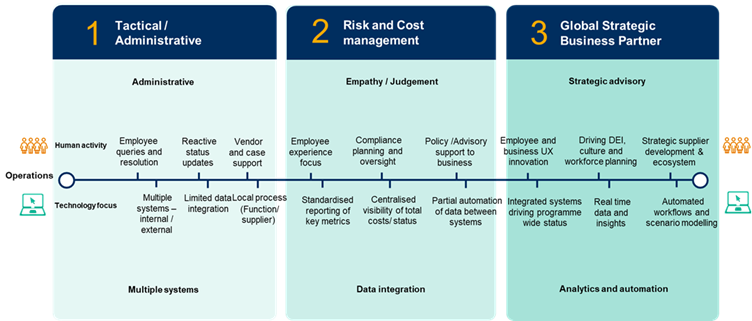
Last year, our maturity model described the levels of development for global mobility functions. This year, we extend the model by focusing on the operational maturity aspect of that same model. We focused on the extent to which processes are streamlined and supported by technology.
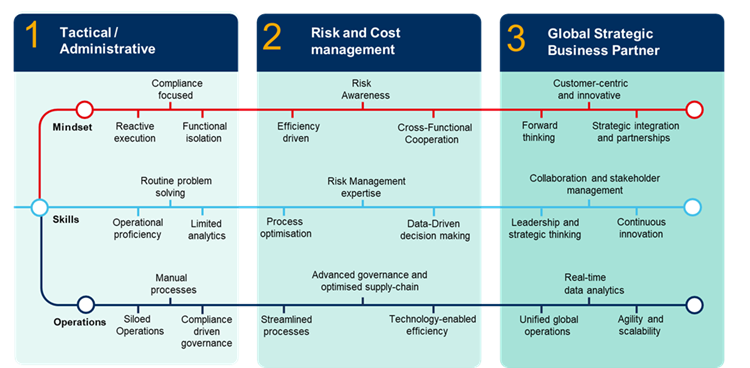
We see three stages:
- Tactical and administrative
At this stage, mobility teams spend most of their time on manual processes – chasing data from multiple systems, reconciling invoices, and responding to repetitive employee questions.- 55% of survey respondents said data fragmentation – too many systems, not enough integration is their number one pain point.
- Professionals at this stage often describe feeling “stuck in administration” rather than able to contribute strategically.
- Risk and cost management
Here, teams begin to introduce automation and structured processes. Compliance tracking, expense reconciliation, and reporting are partially automated. Leaders gain more visibility into cost and risk.- 57% of organisations already use some form of automation, but only 18% say it is fully embedded.
- This stage reduces error and improves consistency, but professionals still feel pulled between operations and strategy.
- Strategic business partner
In the most advanced stage, automation handles the bulk of repetitive work. Data flows from a single source of truth, employee self-service tools reduce repetitive queries, and leaders have real-time insights.
This frees professionals to focus on:- designing better employee experiences
- advising leadership on workforce planning
- supporting diversity, equity, and inclusion through mobility policies
- building trust with employees in moments that matter.
Here the human value of mobility, empathy, engagement, and influence becomes the true differentiator. The know-how and experience of the mobility team is directly translated into valuable advisory for the business and the employees.
What are the potential benefits?
The biggest benefit of operational maturity is not cost reduction, although that could be significant. It is the time given back to skilled, experienced, knowledge-rich professionals who have been under pressure managing more complexity than they can keep up with.
When asked what they would do with more time, mobility leaders consistently said:
- 62% would spend more time improving the employee experience
- 49% would engage earlier with business leaders on workforce planning
- 41% would build stronger cross-functional relationships (with HR, tax, legal, finance).
The wider benefits are clear:
- 71% believe automation will primarily reduce errors and inconsistencies
- 65% say the main benefit will be improved employee satisfaction
- Only 27% see cost reduction as the primary driver.
This is the dividend of automation – not fewer team members, but more human-centric teams driving more strategic value.
Practical steps for mobility teams
For organisations wondering where to start, three actions stand out.
- Map the pain points. Identify where teams spend the most time on repetitive work. These are prime areas for technology.
- Invest in integration. The biggest frustration is fragmented systems. Creating a single source of truth for mobility data is more powerful than isolated automation tools.
- Protect and amplify the human role. As automation scales, leaders should clearly define and elevate the skills that cannot be automated – empathy, judgement, and influence. These are where mobility adds value.
The final action may require refocusing and refreshing of skill sets. A subject for another day.
A human-first mobility future
Our research shows that 64% of mobility leaders believe AI and automation will significantly reshape operations in the next three years. But they also stress that success will not be measured by how much technology is deployed – it will be measured by how much time professionals get back to focus on people and advising the business.
Operational maturity in mobility is therefore not about doing more with less. It is about doing less of the wrong work so professionals can do more of the right human work.
The near future is not robot versus human. It is “technology handling the repetitive tasks, so humans can handle relationships and strategy.”
Conclusion
Global mobility has always been about people, helping employees and families navigate complex moves, supporting businesses as they grow, and balancing compliance with care.
In 2025, the path forward is clear. By investing in smarter operations, mobility leaders can unlock the time and space they need to bring their best human skills to the table.
The organisations that succeed will be those that see AI not as a replacement, but as a release – freeing mobility professionals to do their most human, most valuable work. By acting now, leaders can reduce noise, protect well-being, and amplify the human skills of empathy, judgement, and influence that no technology can replace.
The next three years will not be about who has the most automation, but who uses it best to give time back to people.
For further information on anything discussed in this article, please contact your usual Crowe contact.
Contact us