
Most organizations have an incident response plan. Far fewer know whether that plan will actually work when a real cyber incident occurs.
During a ransomware attack, data breach, or other major security event, organizations rarely have the luxury of perfect information or unlimited time. Security teams may be investigating the incident while executives make business decisions, legal teams assess regulatory obligations, and operations teams work to keep critical services running.
Technology alone cannot coordinate those decisions.
Cybersecurity tabletop exercises give organizations a controlled way to test how people, processes, and plans perform under pressure before a real incident puts them to the test.
The objective isn't to predict every possible cyberattack. It's to determine whether the organization is prepared to make the right decisions when the situation is uncertain, fast-moving, and potentially disruptive.
What Cybersecurity Tabletop Exercises Actually Test
A cybersecurity tabletop exercise is a structured, discussion-based simulation built around a realistic cyber incident. Participants are presented with a scenario that develops over time and discuss how they would respond as new information becomes available.
Scenarios may involve ransomware, data breaches, business email compromise, insider threats, supply chain incidents, or cloud security compromises.
But a tabletop exercise isn't primarily a technical test. Its real value is in examining how the organization responds as a whole.
1. Roles and Responsibilities
Who takes ownership when an incident occurs? Exercises reveal whether responsibilities are clearly understood across security, IT, legal, compliance, communications, human resources, and executive leadership.
2. Escalation and Decision-Making
Exercises help organizations test when an incident should be escalated, who has authority to make critical decisions, and whether existing approval processes are practical under pressure.
3. Communication and Coordination
A major cyber incident can require multiple teams to act simultaneously. Exercises test whether communication channels, reporting structures, and cross-functional coordination work as intended.
4. Incident Response Procedures
Plans can appear effective until tested against a realistic scenario. Tabletop exercises help determine whether documented procedures provide enough practical guidance during an actual incident.
5. Business Continuity and Recovery
Cyber incidents can affect far more than IT systems. Exercises assess how the organization would maintain critical operations, prioritize recovery, and manage dependencies during disruption.
Why Preparedness Matters
Cyber incidents create uncertainty.
Teams may not immediately know how the attack occurred, which systems are affected, whether sensitive information has been compromised, or how long disruption will last. Yet important decisions still need to be made.
Should systems be taken offline? When should leadership be informed? Does the incident trigger regulatory reporting requirements? Should customers or business partners be notified? Which services must be restored first?
These are difficult questions to answer for the first time during an actual crisis.
Tabletop exercises allow organizations to work through them in advance. Participants can challenge assumptions, clarify responsibilities, and identify weaknesses without the operational and financial consequences of a real incident.
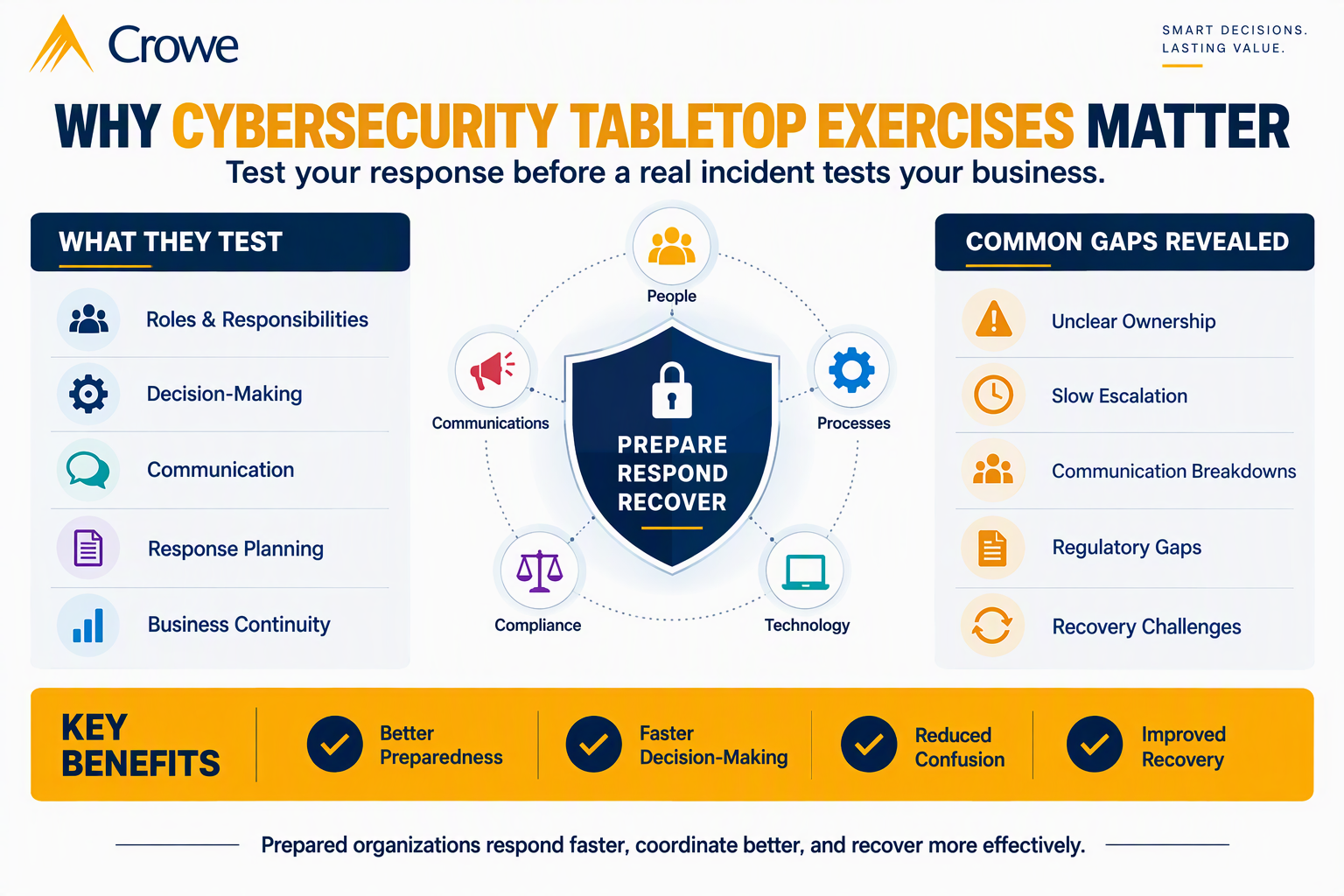
Where Tabletop Exercises Often Reveal Gaps
Many organizations have comprehensive incident response plans. The problem is that a plan can look complete on paper while still containing practical weaknesses.
A well-designed tabletop exercise may uncover:
- Unclear roles or decision-making authority
- Inefficient escalation and approval processes
- Outdated or missing emergency contact information
- Gaps in incident response procedures
- Unclear regulatory or stakeholder notification requirements
- Weak coordination between technical and business teams
- Unidentified dependencies on critical systems or third parties
Finding these issues during an exercise is considerably less costly than discovering them in the middle of a live cyber incident.
Why Executive Participation Matters
Cyber incidents are not solely technical events.
A serious incident can affect operations, customers, contractual obligations, regulatory requirements, revenue, and corporate reputation. Some of the most important response decisions therefore sit outside the security function.
Executives may need to determine:
- When an incident becomes a business crisis
- Which stakeholders should be informed and when
- When legal counsel or external specialists should become involved
- How customers, regulators, and partners should be approached
- Which business functions should receive priority during recovery
Participating in tabletop exercises allows leadership to consider these questions before they have to answer them under real-world pressure.
What Organizations Should Actually Focus On
- Use Realistic Scenarios: Build exercises around threats relevant to the organization's industry, operations, systems, and risk profile.
- Include Business and Technical Stakeholders: Security, IT, leadership, legal, compliance, communications, HR, and operations should understand how their responsibilities connect.
- Create Pressure Through New Information: Effective exercises should evolve as new facts, business impacts, stakeholder questions, or regulatory concerns emerge.
- Document Lessons Learned: Gaps and improvement opportunities should be recorded, prioritized, and assigned to appropriate owners.
- Update Response Plans: Findings should translate into revised procedures, escalation paths, communication plans, or recovery arrangements.
- Exercise Regularly: Threats, systems, employees, suppliers, and regulatory expectations change. Response capabilities need to evolve with them.
The Strategic Questions Leaders Should Ask
Before the next cyber incident occurs, organizations should ask:
- Do our teams know who has decision-making authority during a cyber crisis?
- Are escalation procedures clear enough to work under pressure?
- Do technical and business teams understand each other's responsibilities?
- Are regulatory and stakeholder notification processes clearly defined?
- Have we tested how critical operations would continue if key systems became unavailable?
- Have lessons from previous exercises been incorporated into our response plans?
- If a serious cyber incident occurred today, would our response work as effectively in practice as it does on paper?
Final Thought
Cybersecurity tabletop exercises are not about proving that an organization has a perfect incident response plan. They are about discovering where that plan may fail before the consequences are real.
A well-designed exercise gives teams a safe environment to test decisions, challenge assumptions, clarify responsibilities, and identify weaknesses across both technical and business functions.
The organizations that gain the most value aren't simply the ones that conduct tabletop exercises. They're the ones that turn what they learn into measurable improvements in how they prepare, respond, and recover.
Because during a real cyber crisis, the question is no longer whether the incident response plan looks good on paper.
It's whether people know how to use it when it matters.
The author is Director, Cyber Threat Management at Crowe UAE and can be reached at [email protected] or +971 52 373 4662.
Cyber Shield
Stay ahead of emerging threats, vulnerabilities, and defense strategies with expert insights tailored for today’s digital risk landscape. Because in Cybersecurity, being informed is your first line of defense.
Detect. Defend. Recover.