Password less Authentication
The Future of Identity Security

For decades, passwords have been the primary method of protecting digital accounts and identities. But as phishing, credential theft, data breaches, and social engineering attacks become increasingly sophisticated, passwords can also become a security weakness.
Users must manage multiple credentials, while organizations spend significant resources on password resets, account recovery, and authentication controls.
Password less authentication offers a different approach. By using cryptographic credentials, trusted devices, security keys, or biometrics, organizations can strengthen identity security while creating a simpler authentication experience.
Why Move Beyond Passwords?
Passwords were designed for a simpler digital environment. Today, weak passwords, credential reuse, and phishing can expose organizations to significant security risks.
Common challenges include:
- Weak or predictable passwords
- Password reuse across multiple accounts
- Phishing and social engineering
- Credential stuffing and brute-force attacks
- Password-related help desk and recovery requests
Password less authentication reduces reliance on credentials that users need to remember, enter, and protect.
The Role of Multi-Factor Authentication
Multi-factor authentication (MFA) strengthens security by requiring more than one form of verification. However, many MFA implementations still rely on a password as the first factor.
Password less authentication goes further by replacing passwords with methods such as:
- Fingerprint or facial recognition
- Hardware security keys
- Authenticator applications
- Device-based credentials
- FIDO2 and WebAuthn-based authentication
These approaches can significantly reduce exposure to phishing and credential-based attacks.
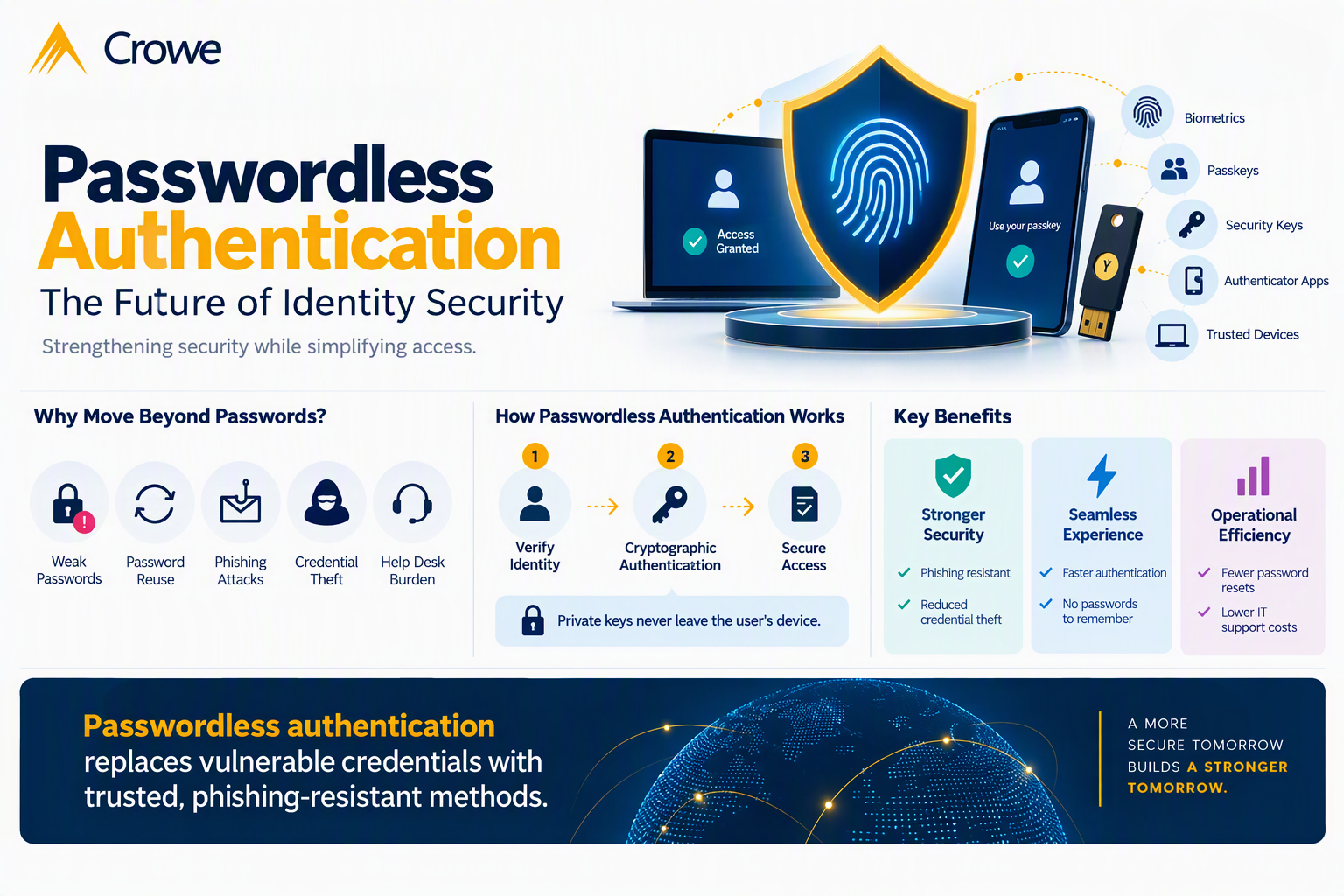
How Password less Authentication Works
Many password less systems use public-key cryptography.
When a user registers, a unique cryptographic key pair is created. The public key is registered with the service, while the private key remains protected on the user's device or authenticator.
During login, the service sends a cryptographic challenge. The user's authenticator responds using the private key, and the service validates the response using the public key.
Because the private key is not transmitted to the service, attackers cannot simply obtain reusable login credentials from a compromised password database.
Core Technologies Behind Password less Authentication
Several technologies are accelerating password less adoption:
FIDO2, WebAuthn, and CTAP. These standards enable secure authentication using public-key cryptography and compatible authenticators.
Hardware security keys. Physical security keys, including devices such as YubiKey, can securely store cryptographic credentials and provide strong resistance to phishing.
Passkeys. Passkeys replace passwords with FIDO-based cryptographic credentials. Depending on the implementation, they may be stored on a device or securely synchronized across a user's devices. Major technology platforms, including Apple, Google, and Microsoft, support passkeys.
Biometrics. Fingerprints and facial recognition can provide convenient user verification. Organizations should, however, consider privacy, secure implementation, regulatory requirements, and alternative authentication methods.
Key Considerations Before Adoption
Organizations considering password less authentication should evaluate:
- Identity infrastructure: Can existing IAM platforms support passwordless technologies?
- Application compatibility: Can modern and legacy applications integrate with password less authentication?
- Compliance and privacy: Are relevant security, privacy, and regulatory requirements addressed?
- Device support: Do users have compatible devices or security keys?
- Account recovery: How will lost or unavailable devices be handled?
- User readiness: What communication, awareness, and training will be required?
A phased rollout beginning with selected users or applications can help organizations identify technical and operational challenges before wider deployment.
Improving the User Experience
Password less authentication is not only about security. It can also make accessing applications easier.
Users no longer need to remember numerous complex passwords or frequently reset forgotten credentials. Authentication can instead use familiar mechanisms such as biometrics, trusted devices, or security keys.
For organizations, this can reduce password-related help desk requests while creating a faster and more consistent authentication experience.
Strategic Questions Leaders Should Ask
Leaders should consider:
- How exposed are we to phishing and credential-based attacks?
- Can our IAM infrastructure support password less authentication?
- Which users and applications should be prioritized?
- How will account recovery and lost devices be managed?
- How can we balance stronger security with user convenience?
- What metrics will measure security, adoption, and user experience?
Final Thought
Passwords have protected digital identities for decades, but authentication is increasingly moving beyond them.
Passkeys, biometrics, security keys, and cryptographic authentication can help organizations reduce credential-based risks while simplifying the sign-in experience.
The transition requires careful consideration of legacy applications, privacy, device compatibility, recovery processes, and user adoption. Organizations that begin evaluating password less authentication today can better prepare their identity strategies for a more secure and user-friendly future.
Is your organization ready to move beyond passwords?
Cyber Shield
Welcome to Cyber Shield Tuesday - your weekly pulse on the evolving world of Cyber Threat Management.
Stay ahead of emerging threats, vulnerabilities, and defense strategies with expert insights tailored for today’s digital risk landscape. Because in Cybersecurity, being informed is your first line of defense.
Detect. Defend. Recover.