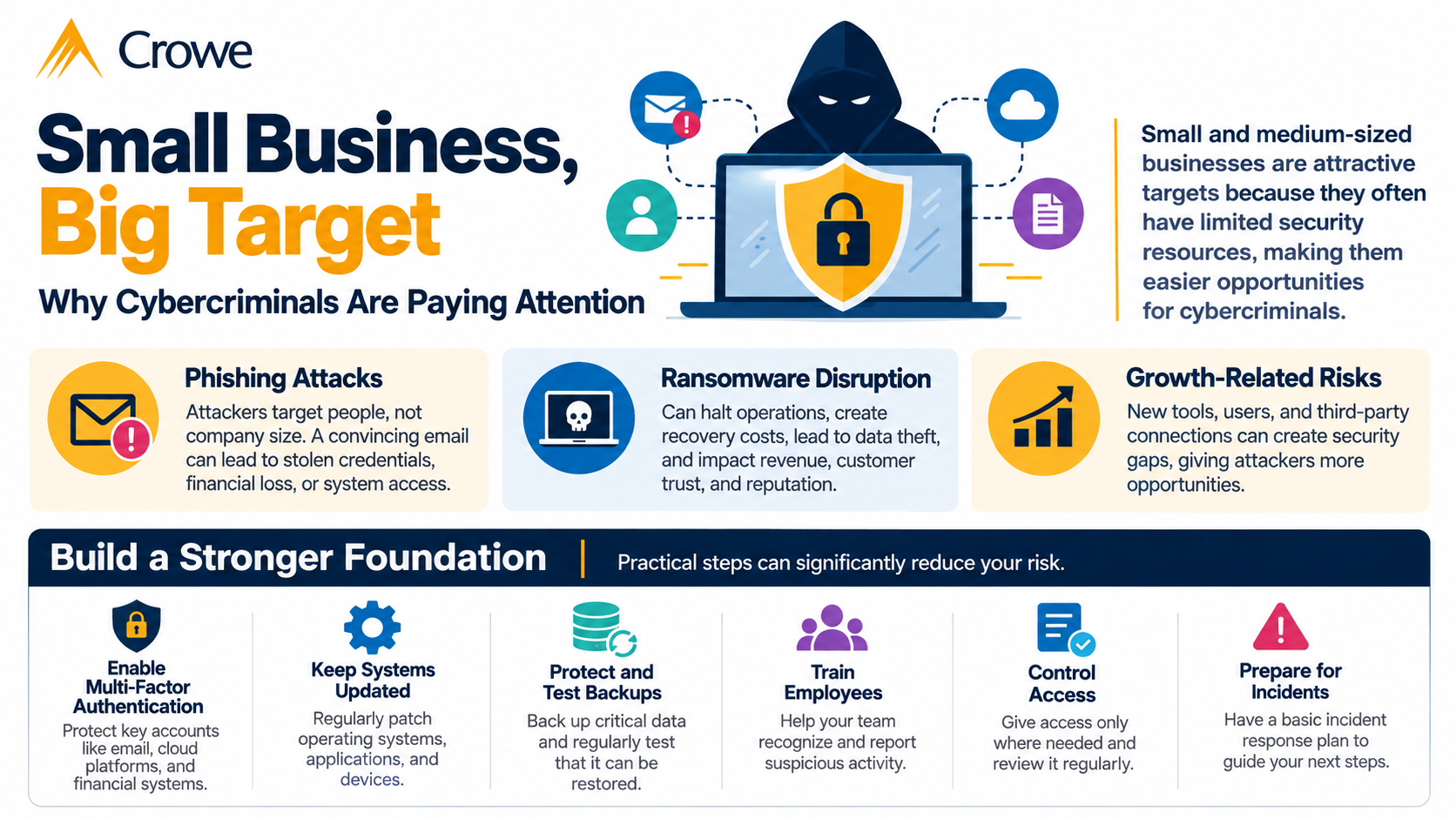
Small Business, Big Target
Why Cybercriminals Are Paying Attention

For many small businesses, cybersecurity can feel like an enterprise problem.
Large organizations hold significant amounts of data, operate complex technology environments, and frequently appear in headlines following major cyberattacks. This can create the impression that cybercriminals have little reason to target smaller companies.
The reality is different. Small and medium-sized enterprises (SMEs) and startups can be attractive targets precisely because they often operate with limited security resources, small IT teams, and rapidly changing technology environments.
Attackers do not always need to pursue the largest organization. They may simply look for the easiest opportunity.
A successful phishing email, compromised employee account, or ransomware infection can create significant consequences for a smaller organization, where prolonged downtime and unexpected recovery costs may be particularly difficult to absorb.
Why Small Businesses Can Be Attractive Targets
Small businesses naturally prioritize growth, customers, employees, and daily operations. Dedicated cybersecurity teams and significant security budgets may not always be practical.
As a result, security responsibilities may fall to small IT teams or employees whose primary roles are unrelated to cybersecurity. This can contribute to delayed patching, limited monitoring, inconsistent access controls, and security alerts being overlooked.
Attackers may not require sophisticated techniques when basic security weaknesses provide an easier route into an organization.
Phishing is a good example. Attackers target people rather than company size. A convincing email may impersonate an executive, supplier, bank, delivery provider, or technology platform and encourage an employee to disclose credentials, open an attachment, or approve an unexpected request.
For growing businesses, employees may also communicate frequently with new customers, vendors, and partners, increasing the opportunities for convincing social engineering attempts.
When Ransomware Becomes a Business Problem
For an SME or startup, ransomware can quickly become more than a technical incident.
If critical files, applications, or systems become unavailable, employees may be unable to process orders, issue invoices, communicate with customers, or deliver services.
Modern ransomware attacks may also involve data theft before systems are encrypted. Even where backups are available, organizations may therefore still need to address concerns about exposed customer, employee, or business information.
The resulting impact can extend to operational downtime, recovery expenses, lost revenue, legal or regulatory obligations, and reputational damage.
For smaller businesses with fewer financial and operational reserves, these consequences can be particularly challenging.
Growth Can Create New Security Gaps
Startups are designed to move quickly. New cloud applications are deployed, employees join, permissions change, and third-party platforms are adopted to support growth.
While this flexibility enables innovation, security controls may struggle to keep pace.
Over time, unused accounts, excessive permissions, unmanaged devices, unsupported software, or misconfigured cloud services can create unnecessary exposure.
SMEs may also have connections with larger customers and business partners through shared systems, data exchanges, or application access. Attackers may view a smaller third party as a potential route to information or systems belonging to a larger organization.
Cybersecurity therefore plays an important role not only in protecting internal operations but also in maintaining customer and partner trust.
Cyber Hygiene: Start With the Basics
Improving cybersecurity does not necessarily require an enterprise-scale Security Operations Center. For many SMEs, meaningful risk reduction can begin with practical controls.
Enable multi-factor authentication. MFA should be prioritized for email, cloud platforms, administrative accounts, financial systems, and remote access.
Keep systems updated. Operating systems, applications, browsers, network devices, and internet-facing systems should be regularly patched. Automatic security updates can be enabled where appropriate.
Protect and test backups. Critical information should be backed up and protected from unauthorized modification or deletion. Organizations should also regularly test whether information can actually be restored.
Train employees. Employees should understand how to recognize suspicious emails, unusual login requests, unexpected payment instructions, and attempts to obtain credentials. They should also know how to report suspicious activity.
Control access. Employees should only have access to systems and information required for their responsibilities. Access should be reviewed when employees change roles or leave the organization.
Prepare for incidents. Even a simple incident response plan can help clarify who makes decisions, who employees should contact, how systems will be restored, and when external specialists may need to be involved.
Questions SME Leaders Should Ask
Business leaders do not need to become cybersecurity specialists, but they should understand their organization's basic level of preparedness.
Leaders should consider:
- Is MFA enabled on our most important accounts?
- Are systems and applications regularly patched?
- Who has access to sensitive business information?
- Could we recover critical data following a ransomware attack?
- When did we last test our backups?
- Do employees know how to recognize and report phishing?
- Do we have a basic cybersecurity incident response plan?
If these questions are difficult to answer, they can provide a useful starting point for improving security.
Final Thought
Cybersecurity maturity does not happen overnight, and a small startup will naturally have different requirements from a larger organization.
The objective should be to build security progressively as the business grows. Start with MFA, patching, secure backups, employee awareness, access controls, and incident response. As the organization expands, more advanced monitoring, endpoint detection, vulnerability management, and formal governance can be introduced according to risk and complexity.
For SMEs and startups, the goal is not perfect security. It is practical security that reduces risk while supporting business growth.
Is your business prepared to respond when a cyber threat becomes a business problem?
Author is Director, Cyber Threat Management at Crowe UAE and can be reached at [email protected] or call +971 52 373 4662.
Cyber Shield
Stay ahead of emerging threats, vulnerabilities, and defense strategies with expert insights tailored for today’s digital risk landscape. Because in Cybersecurity, being informed is your first line of defense.
Detect. Defend. Recover.