Cybersecurity Bulletin
Emerging Vulnerabilities and Cyber Threats | 03–09 August 2026
Reading Time: 3 Minutes
8/11/2026
The cybersecurity landscape continues to evolve as threat actors exploit technology vulnerabilities, target digital identities and adopt increasingly sophisticated social engineering techniques. During 03–09 August 2026, several developments highlighted the risks facing organizations, ranging from critical vulnerabilities and ransomware campaigns to attacks affecting public services and the software supply chain.
For organizations across the UAE and Middle East, these developments provide important insights into emerging cyber risks and the security measures required to strengthen resilience.
Critical Vulnerabilities Under Review
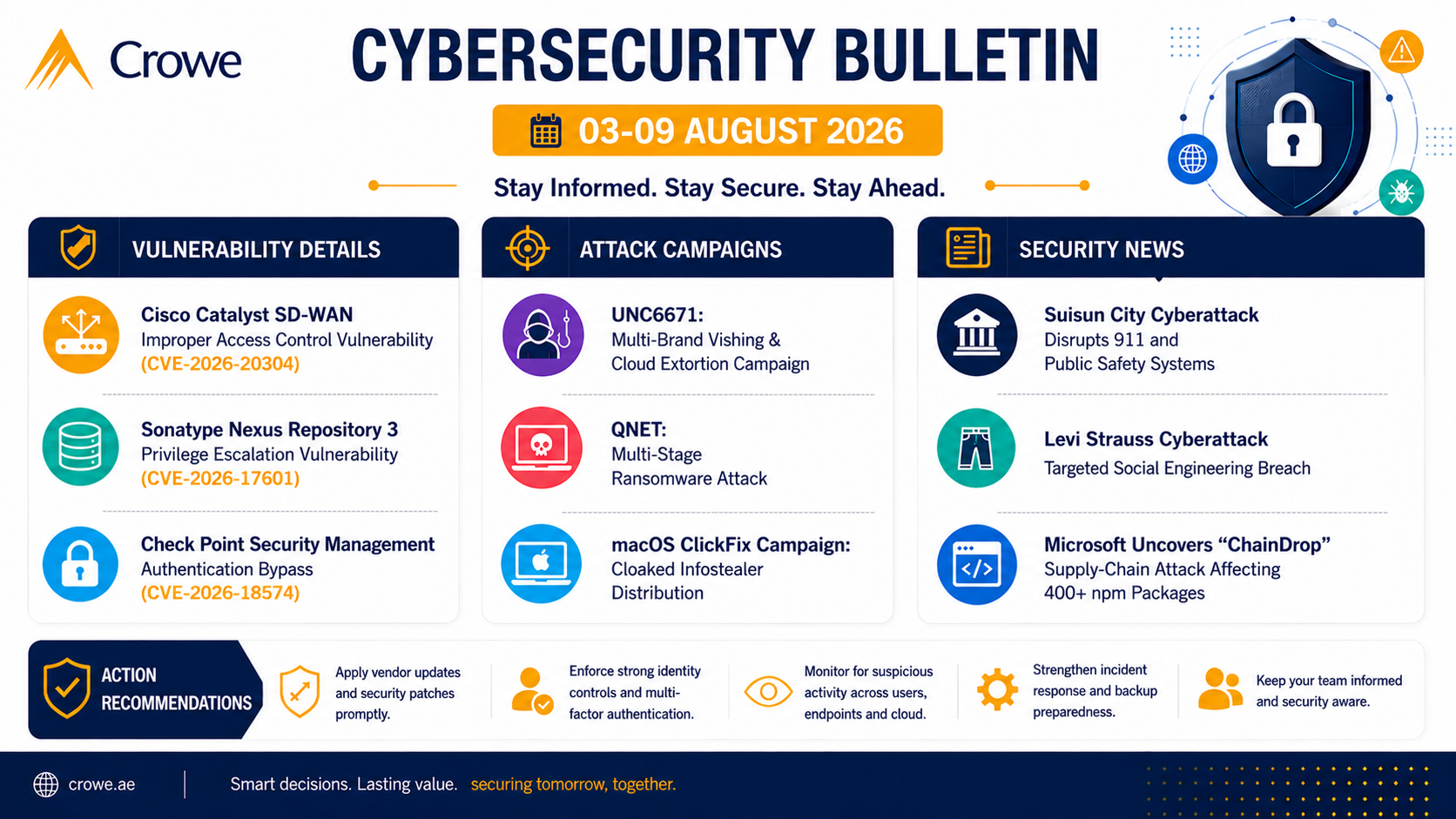
Three vulnerabilities emerged as key areas of attention during the week: Cisco Catalyst SD-WAN Improper Access Control Vulnerability (CVE-2026-20304), Sonatype Nexus Repository 3 Privilege Escalation Vulnerability (CVE-2026-17601), and Check Point Security Management Authentication Bypass (CVE-2026-18574).
Organizations using these technologies should assess their exposure, review the latest vendor security guidance and prioritize remediation based on the criticality of affected systems. Maintaining accurate asset inventories and a risk-based vulnerability management programme can help organizations respond more effectively to newly disclosed security weaknesses.
Evolving Attack Campaigns
Social engineering and multi-stage attacks remain prominent across the threat landscape. The UNC6671 multi-brand vishing and cloud extortion campaign demonstrates how attackers are targeting users and cloud identities through sophisticated social engineering techniques.
The QNET multi-stage ransomware attack further highlights the importance of detecting malicious activity throughout different stages of an intrusion. At the same time, the macOS ClickFix campaign demonstrates how deceptive user interactions can be used to distribute information-stealing malware.
These campaigns reinforce the need for strong identity controls, endpoint visibility, employee awareness and effective incident detection capabilities.
Cyber Incidents Highlight Wider Business Risks
Recent incidents demonstrate how cyberattacks can affect organizations, communities and technology ecosystems. A cyberattack on Suisun City disrupted 911 and public-safety systems, highlighting the potential operational impact of attacks on critical services.
Levi Strauss & Co. also experienced a targeted social engineering breach, reinforcing the continuing importance of protecting employees and identities against manipulation-based attacks.
Meanwhile, the reported “ChainDrop” supply-chain attack affecting more than 400 npm packages highlights the growing security challenges associated with third-party and open-source software dependencies.
Strengthening Cyber Resilience
Organizations in the UAE and Middle East should continue to prioritize timely vulnerability remediation, phishing-resistant authentication, continuous security monitoring, employee awareness and software supply-chain security. Regularly testing incident response and business continuity plans can further help organizations prepare for, respond to and recover from evolving cyber threats.
For Cybersecurity and Cyber Threat Management consulting,
Call / WA +971 52 373 4662 | [email protected]
Read Cyber Security Insights

Dawn Thomas
Senior Partner - Governance Risk & Compliance

Shahnawaz Sheik
Director – Cyber Threat Management