The Licence Is Not the Business
Building a Sustainable Financial Services Busines

Regulatory authorisation has become the entry fee across the UAE and the wider GCC. The eighteen months that follow determine whether there is a business behind it.
Approval is usually treated as the finish line
Approval is usually treated as the finish line. It sits closer to the start, at the point where a firm has to answer what a customer costs to acquire, what they cost to keep, and how many of them will ever transact.
For most of the past decade the question in this region was whether a firm could get authorised at all. Could it be done, how long would it take, and what would the regulator want to see?
That question is now settled for a growing number of institutions.
Enough firms hold licences and in-principle approvals that the binding constraint has moved. Capital recognised the shift before most boards did: funding across the region has become markedly more selective, following recurring revenue and defensible unit economics instead of user growth. Regulators have moved in the same direction, pulling newer models inside the perimeter and taking cost out of onboarding, while open banking has crossed from sandbox into live operation.
Authorisation is the entry fee.
The eighteen months after it are where a business is either built or quietly lost.
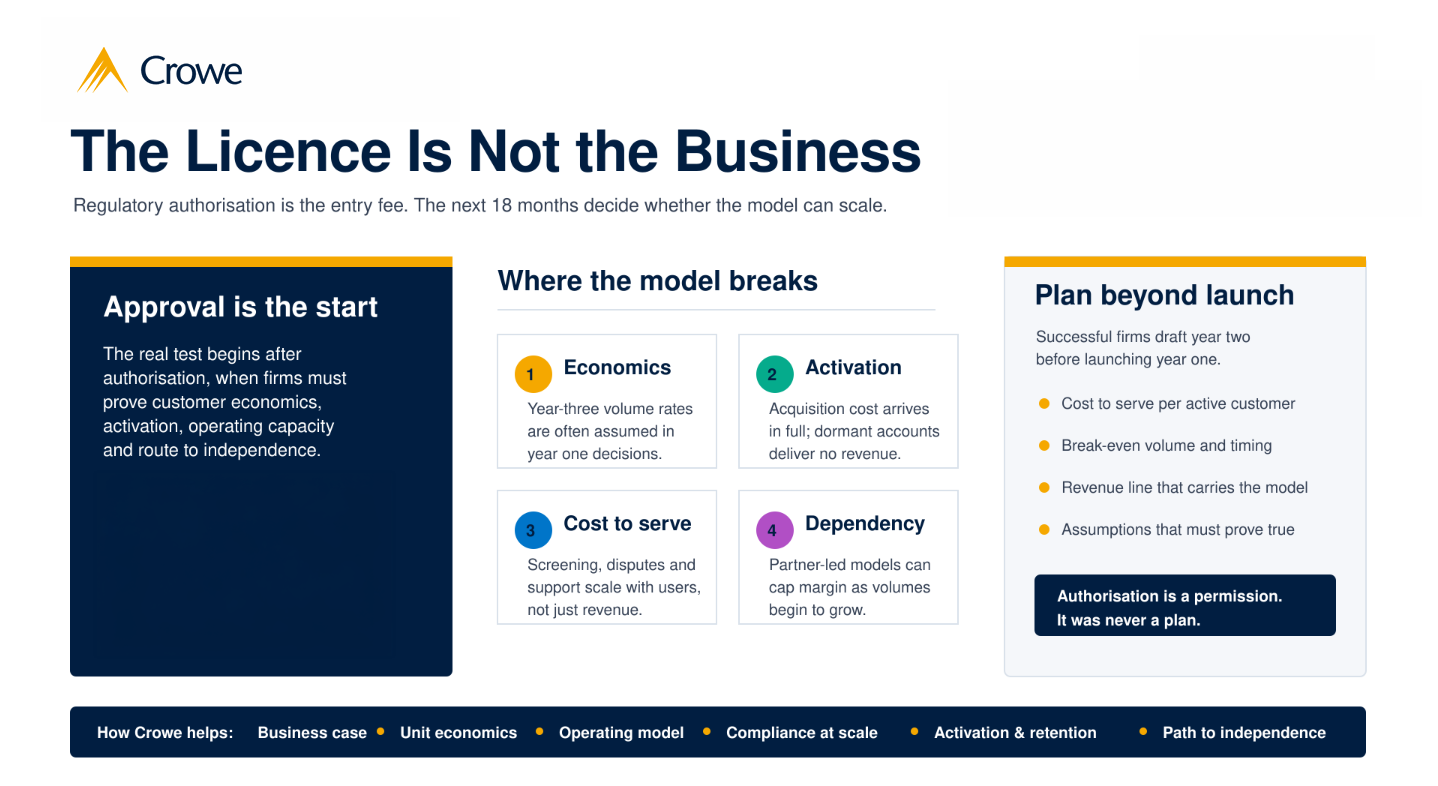
Where the model breaks
Four problems recur, and they rarely arrive alone.
The first sits in the economics.
Interchange, float income, FX spread and scheme incentives all improve with volume. A model that assumes year-three rates in year one reads convincingly, clears the investment committee, and funds decisions that will not hold.
The second is customer activation, and it deserves far more attention than it receives.
The cost of that customer arrives in full: the marketing to reach them, the checks to onboard them, the card to issue and deliver, then an annual charge for screening, file review, record-keeping and regulatory reporting that runs for as long as the account stays open.
The revenue never arrives at all.
In most institutions the number is not reported, because acquisition is measured every month and activation is not measured at all. A portfolio can look healthy on accounts opened while a significant share of those accounts has never carried a single transaction.
The third is cost to serve.
Screening, monitoring, disputes, support and reconciliation scale with customer numbers rather than with revenue. A proposition that is comfortably profitable at ten thousand customers can be loss-making at a hundred thousand with nothing having gone wrong.
The fourth is dependency.
Operating under a partner's licence is usually the right trade at the outset, and it sets a ceiling on margin that becomes binding as volumes grow. Knowing when to move is a calculation rather than an instinct, and few firms model it before the ceiling is already pressing.
Why successful organisations plan beyond launch
Firms that scale well have drafted their second year before launching the first.
Not in detail, since plans do not survive contact with customers, but with enough clarity to state:
- The cost to serve per active customer.
- The volume at which the business breaks even.
- Which revenue line carries the business while the others mature.
- What has to be true for the commercial plan to work.
This work attracts none of the attention a launch does, and it is what separates a business from an announcement.
How Crowe helps
Crowe UAE works with banks, exchange houses, money transfer operators and fintechs at precisely this stage.
We work alongside internal teams across the connected commercial, operational and regulatory workstreams.
- Financial model and business case. Developing the revenue bridge, break-even volumes, and sensitivity analysis around the assumptions that have the greatest commercial impact.
- Unit economics and cost to serve. Modelling profitability per customer, per transaction and per segment at planned volumes rather than current ones.
- Operating model at scale. Designing operating models that support growth and identifying what must change as volumes increase.
- Compliance sized to the plan. Aligning onboarding, screening and monitoring with the customer volumes being forecast.
- Activation and retention. Improving customer activation and reducing dormant accounts by strengthening the first weeks of the customer journey.
- Performance tracking. Monitoring commercial and operational performance against plan so that drift is identified early.
- The path to independence. Assessing when moving beyond a partner-led model becomes commercially justified.
Much of this sits outside the brief a launch team is given, which is no criticism of launch teams.
They are appointed to launch.
The business begins after authorisation
Authorisation is a permission.
It was never a plan.
The commercial assumptions, operating model, customer behaviour and regulatory obligations all continue to evolve after approval. Managing those connections is what turns a licensed institution into a sustainable financial services business.
As the organisation grows, capability should progressively transfer to its own people together with the knowledge, governance and operating discipline needed to support long-term success.
Holding a licence is an achievement. Building the business behind it is the objective.
FIVE QUESTIONS FOR THE BOARD
- Are our commercial assumptions based on realistic customer activation and transaction volumes rather than projected growth alone?
- Do we understand the true cost of acquiring, activating and retaining an active customer?
- At what point does our operating model need to change to support future growth?
- When will our current partnership or licensing model begin to limit commercial performance?
- How are we measuring whether the business is performing against the assumptions that supported regulatory approval?
To discuss digital banking, fintech growth, post-authorisation strategy or building a commercially sustainable financial services business, contact Crowe UAE's Fintech & Banking, Governance, Risk & Compliance team at +971 52 373 4662 or [email protected].
GRC Compass
GRC Compass is a curated weekly newsletter published every Thursday, delivering the most relevant insights and updates in Internal Audit, Governance, Risk & Compliance (GRC), Cyber Threat Management, Technology, and evolving training needs.
Designed for professionals navigating a dynamic business environment, GRC Compass helps you stay informed, prepared, and ahead of the curve.