The Hidden Risks of Shadow IT
Security, Data Protection, and Compliance Challenges

In today's digital workplace, employees have access to countless cloud services, collaboration platforms, and productivity applications. While these tools can improve efficiency and support innovation, they can also introduce significant risks when adopted without the knowledge or approval of the IT department.
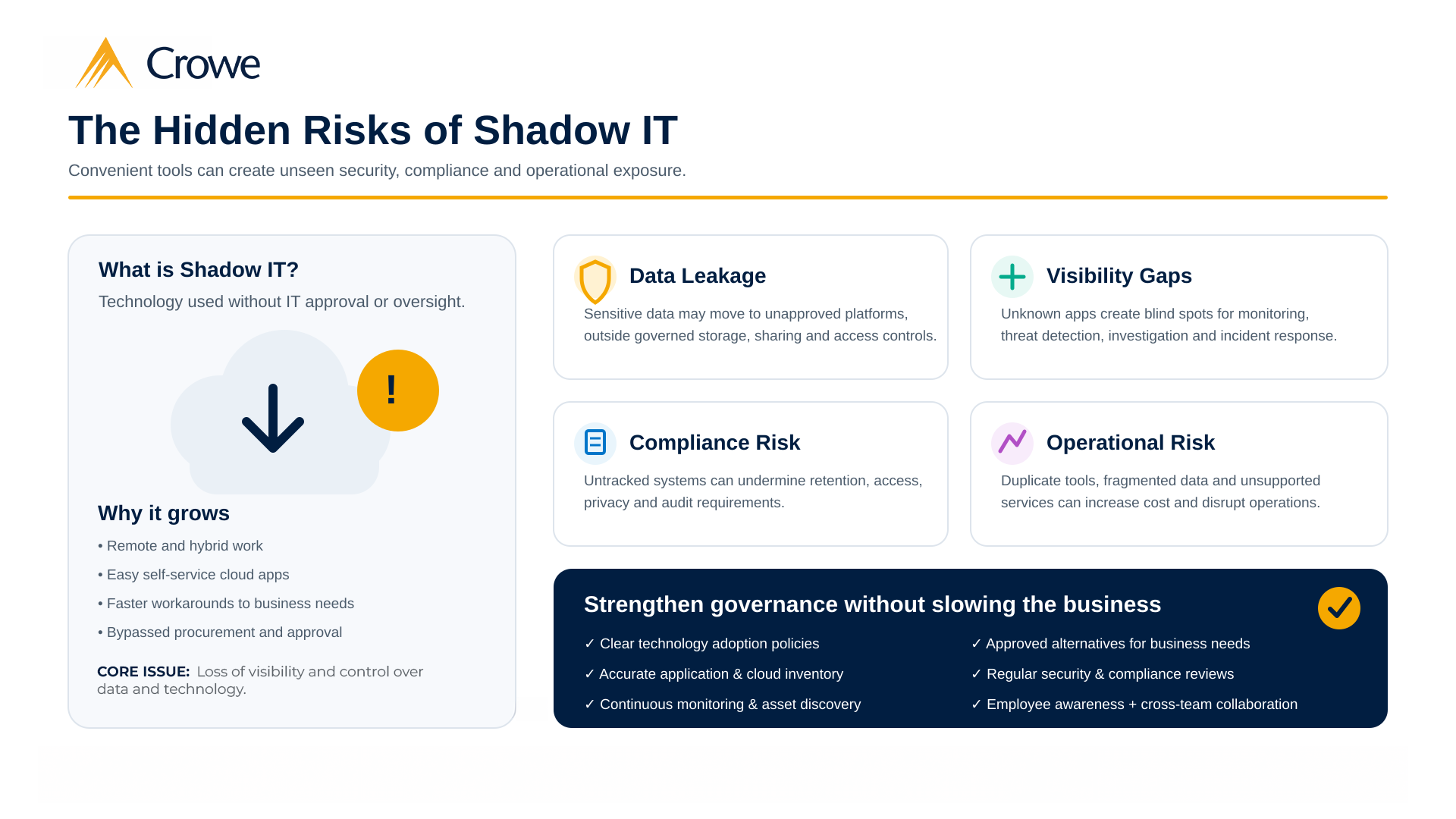
Known as Shadow IT, the use of unauthorized hardware, software, applications, or cloud services can create security, compliance, and operational challenges. Shadow IT is not necessarily malicious. Employees often adopt these tools because they offer faster or more convenient ways to complete their work. However, when technology operates outside established governance frameworks, organizations can lose visibility and control over how business information is stored, accessed, and shared.
Why Shadow IT Is Growing
The rise of remote work, cloud-based applications, and self-service technology has made it easier than ever for employees to adopt new tools. Many applications can be deployed within minutes, allowing users to bypass traditional procurement and approval processes.
While this flexibility can support productivity, it can also create fragmented technology environments. Sensitive business information may be stored across multiple platforms that have not been reviewed or approved by security and governance teams. As organizations continue their digital transformation, maintaining visibility into the technologies being used across the business is increasingly important.
Unauthorized Applications and Services
One of the most common forms of Shadow IT is the use of unapproved applications and cloud services. Employees may use personal file-sharing platforms, messaging applications, project management tools, or external storage solutions to support their day-to-day activities.
These applications may lack appropriate encryption, access management, monitoring, or data protection capabilities. Without centralized oversight, security teams may be unable to assess the risks associated with these platforms or determine where sensitive information is being stored.
The Risk of Data Leakage
Data leakage is one of the most significant risks associated with Shadow IT. When employees transfer corporate information to unauthorized platforms, organizations may lose visibility into where data is stored, who can access it, and how it is being shared.
Customer information, financial records, intellectual property, and confidential business documents could reside outside approved environments. Information may also be shared with external parties without appropriate authorization or oversight.
These practices increase the likelihood of security incidents, regulatory violations, audit findings, and reputational damage. Even when Shadow IT is introduced with good intentions, uncontrolled data movement can have serious consequences.
Visibility Gaps and Security Challenges
Effective cybersecurity depends on visibility. Organizations cannot effectively protect assets, applications, or data they do not know exist.
Shadow IT creates blind spots for security and compliance teams. Unauthorized applications may operate outside established monitoring systems, while incident response teams may be unaware of critical data repositories or technology dependencies.
These visibility gaps can delay threat detection, complicate investigations, and make effective incident response more difficult. As the Shadow IT footprint grows, maintaining a complete view of the technology environment becomes increasingly challenging.
Compliance and Regulatory Concerns
Shadow IT can create significant compliance challenges, particularly for organizations operating in regulated industries. Organizations must maintain appropriate controls over how sensitive information is stored, processed, accessed, and shared.
When employees use unauthorized applications, governance and compliance teams may struggle to demonstrate that data is being handled in accordance with organizational policies and regulatory requirements.
During audits, organizations may also be unable to account for every system containing business information. This can make it difficult to enforce retention requirements, access controls, and data protection standards.
Operational and Business Risks
The impact of Shadow IT extends beyond cybersecurity. When departments independently adopt applications, organizations can experience duplicated functionality, inconsistent processes, fragmented data, and increased costs.
Critical information can become scattered across multiple platforms, making collaboration more difficult and potentially reducing data accuracy. Organizations may also become dependent on applications that have not undergone appropriate security, resilience, or vendor assessments.
If an unauthorized service becomes unavailable or suffers a security incident, business operations could be disrupted without the support mechanisms associated with approved enterprise solutions.
Strengthening Governance and Control
Addressing Shadow IT does not mean restricting every technology employees want to use. Organizations should create a balance between security, governance, and business productivity.
Key practices include:
- Establishing clear policies for technology adoption and usage.
- Maintaining an accurate inventory of applications and cloud services.
- Monitoring network and cloud activity to identify unauthorized tools.
- Providing approved alternatives that meet legitimate business needs.
- Regularly reviewing applications for security and compliance risks.
- Educating employees about the risks associated with unauthorized technology.
- Encouraging collaboration between business teams, IT, security, and governance functions.
The Importance of Visibility and Asset Discovery
Improving visibility is one of the most effective ways to manage Shadow IT. Organizations need an accurate understanding of the applications, cloud services, and technology assets being used throughout the enterprise.
Continuous monitoring and asset discovery can help identify unauthorized technologies before they become significant risks. Understanding what tools employees are using and why they were adopted allows organizations to make more informed decisions about risk management.
Greater visibility also enables security teams to identify potential vulnerabilities, monitor data movement, and ensure critical information remains within appropriately governed environments.
Final Thought
Shadow IT often begins with a legitimate business need for greater speed, flexibility, or convenience. However, unauthorized applications and uncontrolled data movement can create significant security, compliance, and operational risks.
Organizations that combine strong governance with visibility, employee education, and approved technology alternatives can reduce these risks without unnecessarily limiting innovation. By understanding what technologies are being used across the business and why, organizations can strengthen cybersecurity, improve compliance, and maintain greater control over their digital environment.
Cyber Shield
Stay ahead of emerging threats, vulnerabilities, and defense strategies with expert insights tailored for today’s digital risk landscape. Because in Cybersecurity, being informed is your first line of defense.
Detect. Defend. Recove