The Assurance Gap
Who Is Auditing the Risks Between Functions?

Organizations today have more oversight than ever. Internal audit, risk, compliance, information security, finance, legal, quality, and other specialist functions each play a role in identifying, managing, monitoring, or assuring risk.
On paper, this should provide boards and audit committees with greater confidence.
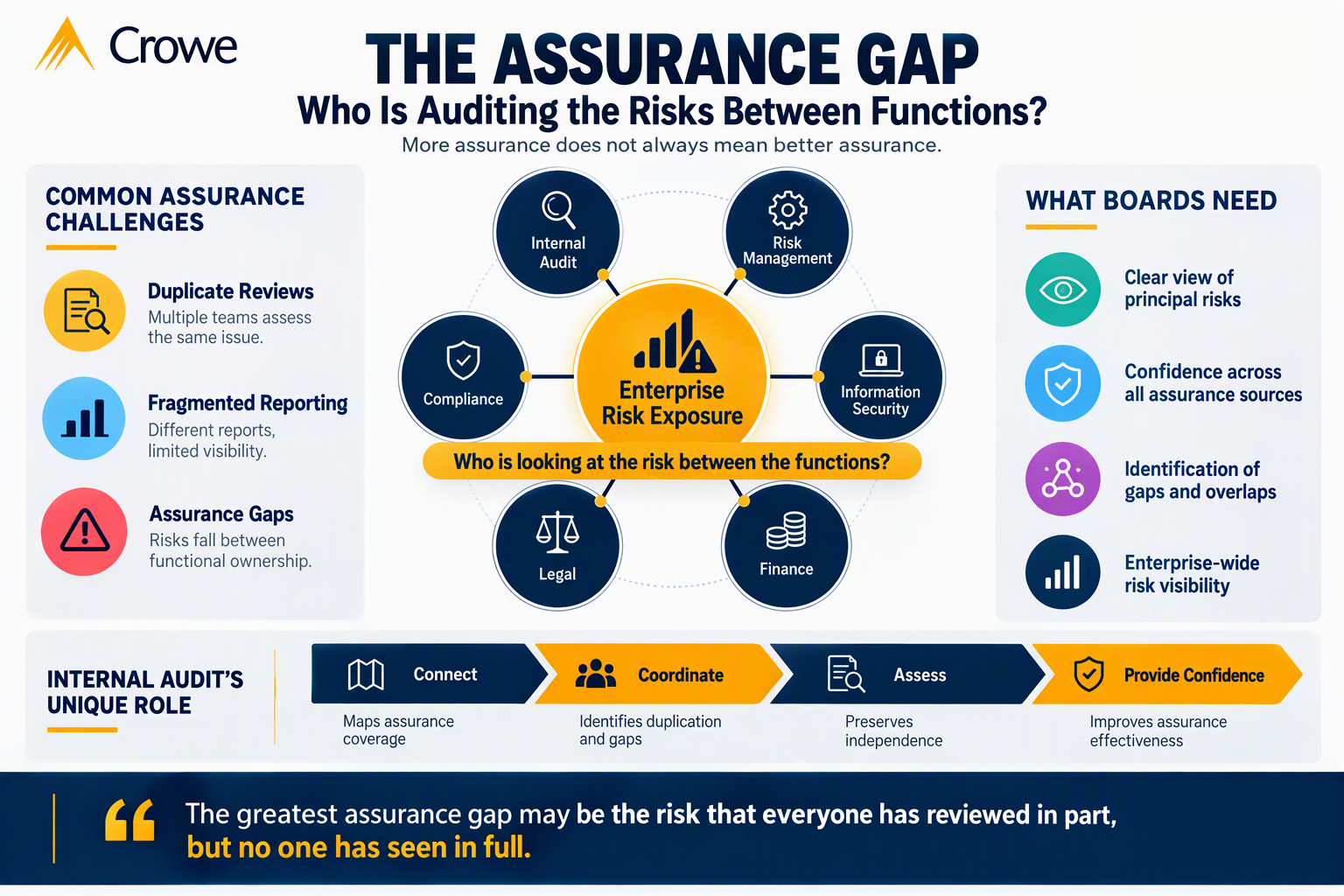
In practice, however, the existence of multiple assurance functions can create a different challenge: everyone may be reviewing risk, but not necessarily the risk as a whole.
The most significant exposures increasingly cut across traditional organizational boundaries. A cyber incident can become a regulatory, operational, financial, legal, and reputational issue within hours. A third-party failure can affect business continuity, customer data, contractual obligations, compliance, and financial performance simultaneously.
Each function may examine its part of the exposure. Yet a critical question remains:
Who is looking at the risk between the functions?
More assurance does not always mean better assurance
Organizations often respond to increasing complexity by adding controls, monitoring activities, committees, reviews, and reporting requirements.
This can create an impression of comprehensive oversight. But the volume of assurance activity is not necessarily an indication of assurance effectiveness.
In some areas, several functions may review essentially the same control or risk from different perspectives. Management may respond to similar information requests multiple times, while boards receive several reports describing different aspects of the same issue.
Elsewhere, the opposite may occur. A risk may fall between functional mandates because each team assumes another function is responsible for reviewing it.
The result can be both assurance duplication and assurance gaps at the same time.
The challenge for organizations is therefore no longer simply determining whether important risks are being reviewed. It is understanding whether assurance, taken collectively, provides a coherent picture of the organization’s exposure.
Risk does not respect organizational boundaries
Many emerging and strategic risks cannot be contained within a single function.
Consider the use of a critical third-party technology provider. Procurement may assess commercial terms and supplier capability. Information security may review cyber controls. Legal may examine contractual protections and data obligations. Compliance may consider regulatory requirements. Business continuity teams may assess resilience.
Individually, each review may be appropriate.
But who determines whether the combined exposure is acceptable?
The same challenge can arise around artificial intelligence, major transformation programmes, ESG commitments, fraud risk, outsourcing, data governance, and regulatory change. These risks intersect multiple functions and often evolve faster than traditional organizational responsibilities.
This is where an assurance gap can emerge, not because nobody is performing oversight, but because nobody has a complete view.
The board needs an assurance picture, not a collection of reports
Boards and audit committees receive significant volumes of risk and assurance information. More reporting, however, does not automatically create greater visibility.
A board may receive an internal audit report, an enterprise risk update, compliance reporting, cyber dashboards, external audit observations, and management assurance. Each can be useful independently while still leaving unanswered questions collectively.
Are the organization’s most significant risks receiving sufficient independent assurance? Are some risks being reviewed repeatedly while others receive limited attention? Where does management self-assurance end and independent assurance begin? Do different reports provide conflicting views of the same exposure?
These questions shift the discussion from “What assurance activities have been completed?” to “What level of confidence do we actually have over our principal risks?”
That is a fundamentally different conversation.
Internal audit can connect the assurance landscape
Internal audit is uniquely positioned to help organizations identify where assurance is strong, duplicated, fragmented, or absent.
Its independence and enterprise-wide mandate allow it to look across functional boundaries rather than through the lens of a single risk discipline.
This does not mean internal audit should assume responsibility for risk, compliance, information security, or other assurance functions. Nor should it simply consolidate every report into another layer of reporting.
The greater opportunity is to assess the organization’s assurance architecture.
Internal audit can consider whether significant risks have clearly identified owners, whether the different sources of assurance are understood, whether assurance activities are appropriately coordinated, and whether the board is receiving sufficient independent confidence over the areas of greatest exposure.
An assurance map can support this process, but the objective should extend beyond creating a matrix. A map that shows extensive coverage is of limited value if the underlying assurance is fragmented, overly dependent on management self-assessment, or focused on individual controls without considering the combined risk.
The real objective is clarity.
Coordination should not compromise independence
Greater coordination between assurance functions can sometimes raise concerns about internal audit independence.
The two should not be confused.
Internal audit can coordinate its understanding of risk, consider work performed by other functions where appropriate, and identify assurance gaps while preserving its independent judgement.
In fact, better coordination can strengthen independence by allowing internal audit to direct its resources towards areas where independent assurance adds the greatest value rather than duplicating work already performed effectively elsewhere.
For organizations, this can also reduce assurance fatigue. Business teams spend considerable time responding to audits, compliance reviews, risk assessments, control testing, certifications, and other requests. Better alignment can reduce unnecessary duplication while improving the quality of overall assurance.
Closing the gaps that matter
As UAE organizations become more complex, digitally connected, and dependent on third parties, the boundaries between traditional risk categories will continue to blur.
The response should not simply be more reviews, more dashboards, or more assurance functions.
Boards and audit committees need confidence that the organization’s assurance activities collectively address its most important risks and that material exposures are not disappearing into the spaces between functional responsibilities.
For internal audit, this creates an opportunity to look beyond individual engagements and consider a broader question: does the organization’s overall assurance model provide the confidence that its stakeholders believe it does?
The future of effective assurance may therefore depend less on how much assurance an organization performs and more on how well that assurance connects.
Because the greatest assurance gap may be the risk that everyone has reviewed in part, but no one has seen in full.
The author is Partner – Internal Audit & Governance Risk Compliance at Crowe UAE and can be reached at +971 52 373 4662 or [email protected].
GRC Compass
GRC Compass is a curated weekly newsletter published every Thursday, delivering the most relevant insights and updates in Internal Audit, Governance, Risk & Compliance (GRC), Cyber Threat Management, Technology, and evolving training needs.
Designed for professionals navigating a dynamic business environment, GRC Compass helps you stay informed, prepared, and ahead of the curve.