Is Internal Audit Still Auditing the Business the Way the Business Actually Operates?

Internal audit has traditionally organised its work around the way an organisation is structured. Business units, legal entities, departments, processes, systems, and locations become auditable areas. Risks are assessed against them, priorities are established, and an audit plan follows.
It is a logical model. But organisations themselves are becoming less straightforward.
A customer transaction may pass through digital platforms, third-party providers, automated controls, finance processes, compliance requirements, and data environments before it is complete. A strategic transformation may involve several functions and external partners simultaneously. Critical business services increasingly depend on technology and data that sit beyond conventional departmental boundaries.
The question for internal audit is therefore becoming more fundamental:
Does the audit universe still reflect how the organisation actually operates and assumes risk?
Organisational boundaries are becoming less relevant to risk
Risk rarely respects the organisational chart.
Consider a customer onboarding process. Responsibility may involve sales, operations, compliance, technology, finance, data privacy, and external service providers. Each function may have appropriate controls, clear ownership, and satisfactory audit results when considered independently.
Yet the customer does not experience seven separate functions. The customer experiences one journey.
The same is true of risk.
A weakness at the point where information moves from one function to another may not be visible in a traditional functional audit. Neither may conflicting responsibilities, inconsistent data, poorly integrated systems, or dependencies on external providers.
Internal audit can therefore provide assurance over individual components while still missing weaknesses created by the way those components interact.
A successful audit can still leave an unanswered question
This creates an uncomfortable possibility for the profession.
An audit can be completed successfully. Controls can be tested. Findings can be reported and addressed. Yet the organisation may still lack assurance over the end-to-end outcome that matters most.
That does not mean functional auditing has become ineffective. Functions, entities, and processes remain important parts of the audit universe.
The issue is whether they are sufficient on their own.
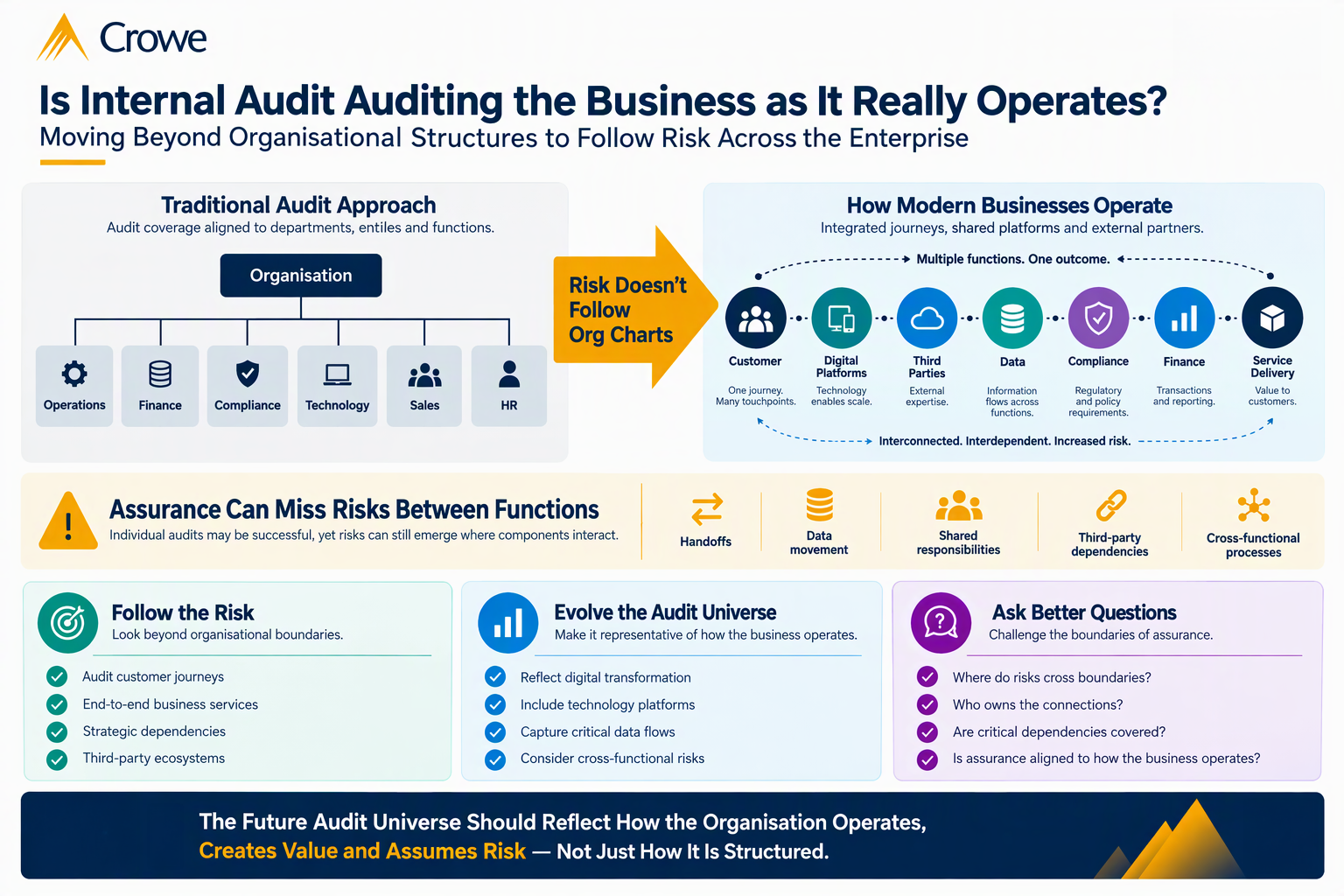
As operating models become more interconnected, internal audit needs to consider whether its assurance perspective should increasingly follow value, decisions, data, and risk across the organisation, rather than stopping where one department's responsibility ends.
This is a different way of defining what is auditable.
Follow the risk, not only the structure
An audit universe should not simply be a catalogue of organisational components. It should provide a meaningful representation of where significant risk exists and where assurance is required.
For some organisations, this may mean looking at critical customer journeys rather than individual departments. For others, it may mean auditing an end-to-end business service, a major transformation, a strategic dependency, or the lifecycle of critical data.
Third-party relationships make this particularly important.
An organisation may outsource an activity, use cloud infrastructure, depend on a technology platform, or integrate external providers into critical processes. Operational responsibility may move outside the organisation, but accountability for the resulting risk often does not.
If the audit universe remains predominantly internally focused, significant dependencies may receive less assurance than their importance warrants.
The principle is straightforward: internal audit should follow the risk wherever the risk travels.
The audit universe should evolve with the business
Many organisations update their risk assessments regularly while making fewer fundamental changes to the structure of their audit universe.
Over time, this can create a mismatch.
The terminology may be updated and new risks may be added, but the underlying assurance model can remain anchored to structures established years earlier.
For UAE organisations experiencing rapid transformation, digitalisation, new business models, regulatory development, and increasing reliance on third parties, this deserves particular attention.
The audit universe should be challenged when the business changes materially, not simply refreshed as part of an annual planning exercise.
Internal audit leaders can ask whether the current universe captures critical business services, major strategic programmes, important technology and data dependencies, external ecosystems, and the points where responsibility moves between functions.
The objective is not to make the audit universe larger. It is to make it more representative.
A different conversation with the audit committee
This shift also has implications for audit committees.
Audit committee discussions often focus on whether high-risk areas are included in the audit plan and whether planned reviews are being completed. An equally important question is whether the organisation is defining its auditable areas in the right way in the first place.
A plan can provide excellent coverage of an outdated audit universe.
Boards and audit committees should therefore understand not only what internal audit intends to review, but also how the function has determined the boundaries of its assurance coverage.
Where does one audit area end and another begin? Which critical risks cross those boundaries? Where is the organisation dependent on third parties, shared platforms, or cross-functional processes? Who provides assurance over the connections?
These questions can reveal blind spots that traditional coverage discussions may not.
Rethinking what internal audit sees
The fundamentals of internal audit remain unchanged. Independence, professional judgement, risk-based planning, and objective assurance continue to define the function.
What needs to evolve is the lens through which the organisation is viewed.
As businesses become more interconnected, internal audit has an opportunity to move beyond an assurance model that primarily mirrors organisational structure and towards one that more closely reflects how value is created, decisions are made, services are delivered, and risk moves across the enterprise.
The organisational chart will remain useful. But it should not become the boundary of internal audit's vision.
The future audit universe should not simply reflect how the organisation is structured. It should reflect how the organisation actually operates, creates value, and assumes risk.
The author is Partner, Internal Audit & Governance Risk Compliance at Crowe UAE and can be reached at +971 52 373 4662 or [email protected].
GRC Compass
GRC Compass is a curated weekly newsletter published every Thursday, delivering the most relevant insights and updates in Internal Audit, Governance, Risk & Compliance (GRC), Cyber Threat Management, Technology, and evolving training needs.
Designed for professionals navigating a dynamic business environment, GRC Compass helps you stay informed, prepared, and ahead of the curve.