Open Finance: The Power Shift
The sooner you go live, the sooner the customer relationship is yours to build.

The relationship no longer follows the data
Until now, a bank's position in the customer relationship has been reinforced by something fundamental: it holds the customer's financial data.
Open finance changes that relationship.
With consent, customers can allow their financial data to be shared with banks, exchange houses, fintechs, NBFIs, insurers and payment firms. The institution holding the data is therefore not necessarily the institution that owns the most valuable customer interaction.
The relationship can move to whoever does the most useful thing with it.
Customers can pay directly from their bank accounts. Lenders can assess credit using verified cash flow rather than relying only on payslips and statements. Onboarding and KYC can use information customers have already consented to share. Remittances can be funded directly from a bank account, while insurers can make decisions using richer financial information.
Each use case creates another reason for an institution to become the customer's first stop.
The strategic question is no longer simply how to comply with open finance.
It is what to do with it.
The UAE framework is moving into operation
The Central Bank of the UAE's Open Finance Regulation establishes the framework through which open finance will operate across the regulated financial sector.
Banks, foreign bank branches and insurers are within the initial phase, with other CBUAE licensed financial institutions entering under Phase 2.
Third parties seeking to access customer data or initiate payments need to operate within the CBUAE licensing framework. Customer consent must be explicit, recorded and managed. Connections are designed to run through Al Tareq, the UAE's centralised open finance infrastructure operated by Nebras Open Finance.
The market is moving from regulatory design into practical adoption.
As the framework expands to additional institutions, exchange houses, finance companies and payment providers face an important question:
What will we launch once we are connected?
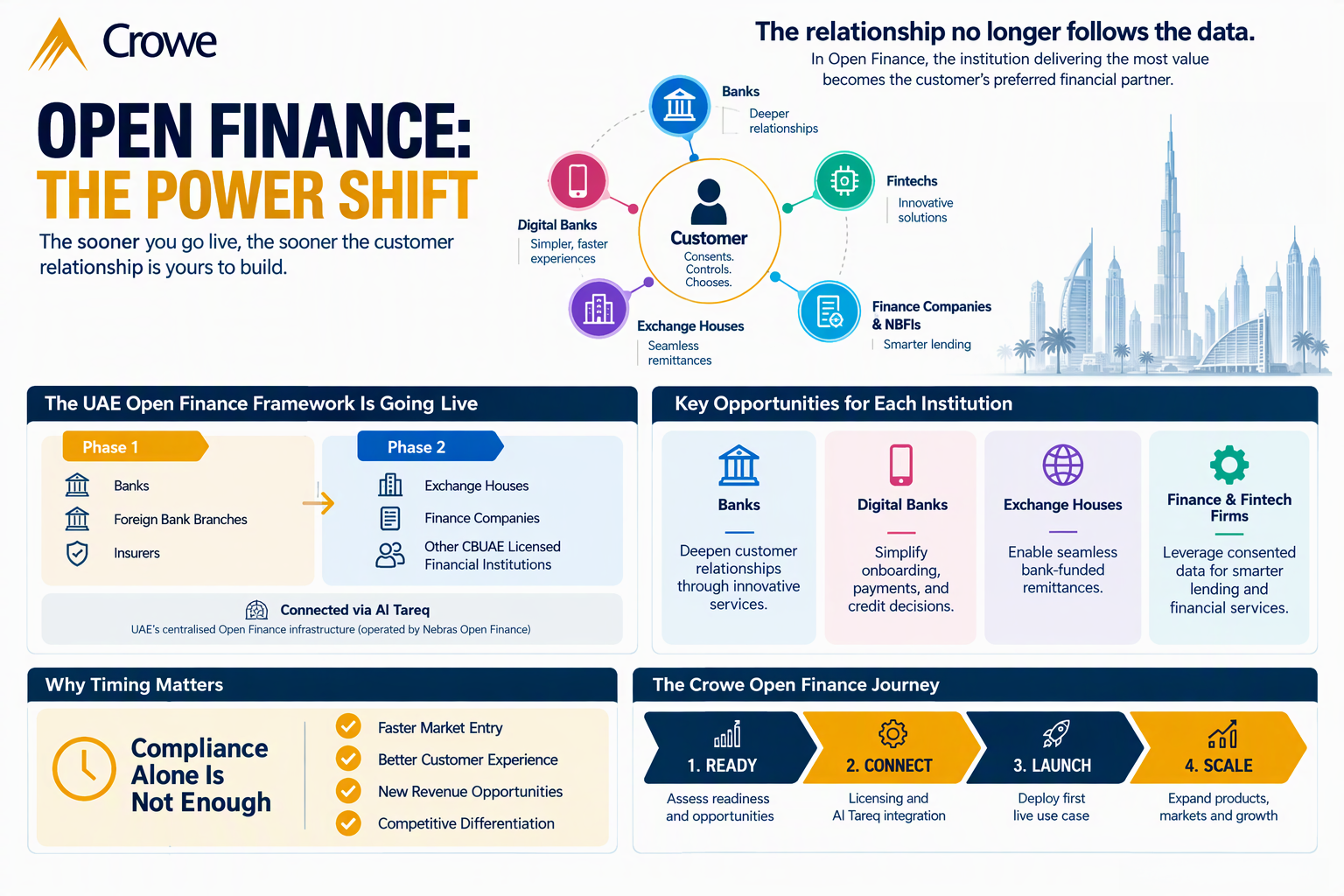
The opportunity is different for every institution
There is no single open finance strategy.
Banks already hold customer relationships, financial data and established trust. Open finance gives them an opportunity to deepen those relationships through new services rather than allow another provider to become the customer's preferred financial interface.
Digital banks can use account-to-account payments and consented data to remove friction from payments, onboarding and credit, helping turn a secondary account into a primary financial relationship.
Exchange houses can prepare for Phase 2 by identifying practical use cases. One of the clearest is repeat remittances funded directly from a customer's bank account.
Fintechs can become the infrastructure and experience layer connecting financial institutions, merchants and customers. Licensing, connectivity and institutional trust are prerequisites, but providers that establish them can build services others consume repeatedly.
NBFIs and finance companies can use consented data to verify customers, assess affordability and make credit decisions based on actual financial behaviour.
Across each segment, timing matters. Early institutions have an opportunity to establish the experience customers expect from those that follow.
Why timing matters
Treating open finance only as a compliance programme risks missing its commercial potential.
Regulation, technology, operating model, customer experience and commercial use cases need to develop together.
A licensing decision affects what services can be offered. A consent model shapes the customer journey. API architecture affects which products can be launched. Fraud, AML, cyber and data controls determine how those products operate as volumes increase.
The objective is not simply to become connected.
It is to reach a first live use case with a proposition customers have a reason to use.
How Crowe helps
Crowe UAE works with banks, exchange houses, finance companies, fintechs and other regulated institutions to prepare for and build propositions around open finance.
Our work starts with the business case: identifying where value exists, which use cases should come first, whether capabilities should be built, bought or accessed through partners, and how the proposition can generate value.
Strategy and use cases. Prioritising opportunities, developing the business case and establishing the roadmap to launch.
Regulation and licensing. Assessing regulatory requirements, supporting licence applications and regulatory engagement, and developing the required policies and governance.
Operating model and consent. Establishing ownership and third-party arrangements, and designing consent, onboarding and servicing journeys.
API and technology enablement. Supporting architecture and implementation decisions and preparing institutions for Al Tareq connectivity and certification.
Risk and assurance. Testing security, AML, fraud, data and operational controls and providing independent assurance.
Crowe Advisory remains independent of the technology selected. Where an established solution can accelerate delivery, clients can also draw on Cygnus One, Crowe's suite for regulated institutions covering regulatory requirements, digital KYC and AML, fraud and cyber, payments and wallets, and data and AI.
From readiness to scale
We structure delivery around four stages.
Ready. Assess the regulatory perimeter, current capability, data readiness and priority use cases.
Connect. Support licensing or build, establish the required foundations and progress through Al Tareq certification.
Launch. Take the first use case live with the customer journey, operating model and controls tested around it.
Scale. Add products, customer segments and markets while maintaining assurance and monitoring performance.
The same capabilities can also support regional expansion as open finance develops across the GCC.
FIVE QUESTIONS FOR THE BOARD
- Are we treating open finance as a regulatory obligation or a commercial opportunity?
- Which use case gives customers the strongest reason to choose us first?
- Are licensing, technology, consent, operating model and controls developing together?
- What should we build ourselves, and where could a partner get us to market faster?
- If competitors launch first, what part of the customer relationship could become harder to win back?
Open finance makes customer data more portable. The competitive advantage will come from what institutions build around it.
To discuss open finance readiness, licensing, Al Tareq connectivity or building an open finance proposition, contact Crowe UAE's GRC, Open Finance & Fintech advisory team at +971 52 373 4662 or [email protected].
GRC Compass
Designed for professionals navigating a dynamic business environment, GRC Compass helps you stay informed, prepared, and ahead of the curve.