Cybersecurity Bulletin 16–22 Nov 2026
Apache Roller RCE, Java4Shell, NGINX Vulnerability and Emerging Cyber Threats
Reading Time: 3 Minutes
11/25/2026

The global cybersecurity landscape continues to evolve as organizations face critical remote code execution vulnerabilities, ransomware attacks, infrastructure breaches, malicious code injection and data exposure incidents. Recent developments involving Apache Roller, OpenJDK and Oracle Java SE, NGINX, Ipsos, Osaki Electric, Equinor, Optimizely, Contabo and Reka reinforce the importance of proactive vulnerability management, threat monitoring, data protection and cyber resilience.
Critical Vulnerabilities Demand Immediate Attention
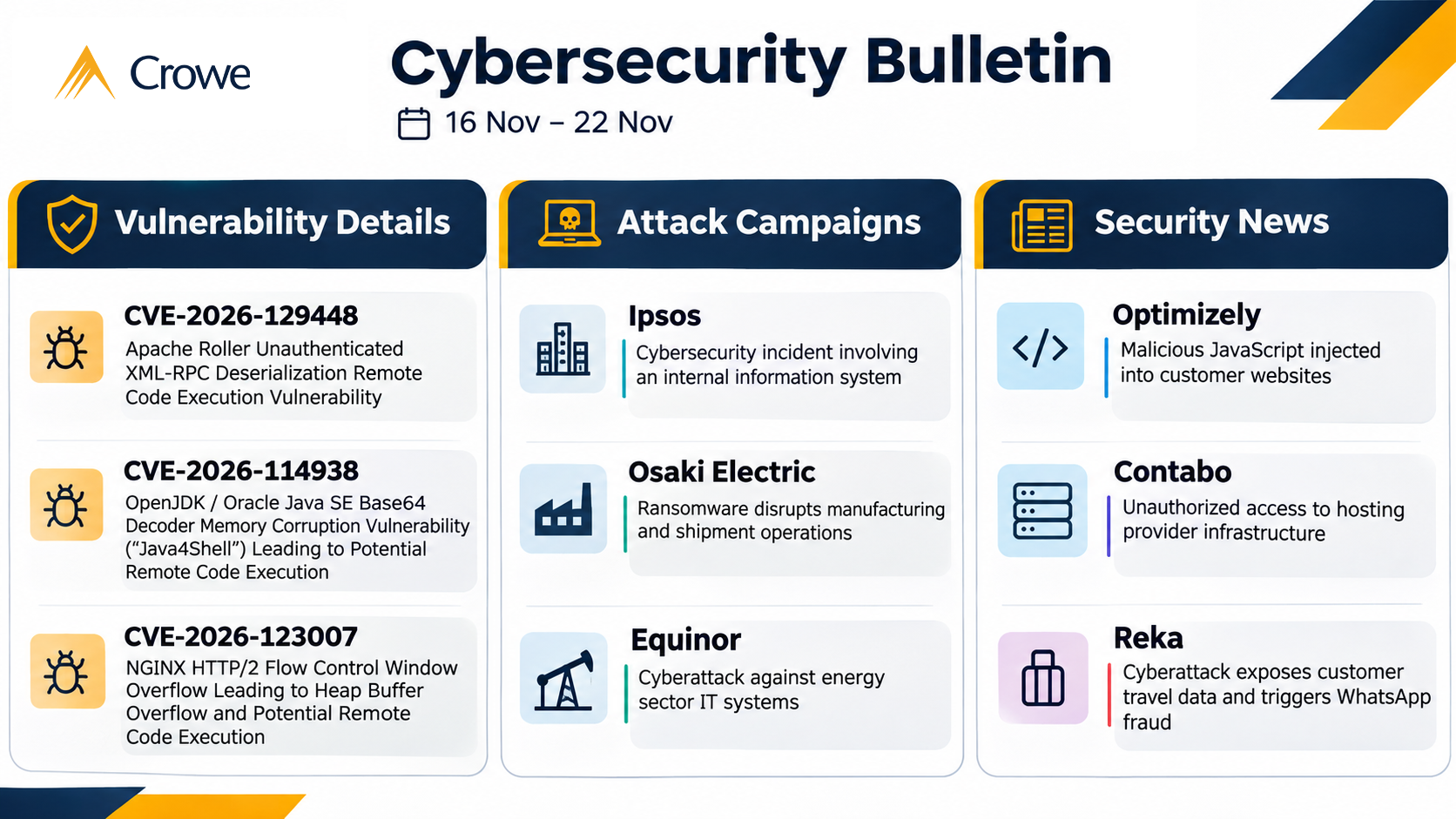
Organizations should urgently assess exposure to CVE-2026-129448, an Apache Roller unauthenticated XML-RPC deserialization vulnerability that could allow remote attackers to execute arbitrary code. The vulnerability is being actively exploited and has been added to CISA’s Known Exploited Vulnerabilities catalog. Organizations using affected versions should prioritize vendor-recommended updates and mitigations.
CVE-2026-114938, known as “Java4Shell,” is a critical memory corruption vulnerability affecting OpenJDK and Oracle Java SE Base64 decoding. Under specific conditions, successful exploitation could enable unauthenticated remote code execution, making remediation of exposed Java environments a priority.
CVE-2026-123007 affects NGINX environments using HTTP/2 and can cause heap memory corruption, worker crashes and potentially remote code execution. Organizations should assess internet-facing NGINX deployments and apply available security updates.
Attack Campaigns Highlight Operational and Infrastructure Risks
Ipsos experienced a cybersecurity incident involving an internal information system, highlighting the importance of enterprise security monitoring and incident response preparedness.
A ransomware attack on Osaki Electric disrupted manufacturing and shipment operations, demonstrating the potential operational and business continuity impact of ransomware.
Equinor also faced a cyberattack against energy-sector IT systems, reinforcing the persistent cybersecurity risks facing critical infrastructure and energy organizations.
Security Developments Reinforce the Need for Cyber Resilience
Optimizely experienced malicious JavaScript injection affecting customer websites, while hosting provider Contabo reported unauthorized access to its infrastructure.
Separately, a cyberattack on Reka exposed customer travel data and reportedly contributed to WhatsApp fraud targeting affected individuals.
For organizations across the UAE, Middle East and global markets, these developments reinforce the need to strengthen vulnerability management, ransomware preparedness, data protection, third-party risk management, threat intelligence and incident response capabilities to reduce exposure to evolving cyber threats.
For Cybersecurity and Cyber Threat Management consulting,
Call / WA +971 52 373 4662 | [email protected]

Dawn Thomas
Senior Partner - Governance Risk & Compliance

Shahnawaz Sheik
Director – Cyber Threat Management