Beyond Traditional Assurance
Internal Audit’s Role in Governing Agentic AI

Artificial intelligence is entering a new phase. Until recently, much of the discussion around AI in business focused on tools that support people - generating content, analyzing information, identifying patterns, or improving productivity. The emergence of agentic AI changes that conversation.
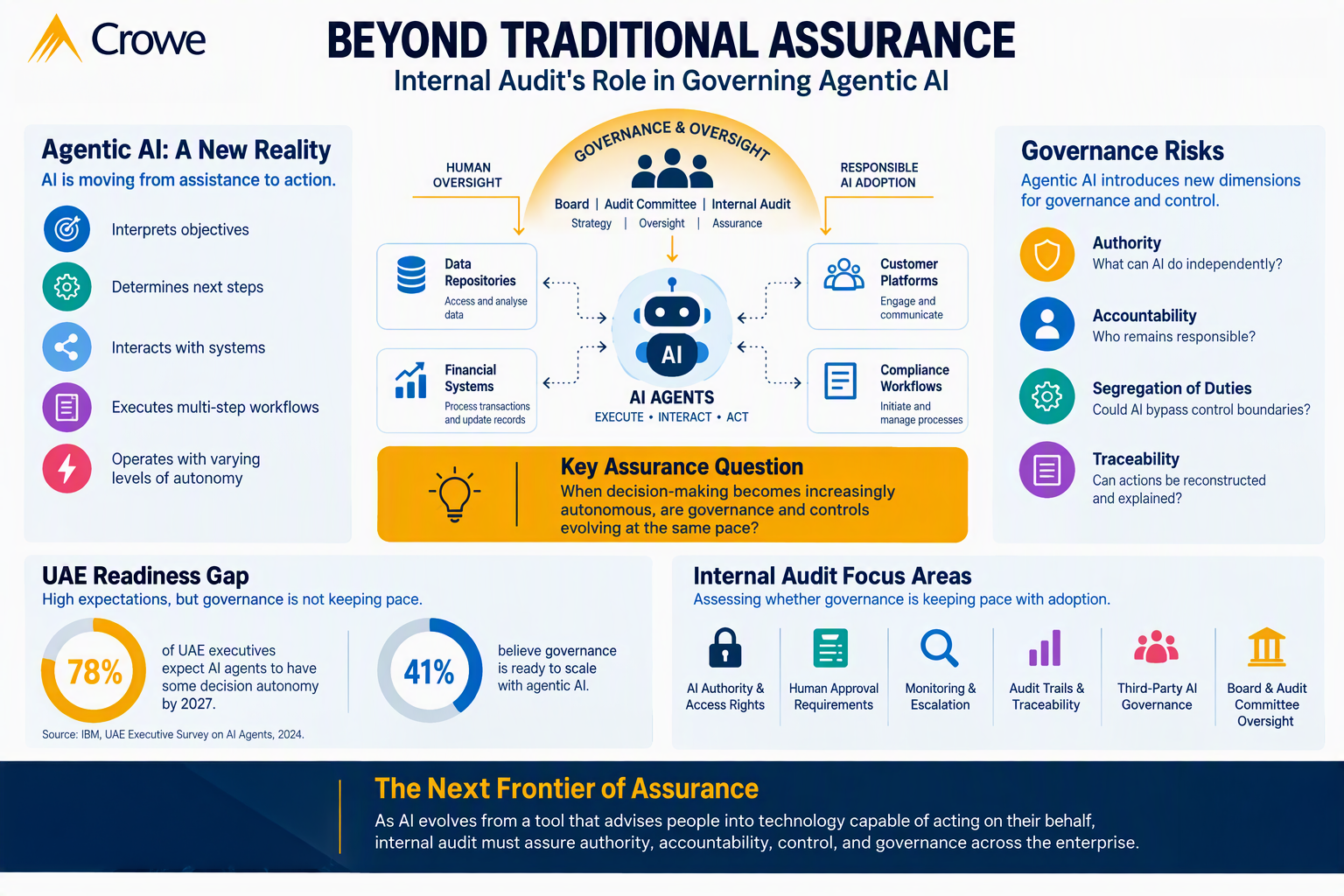
AI agents can potentially interpret objectives, determine a course of action, interact with systems, and execute multi-step activities with varying levels of human intervention. As organizations explore these capabilities, the governance question is no longer simply about how employees use AI. It increasingly extends to what happens when AI itself is authorized to act.
For internal audit, this represents an important shift. Traditional assurance models have largely been built around human accountability, predictable system behaviour, and established approval structures. Agentic AI challenges these assumptions and raises a more fundamental question: when decision-making becomes increasingly autonomous, are governance and controls evolving at the same pace?
When automation becomes autonomy
Automation itself is not new. Organizations have long relied on systems to execute predefined rules and repetitive processes. Agentic AI is different because of the potential degree of discretion it can exercise.
A conventional automated process generally follows an established sequence. An AI agent may have greater flexibility to determine how an objective should be achieved, what information should be considered, and which action should be taken next.
That distinction matters for assurance.
An AI tool that recommends an action for an employee to review presents one level of risk. An AI agent that can communicate externally, update records, initiate workflows, interact with other applications, or execute actions independently presents another.
This shifts the conversation from whether an AI output is accurate to whether the organization has established appropriate boundaries around AI authority and accountability.
The issue is becoming increasingly relevant in the UAE. Recent IBM research found that 78% of UAE executives surveyed expect AI agents to have some level of autonomy over decisions by 2027, yet only 41% believe their governance is designed to scale with agentic AI deployment.
The gap between capability and governance deserves attention.
The control environment must evolve
Many organizations already have controls covering technology access, cybersecurity, data privacy, system changes, and third-party risk. These remain essential, but agentic AI introduces additional dimensions.
Consider access rights. Organizations carefully control what employees, and privileged system accounts can access and execute. An AI agent interacting with enterprise applications should be subject to comparable scrutiny. Its authority should be proportionate to its purpose and restricted to what is necessary.
Segregation of duties may also need to be reconsidered. Controls traditionally prevent one individual from initiating, approving, and completing incompatible activities. If AI agents participate across different stages of a process, organizations need to understand whether those agents could unintentionally bridge control boundaries designed around human roles.
Traceability is equally important. Where an AI-driven action has a financial, regulatory, operational, or customer impact, management should be able to reconstruct what occurred, what information influenced the action, what authority existed, and whether human intervention took place.
Autonomy without traceability creates an assurance gap.
Internal audit should not wait for maturity
Internal audit has an opportunity to engage before agentic AI becomes deeply embedded across the organization.
This does not mean internal audits should own AI governance or design management controls. Those responsibilities remain with management. Internal audit's value lies in independently assessing whether governance arrangements are keeping pace with adoption and whether emerging risks are being recognized early enough.
One challenge may simply be visibility.
AI capabilities can enter organizations through transformation programmes, existing software upgrades, third-party platforms, and initiatives undertaken by individual business functions. An organization may therefore maintain an inventory of approved AI applications without fully understanding the autonomy those applications possess.
Knowing where AI exists is no longer enough.
Organizations increasingly need to understand where AI has the authority to act.
This means looking beyond an AI inventory towards an accountability model that identifies the business owner, purpose, systems and data accessed, actions permitted, human approval requirements, monitoring arrangements, and escalation mechanisms for significant AI use cases.
AI governance is a board-level issue
Agentic AI should ultimately be viewed as more than a technology risk.
Its implications extend to corporate governance, operational resilience, regulatory compliance, financial controls, data governance, third-party risk, and organizational accountability. Responsibility cannot therefore sit solely with technology teams.
Boards and audit committees should have sufficient visibility over material AI use cases and understand where increased autonomy could create significant exposure. Management should be able to explain who remains accountable for an AI-driven action, which decisions require human intervention, how exceptions are identified, and whether an agent's authority can be restricted or withdrawn when necessary.
Third-party AI adds another dimension. As organizations increasingly consume AI capabilities through vendors and enterprise platforms, assurance will depend not only on internal controls but also on how effectively external AI dependencies are understood and governed.
Internal audit is well positioned to connect these areas and provide an independent, enterprise-wide view of whether governance remains coherent as adoption accelerates.
The next frontier of assurance
Agentic AI does not make established internal control principles obsolete. It makes them more important.
Accountability, appropriate authority, segregation of duties, evidence, monitoring, escalation, and independent assurance remain fundamental. What changes is the environment in which those principles must operate.
For UAE organizations pursuing ambitious digital transformation agendas, the opportunity presented by AI is significant. Sustainable adoption, however, will depend on whether governance develops alongside capability.
For internal audit, this is an opportunity to move beyond viewing AI assurance as primarily a technology review and towards a broader assessment of authority, accountability, and control.
As AI evolves from a tool that advises people into technology increasingly capable of acting on their behalf, the defining assurance question will also evolve.
When AI is given the authority to act, can the organization demonstrate that it remains in control?
The author is Partner – Internal Audit & Governance Risk Compliance at Crowe UAE and can be reached at +971 52 373 4662 or [email protected].
GRC Compass
Designed for professionals navigating a dynamic business environment, GRC Compass helps you stay informed, prepared, and ahead of the curve.

