How AI Is Changing Cybersecurity - For Better and Worse
Not long ago, a security team's job was fairly well defined: patch known vulnerabilities, block known malware, and train employees to spot the obvious phishing email with the bad grammar and the suspicious link. That world is gone.
Today, the same tools that power chatbots, coding assistants, and customer service platforms are sitting on both sides of the security fence. Defenders are using AI to work faster. Attackers are using AI to work smarter. Neither side got there by accident - technology simply rewards whoever adapts to it first.
The result isn't a future risk to plan for. It's the environment organizations are already operating in.
AI is neither inherently good nor bad. Its impact depends on who is using it and how effectively it is governed.
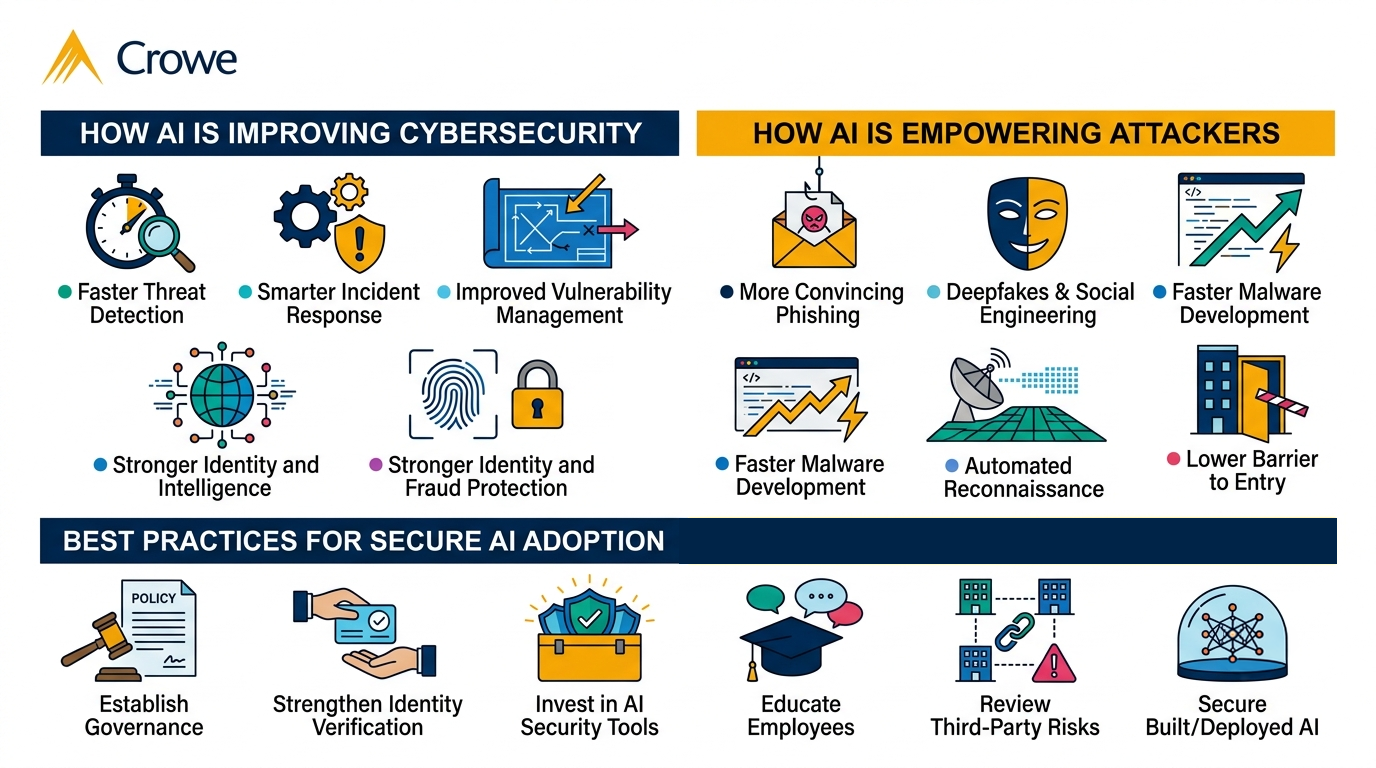
How AI Is Improving Cybersecurity
Faster Threat Detection AI analyzes large volumes of security logs in real time, identifies unusual patterns, detects anomalies rule-based tools may miss, and prioritizes high-risk alerts. This lets Security Operations Centers (SOCs) focus on incidents that truly need attention.
Smarter Incident Response Organizations use AI to correlate alerts across tools, recommend response actions, automatically isolate compromised devices, and generate incident summaries - reducing response time and helping contain attacks before they spread.
Improved Vulnerability Management Rather than treating every vulnerability equally, AI prioritizes based on exploitability, identifies the systems most at risk, and predicts which vulnerabilities attackers are likely to target next.
Enhanced Threat Intelligence AI enables faster analysis of global threat data - identifying emerging attack trends, analyzing malware behavior, and spotting similarities between campaigns before they become incidents.
Stronger Identity and Fraud Protection AI help detect account takeover attempts, flag synthetic identities during onboarding, and identify fraud rings through pattern correlation catching fraud earlier without adding friction for legitimate users.
How AI Is Empowering Attackers
More Convincing Phishing Attacks AI-generated phishing emails use natural language, mimic an organization's writing style, and personalize messages using publicly available information - making them far harder to detect than the poorly written phishing of the past.
Deepfakes and Social Engineering Attackers use AI-generated audio and video to impersonate executives, trick employees into authorizing payments, and bypass identity verification. Organizations can no longer rely solely on voice or video as proof of identity.
Faster Malware Development AI helps attackers modify malicious code to evade detection, automate code generation, and identify weaknesses in target environments - increasing efficiency even though it doesn't replace skilled attackers.
Automated Reconnaissance AI can rapidly analyze company websites, social media, public documents, and technology footprints - allowing attackers to prepare highly targeted campaigns with minimal effort.
A Lower Barrier to Entry Sophisticated attacks once required years of technical experience. AI now let’s less experienced attackers generate working exploit code, get step-by-step guidance, and scale "good enough" attacks that succeed through volume rather than skill.
A New Attack Surface: The AI Systems Themselves
Adopting AI internally introduces a risk category that didn't exist a few years ago - risk to the AI systems themselves. This includes prompt injection targeting AI assistants and agents, data poisoning during training, model theft through repeated querying, and AI agents granted more access than a task actually requires. Securing the AI an organization builds or deploys is becoming as important as using AI to secure everything else.
Why AI Risk Is Growing
Risk is climbing because of widespread tool availability, rapid adoption without governance, growing reliance on automation, limited employee awareness of AI-enabled attacks, and overreliance on AI outputs without human validation. An AI model can misclassify a threat or recommend the wrong action - treating its output as a starting point, not a final answer, is what keeps that risk in check.
Best Practices for Secure AI Adoption
Establish AI Governance - Define acceptable use, assign ownership, and assess risk before deploying AI solutions.
Strengthen Identity Verification - Require MFA and independent verification for high-risk or financial requests.
Invest in AI-Enabled Security Tools - Deploy AI-powered detection, EDR, and SOC integration, and keep tuning models to reduce false positives.
Educate Employees - Train on AI-generated phishing, deepfake awareness, and safe use of generative AI tools.
Review Third-Party AI Risks - Assess vendor security controls, data handling, and AI governance frameworks.
Secure the AI You Build or Deploy - Limit agent permissions, test for prompt injection, and monitor for unusual querying patterns.
The Strategic Question Leaders Should Ask
Organizations should ask:
- Do we have a policy governing the use of AI?
- Are employees trained to recognize AI-enabled threats?
- Are we using AI to strengthen our cybersecurity capabilities?
- Have we assessed the risks of the AI tools, vendors, and systems we rely on?
- Can we detect attacks that leverage AI?
If your organization experienced an AI-assisted cyberattack tomorrow, would you be prepared to identify and respond to it effectively?
Final Thought
AI is reshaping cybersecurity faster than almost any technology before it. For defenders, it offers faster detection, greater efficiency, and improved decision-making. For attackers, it lowers the barrier to entry and enables more convincing, scalable attacks.
The challenge is not whether AI should be used-it already is. The real differentiator is how well organizations govern its use, integrate it into their security strategy, and prepare their people for a new generation of cyber threats.
In the end, AI will not replace cybersecurity professionals. But cybersecurity professionals who understand and effectively use AI will be far better positioned to defend against those who do.
Cyber Shield
Stay ahead of emerging threats, vulnerabilities, and defense strategies with expert insights tailored for today’s digital risk landscape. Because in Cybersecurity, being informed is your first line of defense.
Detect. Defend. Recover.