Data Privacy vs Cybersecurity: Understanding the Difference

Introduction
Data privacy and cybersecurity are often discussed together, and while they share common goals, they are not the same.
Organizations frequently invest in cybersecurity technologies to protect information, but strong security controls alone do not guarantee privacy compliance. Similarly, privacy programs cannot effectively protect personal information without adequate cybersecurity measures.
Understanding the distinction between data privacy and cybersecurity is essential for compliance, legal, and governance teams responsible for managing organizational risk, meeting regulatory obligations, and maintaining stakeholder trust.
What Is Data Privacy?
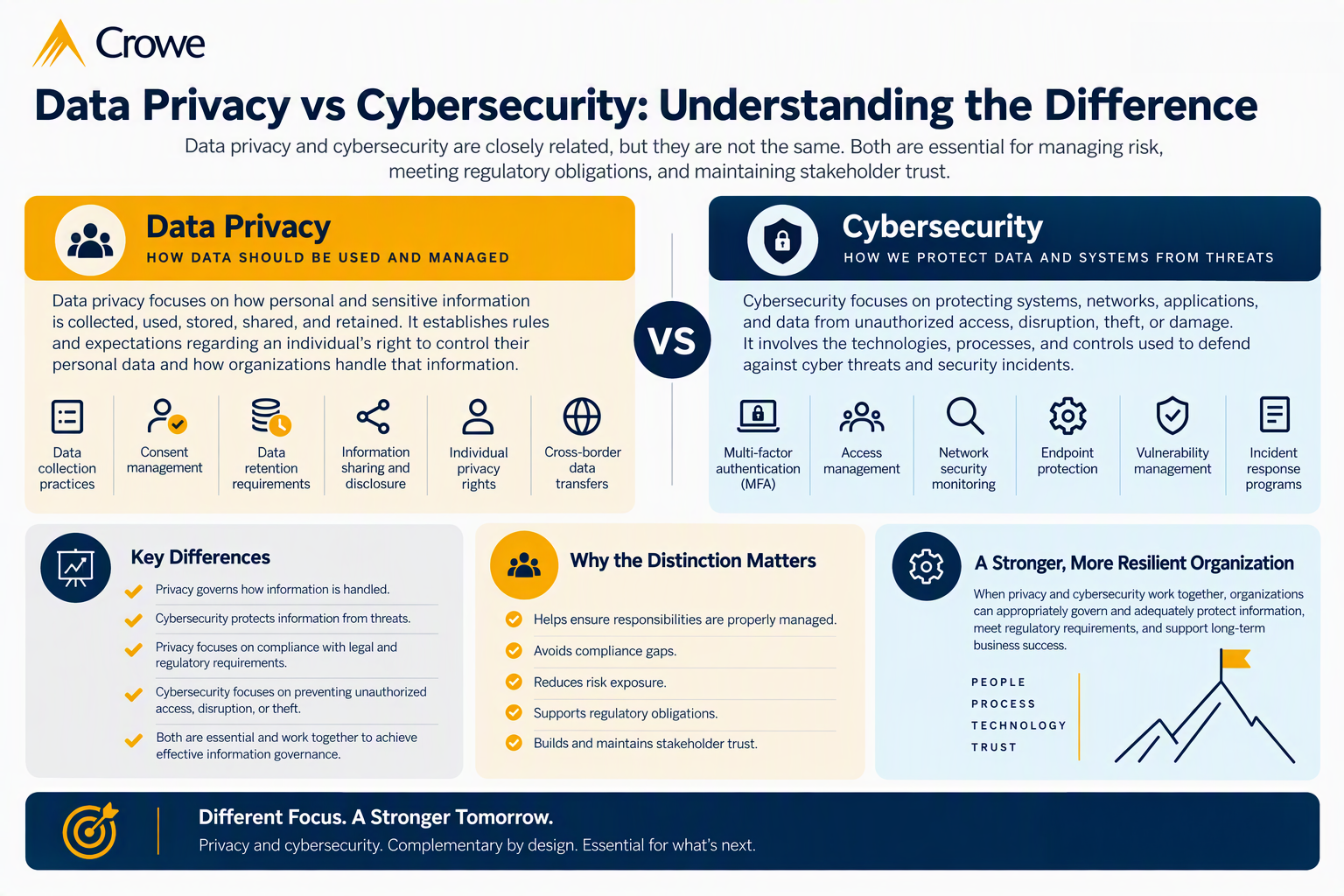
Data privacy focuses on how personal and sensitive information is collected, used, stored, shared, and retained. It establishes rules and expectations regarding an individual's right to control their personal data and how organizations handle that information.
Privacy programs are designed to ensure that personal information is processed lawfully, transparently, and for legitimate business purposes. They also help organizations meet regulatory requirements and maintain public trust.
Key privacy considerations include:
- Data collection practices
- Consent management
- Data retention requirements
- Information sharing and disclosure
- Individual privacy rights
- Cross-border data transfers
At its core, data privacy answers the question:
“How should data be used and managed?”
What Is Cybersecurity?
Cybersecurity focuses on protecting systems, networks, applications, and data from unauthorized access, disruption, theft, or damage. It involves the technologies, processes, and controls used to defend against cyber threats and security incidents.
Cybersecurity programs aim to maintain the confidentiality, integrity, and availability of information while reducing organizational risk.
Examples of cybersecurity controls include:
- Multi-factor authentication (MFA)
- Access management
- Network security monitoring
- Endpoint protection
- Vulnerability management
- Incident response programs
Cybersecurity answers a different question:
“How do we protect data and systems from threats?”
Understanding the Key Differences
Although privacy and cybersecurity are closely related, their objectives differ.
Data privacy focuses on governing how information is handled and ensuring compliance with legal and regulatory requirements. Cybersecurity focuses on protecting information from unauthorized access and cyber threats.
For example, an organization may securely store customer information using strong cybersecurity controls. However, if that information is collected without proper consent or retained longer than necessary, privacy requirements may still be violated.
Likewise, an organization may have clear privacy policies and consent mechanisms, but without strong cybersecurity protections, sensitive information remains vulnerable to compromise.
Both disciplines are essential and must work together to achieve effective information governance.
Why the Distinction Matters
For compliance and legal teams, understanding the difference between privacy and cybersecurity helps ensure responsibilities are properly managed.
Treating cybersecurity as a substitute for privacy can create compliance gaps, while viewing privacy solely as a legal requirement may overlook important security risks.
Organizations that clearly define privacy and cybersecurity responsibilities are better positioned to manage regulatory obligations, reduce risk exposure, and respond to evolving business challenges.
A balanced approach ensures that information is both appropriately governed and adequately protected.
Privacy Regulations and Compliance Requirements
Organizations today operate within an increasingly complex regulatory environment. Privacy regulations establish requirements for how personal information must be handled and protected throughout its lifecycle.
Compliance teams are responsible for ensuring that organizational practices align with applicable legal, contractual, and regulatory obligations. This includes managing requirements related to transparency, consent, data subject rights, retention policies, and breach notification procedures.
Failure to comply with privacy requirements can result in financial penalties, legal consequences, regulatory investigations, and reputational damage.
As data volumes continue to grow, maintaining effective privacy governance becomes increasingly important for long-term business success.
The Role of Security Controls in Privacy Protection
While privacy and cybersecurity serve different purposes, effective privacy programs rely heavily on strong security controls.
Organizations use security measures to protect personal information from unauthorized access, accidental exposure, and malicious activity. Security controls help reduce the likelihood of data breaches and support compliance with privacy obligations.
Examples include:
- Role-based access controls
- Encryption of sensitive information
- Secure data storage practices
- Continuous monitoring and logging
- Regular vulnerability assessments
- Security awareness training
By strengthening cybersecurity capabilities, organizations can better support privacy objectives and reduce overall risk.
Governance: Bridging Privacy and Security
Governance plays a critical role in aligning privacy and cybersecurity efforts across the organization.
Effective governance ensures that policies, roles, responsibilities, and decision-making processes support both regulatory compliance and information protection.
Strong governance practices help organizations:
- Define accountability for privacy and security initiatives
- Establish consistent policies and procedures
- Monitor compliance obligations
- Manage risks effectively
- Improve collaboration between legal, compliance, security, and business teams
When governance is properly implemented, privacy and cybersecurity become complementary functions rather than separate initiatives.
Building a Balanced Approach
Organizations often face challenges when attempting to balance business objectives, privacy expectations, and security requirements.
Excessive data collection can increase privacy risks, while insufficient security controls can expose sensitive information to threats.
A balanced approach requires organizations to:
- Collect only necessary information
- Apply appropriate security controls
- Regularly assess risks
- Review governance processes
- Continuously monitor compliance requirements
This approach helps organizations protect information while maintaining trust with customers, employees, regulators, and business partners.
Conclusion
Data privacy and cybersecurity are closely connected but serve distinct purposes.
Privacy focuses on how information is collected, used, and governed, while cybersecurity focuses on protecting information and systems from threats.
Organizations that understand this distinction are better equipped to meet regulatory obligations, strengthen governance practices, and reduce overall risk.
For compliance and legal teams, success depends on treating privacy and cybersecurity as complementary components of a broader information governance strategy.
Author is Director, Cyber Threat Management at Crowe UAE and can be reached at [email protected] or call +971 52 373 4662
Cyber Shield
Stay ahead of emerging threats, vulnerabilities, and defense strategies with expert insights tailored for today’s digital risk landscape. Because in Cybersecurity, being informed is your first line of defense.
Detect. Defend. Recove