
Cybersecurity is changing faster than most organizations can adapt.
Artificial intelligence is reshaping both attack and defence. Regulatory expectations are increasing. Security operations are becoming more automated, while organizations are more dependent than ever on cloud platforms, vendors, digital services, and interconnected supply chains.
For business leaders, the question is no longer simply how to prevent the next cyberattack. It is whether the organization can anticipate changing risks, respond effectively, and continue operating when disruption occurs.
Over the next five years, several trends are likely to reshape how organizations manage cyber risk. While predicting individual threats is impossible, understanding these broader shifts can help leaders make better investment decisions and build security programs that are prepared to adapt.
1. AI Will Become Both a Defence Tool and a Threat
Artificial intelligence is already changing cybersecurity, but its influence is likely to increase significantly.
Security teams will increasingly use AI to analyze large volumes of data, identify suspicious behaviour, automate investigations, prioritize alerts, and accelerate incident response. Used effectively, these capabilities can help teams identify threats faster while reducing the burden of repetitive security tasks.
But attackers have access to the same technological advances.
AI can make phishing campaigns more convincing, automate reconnaissance, support sophisticated social engineering, and allow malicious activity to operate at greater scale.
The challenge will not simply be adopting AI. Organizations will need to establish how AI can be used securely and responsibly while preparing for threats that increasingly use the same technology against them.
2. Cybersecurity Regulation Will Continue to Expand
Governments and regulators worldwide are placing greater emphasis on cybersecurity, privacy, and digital resilience.
As cyber incidents affect businesses, customers, and critical infrastructure, organizations can expect greater scrutiny of how cyber risks are governed and reported.
Future requirements are likely to place increasing emphasis on:
- Incident reporting and disclosure
- Third-party and supply chain risk
- Data protection
- Critical infrastructure security
- Cyber resilience and recovery
- Executive and board accountability
For leaders, this means cybersecurity will increasingly be a governance responsibility rather than solely an IT concern.
Organizations that strengthen governance and compliance before new requirements take effect will generally be better positioned than those responding only when regulation demands it.
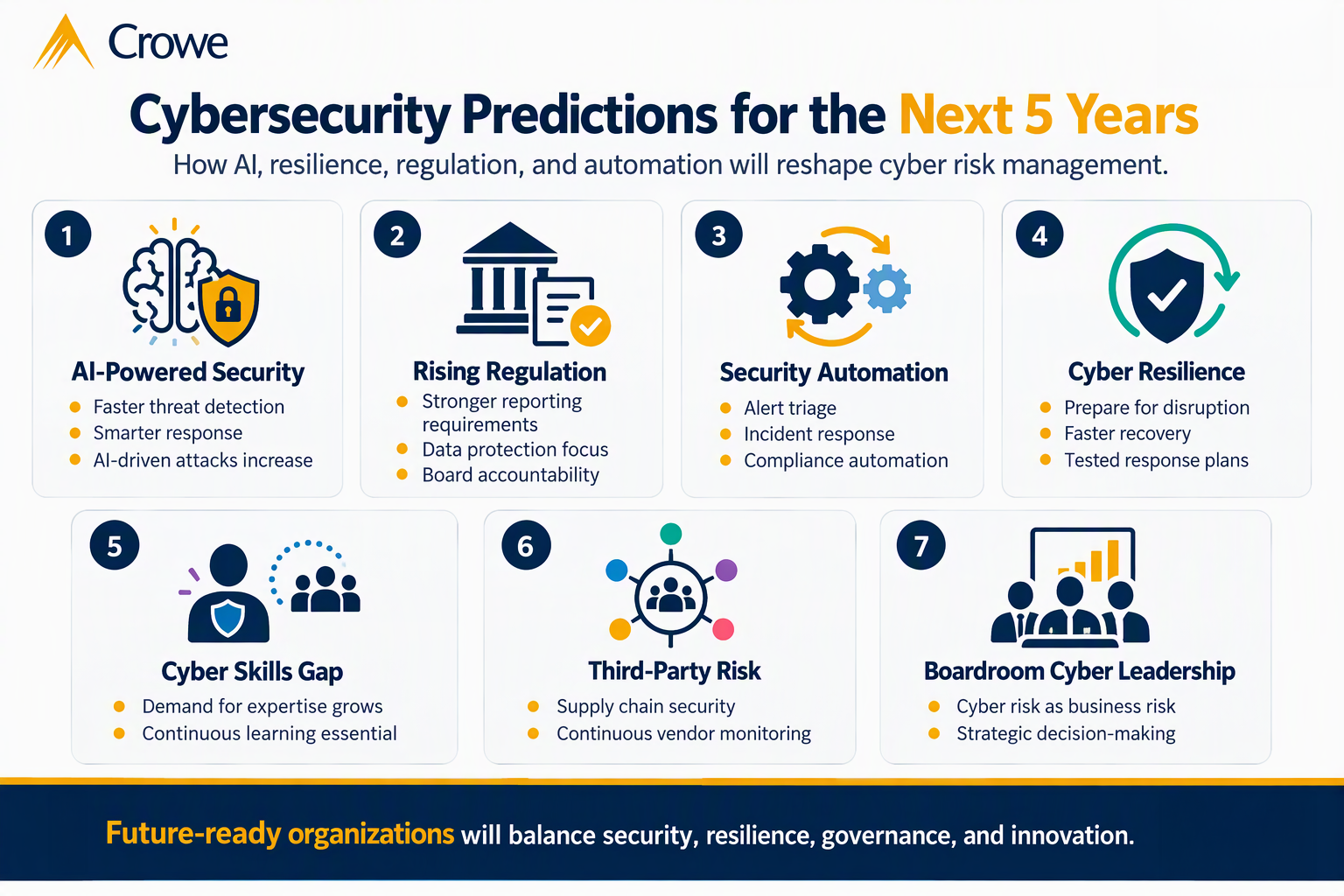
3. Automation Will Become Essential
The volume of alerts, vulnerabilities, security data, and emerging threats continues to grow. Managing all of this manually is becoming increasingly difficult.
Over the next five years, automation is likely to become a core component of mature cybersecurity programs.
Organizations will increasingly automate areas such as alert triage, threat intelligence processing, vulnerability prioritization, incident response workflows, and compliance reporting.
The objective is not to remove people from cybersecurity. It is to allow security professionals to spend less time on repetitive tasks and more time on investigations, risk analysis, and strategic decision-making.
Human judgement will remain critical, particularly when incidents involve uncertainty, business impact, or complex decisions.
4. Cyber Resilience Will Become as Important as Prevention
For years, cybersecurity strategies have focused heavily on preventing attacks.
That remains essential, but no organization can reasonably assume every attack will be prevented.
The conversation is therefore shifting towards resilience.
Leaders will increasingly need to ask:
- Can critical operations continue during a cyber incident?
- How quickly can essential systems be restored?
- Are recovery priorities clearly defined?
- Have incident response and recovery plans actually been tested?
- How much disruption can the business tolerate?
This will place greater emphasis on incident response, business continuity, disaster recovery, crisis management, and resilience testing.
The organizations best prepared for future cyber risk may not be those that believe they can prevent every incident, but those that know how to respond and recover when prevention fails.
5. The Cybersecurity Skills Gap Will Continue
Technology may become more capable, but skilled cybersecurity professionals will remain essential.
As security roles evolve, organizations will require expertise across cloud security, AI, threat intelligence, risk management, governance, compliance, and security operations.
The challenge will extend beyond recruitment. Organizations will also need to develop existing employees as technologies, threats, and regulatory expectations change.
Investing in training, continuous learning, and workforce development will become increasingly important. Automation can increase efficiency, but it cannot replace the judgement and business understanding required for complex cyber risk decisions.
6. Third-Party Risk Will Receive Greater Attention
Few organizations operate independently.
Cloud providers, technology vendors, outsourced services, business partners, and other third parties are deeply integrated into modern operations. Each relationship can create efficiencies, but it can also introduce additional risk.
Organizations are likely to place greater emphasis on vendor security assessments, supply chain security, contractual requirements, continuous monitoring, and ongoing risk evaluation.
The key shift will be from assessing third parties once to understanding how their risk changes over time.
An organization's security is increasingly influenced by the resilience of the wider ecosystem it depends on.
7. Cybersecurity Will Become a Boardroom Priority
Cybersecurity has already moved beyond the IT department. Over the next five years, that shift is likely to become even more pronounced.
Boards and executive teams will increasingly be expected to understand cyber risk exposure, incident readiness, regulatory obligations, security investments, and organizational resilience.
This creates an important challenge for cybersecurity leaders.
Technical metrics alone are not enough. Security teams will need to communicate risk in terms leadership can use to make decisions, including operational impact, financial exposure, regulatory consequences, and business priorities.
The Strategic Questions Leaders Should Ask
Organizations preparing for the next five years should consider:
- Are we using AI in a way that is both secure and governed?
- Can our security operations scale as threats and data volumes increase?
- Are we preparing for regulatory change or simply reacting to it?
- Can critical operations continue during a major cyber incident?
- Are we developing the skills our security teams will need in the future?
- Do we understand the cyber risks introduced by critical third parties?
- Does the board have the information it needs to make informed cyber risk decisions?
Final Thought
The next five years will bring new technologies, new threats, and new regulatory expectations. But effective cybersecurity will not depend on predicting every change correctly.
It will depend on adaptability.
Organizations that strengthen governance, develop their people, use automation responsibly, understand third-party dependencies, and build resilience into their operations will be better positioned to manage whatever comes next.
The future of cybersecurity is not simply about preventing the next attack. It is about building an organization capable of responding, recovering, and adapting when the threat landscape changes.
The author is Director, Cyber Threat Management at Crowe UAE and can be reached at [email protected] or +971 52 373 4662.
Cyber Shield
Stay ahead of emerging threats, vulnerabilities, and defense strategies with expert insights tailored for today’s digital risk landscape. Because in Cybersecurity, being informed is your first line of defense.
Detect. Defend. Recover.