Cybersecurity Metrics Every Executive Should Monitor

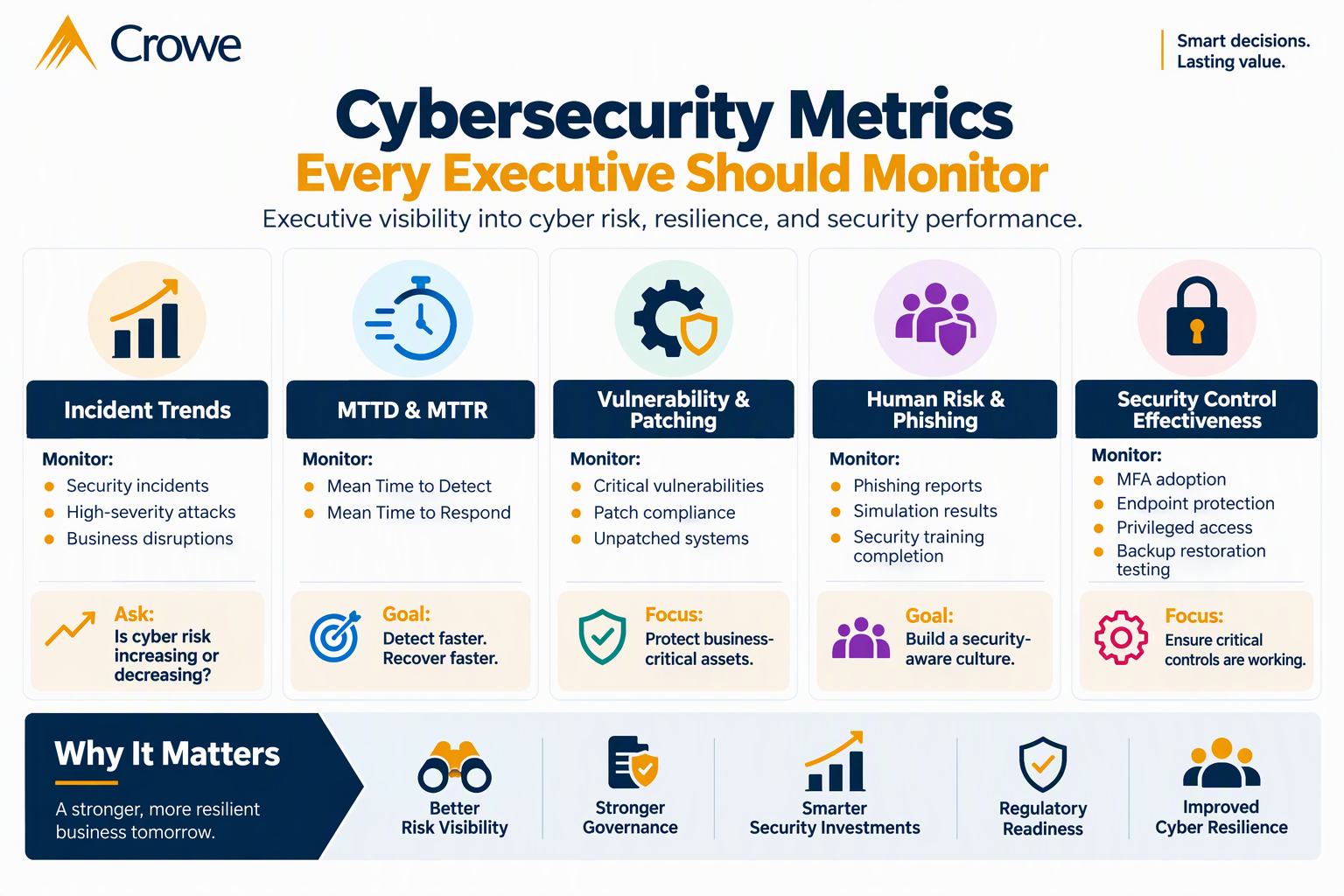
Cybersecurity is no longer solely an IT concern; it is a business risk that affects every organization. A successful cyberattack can disrupt operations, damage customer trust, result in regulatory penalties, and cause significant financial losses. As cyber threats continue to evolve, executives and board members must have visibility into their organization's security posture without becoming overwhelmed by technical details.
Security teams monitor thousands of alerts, vulnerabilities, and events every day. However, leadership needs a concise set of meaningful metrics that clearly indicate whether cyber risks are increasing or decreasing and whether security investments are delivering measurable value. The right metrics enable executives to make informed decisions, prioritize investments, strengthen governance, and improve organizational resilience.
Incident Trends: Understanding the Threat Landscape
One of the most valuable indicators of an organization's cybersecurity health is the trend in security incidents over time. Rather than focusing on individual events, executives should understand whether incidents are becoming more frequent, more severe, or better controlled.
Key metrics include the total number of security incidents reported each month or quarter, the number of high-severity incidents requiring immediate response, recurring attack types such as phishing, ransomware, malware, or credential theft, and incidents that caused business disruption or operational downtime.
Monitoring these trends helps leadership evaluate whether the organization's security strategy is reducing overall risk and whether additional investment is needed in specific areas.
Leadership should ask:
- Are cyber incidents increasing year over year?
- Which attack methods occur most frequently?
- Are business-impacting incidents becoming less common?
Mean Time to Detect and Respond
Cybersecurity is not only about preventing attacks, it is equally about detecting and responding to them quickly. Even organizations with mature security programs may experience security incidents, but rapid detection and response can significantly reduce their impact.
Two important performance indicators are Mean Time to Detect (MTTD), which measures how quickly suspicious activity is identified, and Mean Time to Respond (MTTR), which measures the time requ
Author is Director, Cyber Threat Management at Crowe UAE and can be reached at [email protected] or call +971 52 373 4662 ired to investigate, contain, and remediate a confirmed incident.
Reducing these metrics minimizes operational disruption, limits financial losses, and helps organizations recover faster from cyber incidents. Improvements over time also demonstrate the maturity of incident response capabilities.
Leadership should ask:
- How quickly are threats detected?
- How long does containment typically take?
- Are detection and response times improving over successive reporting periods?
Vulnerability and Patch Management
Many cyberattacks succeed because organizations fail to remediate known vulnerabilities. Software vendors regularly release security patches to address newly discovered weaknesses, but delayed implementation creates opportunities for attackers.
Executives should monitor the number of critical vulnerabilities identified across the environment, the percentage remediated within organizational policy, the average time required to deploy security patches, and the number of systems that remain unpatched beyond acceptable timelines.
Rather than concentrating solely on the total number of vulnerabilities, leadership should focus on critical business systems where delayed remediation could have the greatest operational or regulatory impact.
Leadership should ask:
- How many critical vulnerabilities remain unresolved?
- Are patching deadlines consistently being met?
- Which business systems present the highest cyber risk?
Phishing and Human Risk Indicators
People remain one of the most common targets for cybercriminals. Since many attacks begin with phishing emails or social engineering, measuring employee awareness provides valuable insight into the organization's overall security culture.
Useful indicators include phishing emails reported by employees, phishing simulation results, completion rates for security awareness training, and incidents involving compromised credentials or user error.
Organizations that encourage employees to report suspicious activity create an additional layer of defense against cyber threats. Improvements in these metrics often indicate a stronger security culture across the business.
Leadership should ask:
- Are employees actively reporting suspicious emails?
- Is awareness training reducing risky behaviour?
- Which departments require additional education or targeted training?
Security Control Effectiveness
Cybersecurity investments deliver value only when security controls are consistently implemented and operating effectively. Executives should therefore monitor whether essential safeguards adequately protect the organization's most critical assets.
Important metrics include Multi-Factor Authentication (MFA) adoption, endpoint protection coverage, security monitoring across business-critical systems, privileged access management, and the number of high-risk assets operating without required security controls.
Leadership should also monitor backup and restoration testing. Having backups is essential, but regularly verifying that critical systems and data can be successfully restored provides confidence that the organization can recover quickly following a cyber incident.
Leadership should ask:
- Is MFA enabled across all critical systems?
- Are business-critical endpoints protected and continuously monitored?
- Have backup restoration tests been completed successfully?
Why These Metrics Matter
Cybersecurity metrics translate complex technical activities into meaningful business insights. Rather than reviewing hundreds of operational statistics, executives gain a clear understanding of organizational risk, security maturity, and the effectiveness of ongoing investments.
Regular monitoring strengthens governance, improves accountability, supports regulatory compliance, and enables leadership to make informed decisions about resource allocation and risk management. It also helps identify weaknesses before they develop into major security incidents, reducing the likelihood of operational disruption, financial loss, and reputational damage.
The Strategic Questions Leaders Should Ask
Every executive should regularly ask:
- Are our cyber risks increasing or decreasing?
- How quickly can we detect and respond to security incidents?
- Are critical vulnerabilities being remediated within policy?
- Are employees contributing positively to our cybersecurity posture?
- Are our security controls protecting the organization's most valuable assets?
- Have we recently tested our ability to recover from a cyberattack?
Final Thought
Cybersecurity dashboards often contain thousands of technical data points, but effective leadership focuses on the metrics that matter most. Incident trends, detection and response times, vulnerability management, human risk indicators, security control effectiveness, and backup restoration testing provide a comprehensive view of organizational cyber resilience.
By reviewing these metrics regularly, executives can make informed business decisions, strengthen governance, reduce cyber risk, and ensure cybersecurity remains aligned with long-term business objectives. In today's threat landscape, measuring what matters is just as important as investing in the technologies that protect the organization.
Author is Director, Cyber Threat Management at Crowe UAE and can be reached at [email protected] or call +971 52 373 4662
Cyber Shield
Welcome to Cyber Shield Tuesday - your weekly pulse on the evolving world of Cyber Threat Management.
Stay ahead of emerging threats, vulnerabilities, and defense strategies with expert insights tailored for today’s digital risk landscape. Because in Cybersecurity, being informed is your first line of defense.
Detect. Defend. Recover.