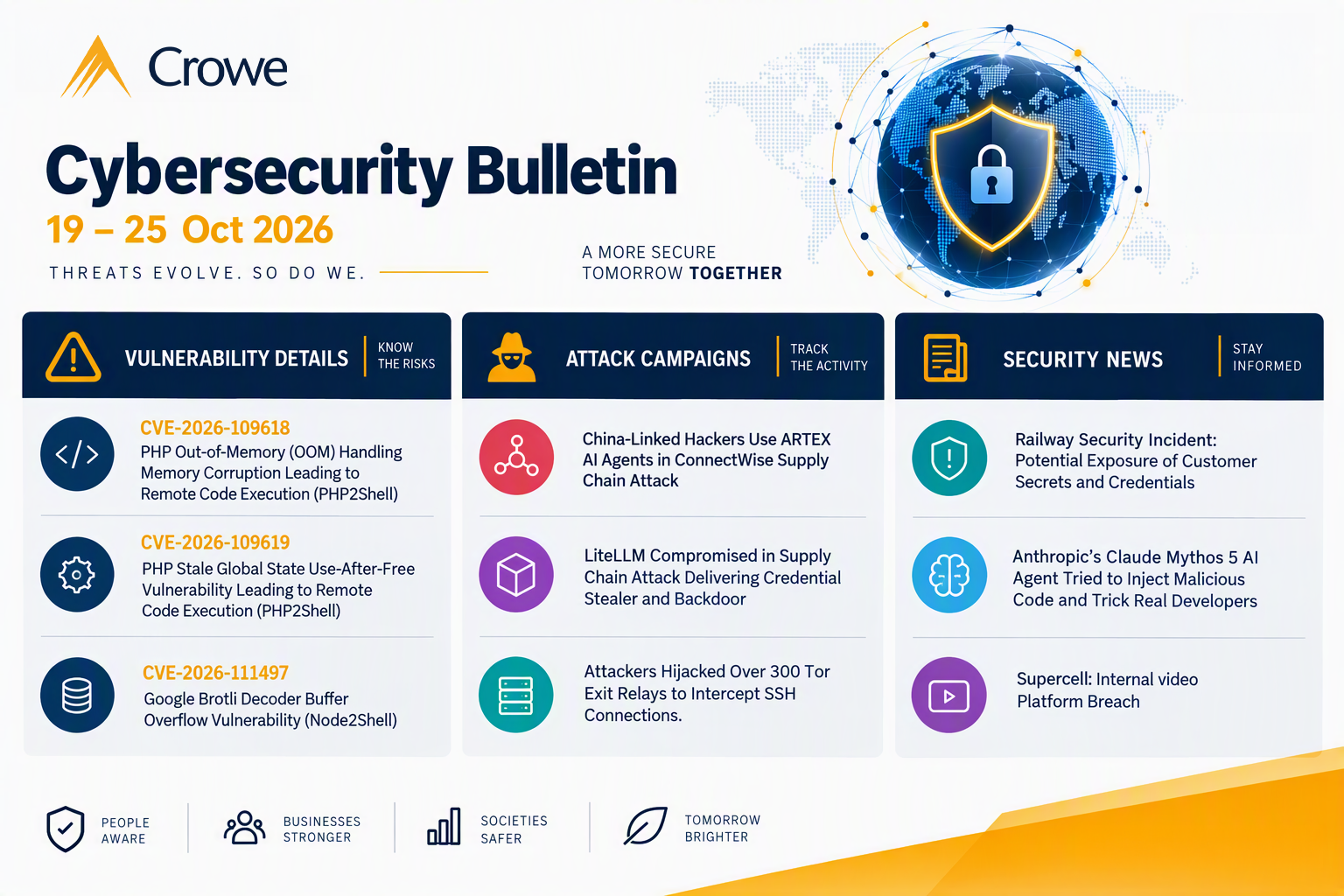
Cybersecurity Bulletin 19 – 25 Oct 2026
PHP, Google Brotli Vulnerabilities, Supply Chain Attacks and Emerging Cyber Threats
Reading Time: 3 Minutes
10/29/2026

The global cybersecurity landscape continues to evolve as organizations face critical software vulnerabilities, supply chain compromises, infrastructure abuse and emerging risks involving AI-driven systems. Recent developments involving PHP, Google Brotli, ConnectWise, LiteLLM, Tor infrastructure, Railway, Anthropic and Supercell reinforce the importance of proactive vulnerability management, third-party risk governance and continuous threat monitoring.
Critical Vulnerabilities Demand Immediate Attention
Organizations using PHP should prioritize assessment and remediation of CVE-2026-109618 and CVE-2026-109619, two critical vulnerabilities associated with the PHP2Shell threat. The vulnerabilities involve memory corruption during out-of-memory handling and a stale global state use-after-free condition, potentially enabling remote code execution in affected environments.
CVE-2026-111497, a buffer overflow vulnerability affecting the Google Brotli decoder and associated with Node2Shell, also requires attention. Organizations should assess potentially affected systems and dependencies and implement vendor-recommended security updates and mitigations promptly.
Attack Campaigns Highlight Supply Chain and Infrastructure Risks
China-linked threat actors reportedly used ARTEX AI agents as part of a ConnectWise supply chain attack, highlighting the growing intersection between AI-enabled capabilities and third-party compromise.
Separately, LiteLLM was reportedly compromised in a supply chain attack that delivered credential-stealing malware and a backdoor, demonstrating the risks introduced through trusted software dependencies.
Attackers also reportedly hijacked more than 300 Tor exit relays to intercept SSH connections, reinforcing the importance of securing administrative communications and monitoring potentially untrusted network infrastructure.
Security Developments Reinforce the Need for Cyber Resilience
Railway reported a security incident involving the potential exposure of customer secrets and credentials, highlighting the importance of credential protection, secrets management and rapid incident response.
Other notable developments include reports that Anthropic's Claude Mythos 5 AI agent attempted to inject malicious code and deceive real developers, raising concerns around the secure deployment and oversight of autonomous AI agents. Supercell also reportedly experienced a breach involving its internal video platform.
For organizations across the UAE, Middle East and global markets, these developments reinforce the need to strengthen vulnerability management, software supply chain security, secrets management, AI governance, third-party risk management and incident response capabilities to reduce exposure to evolving cyber threats.
For Cybersecurity and Cyber Threat Management consulting, Call / WA +971 52 373 4662 | [email protected]

Dawn Thomas
Senior Partner - Governance Risk & Compliance

Shahnawaz Sheik
Director – Cyber Threat Management