When Controls Look Effective but Culture Says Otherwise
Culture Risk & Internal Audit

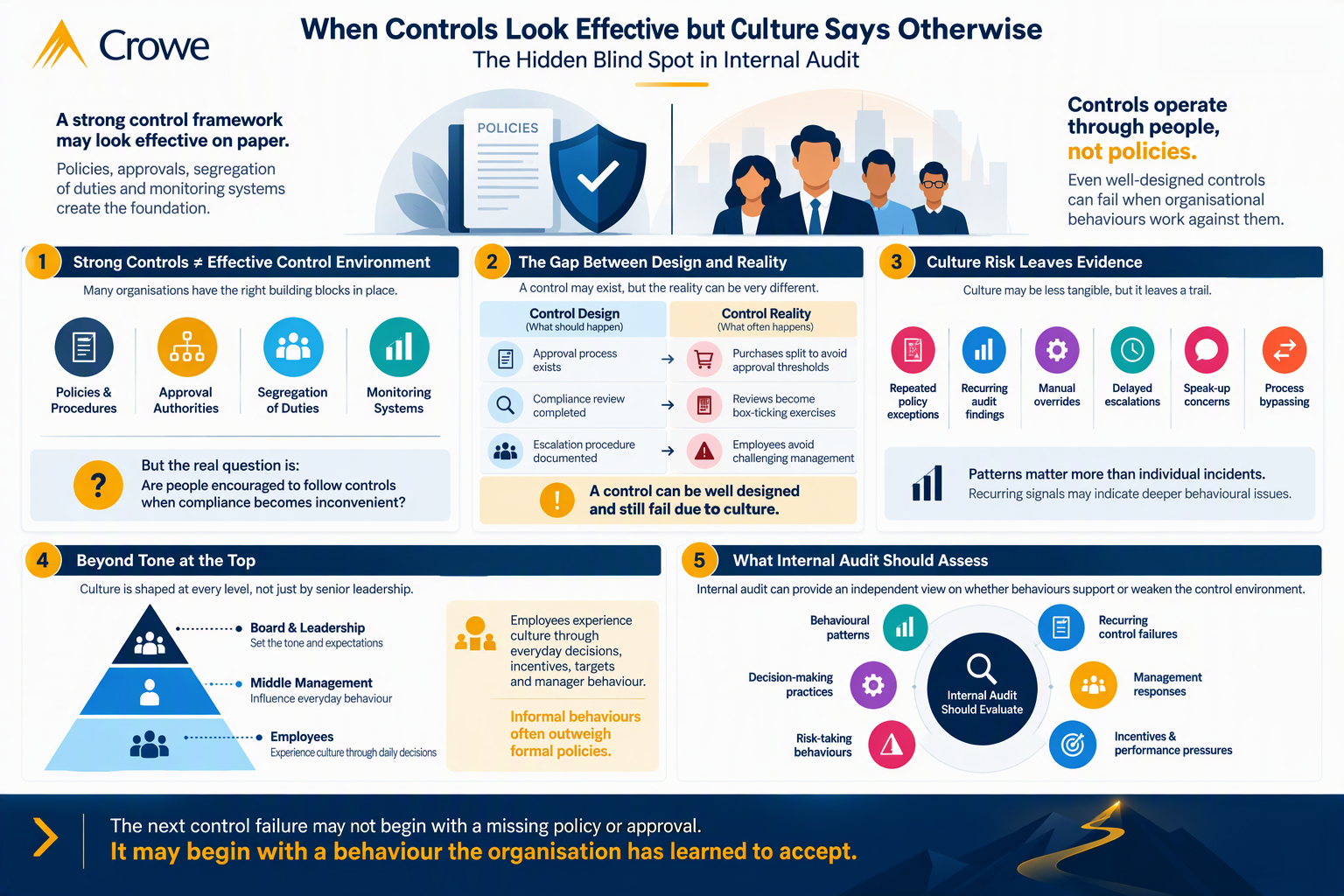
An organisation can have comprehensive policies, clearly defined approval authorities, segregation of duties, compliance procedures, and sophisticated monitoring systems. On paper, the control environment may appear strong.
Yet controls do not operate on paper. They operate through people.
Employees decide whether to challenge an unusual transaction, escalate a concern, follow an approval process, or find a way around it. Managers influence whether exceptions remain exceptional or gradually become accepted practice. Leadership behaviour shapes whether controls are viewed as safeguards or as obstacles to achieving business targets.
This creates an important consideration for internal audit. Assessing whether a control exists and operates as designed may not always reveal whether the culture surrounding that control supports its intended purpose.
A control can be well designed and still fail when organisational behaviour works against it.
The difference between control design and control reality
Traditional control assessments provide valuable assurance over whether appropriate processes and safeguards have been established. Internal audit may examine approval evidence, access rights, reconciliations, documentation, system configurations, and compliance with established procedures.
These tests remain fundamental. But they may not always capture what happens when employees face commercial pressure, deadlines become difficult, senior individuals request exceptions, or following the prescribed process is perceived to slow the business down.
A procurement approval may technically operate while employees divide purchases to remain below approval thresholds. A compliance review may be completed but treated primarily as a documentation requirement. An escalation procedure may exist while employees hesitate to use it because challenging a senior colleague is perceived to carry consequences.
In each case, the documented control exists. The underlying behaviour tells a different story.
The real question is therefore not only whether people can comply with a control, but whether the organisation encourages them to do so when compliance becomes inconvenient.
Culture risk often leaves a trail
Culture can appear difficult to audit because it is less tangible than a transaction, system configuration, or policy.
But culture leaves evidence.
Repeated policy exceptions, unusual approval patterns, recurring audit findings, excessive manual overrides, delayed escalation of incidents, unresolved speak-up themes, and repeated attempts to bypass established processes can all provide signals.
Individually, these indicators may have reasonable explanations. Collectively, they may reveal something more significant about how an organisation actually manages risk.
This is where internal audit can add value by looking beyond isolated exceptions and identifying behavioural patterns.
A recurring control failure may not always require another control. It may require understanding why the existing control continues to be circumvented.
Tone at the top is not the whole story
Boards and senior executives rightly place considerable emphasis on tone at the top. Leadership commitment to ethics, compliance, and effective control is essential.
However, employees experience organisational culture much closer to where work happens.
The behaviour of line managers, department heads, and project leaders can significantly influence whether controls operate effectively in practice.
Senior leadership may communicate a strong message about integrity and accountability while employees receive a different message through performance targets, incentives, deadlines, or local management behaviour.
If employees are told that compliance is important but consistently observe that results are rewarded regardless of how they are achieved, the informal message can become more powerful than the formal one.
For internal audit, this means evaluating culture should extend beyond reviewing board-approved policies and leadership communications. A more revealing question is whether the organisation's stated values are reflected consistently in everyday decisions.
Connecting behaviour with risk
Internal audit should not become the owner of organisational culture. Culture is shaped collectively by the board, executive leadership, management, human resources, and employees.
Internal audit can, however, provide an independent perspective on whether behaviours are supporting or weakening the control environment.
This may require looking differently at information the function already possesses.
Audit findings can be analysed for recurring behavioural themes rather than viewed only as individual control deficiencies. Management action plans can reveal whether underlying causes are being addressed or whether similar issues repeatedly return in different forms. Interviews and walkthroughs can explore how decisions are actually made, not simply how procedures state they should be made.
Internal audit can also consider whether incentive structures, performance expectations, and management practices unintentionally encourage excessive risk taking or control circumvention.
The objective is not to assign a score to culture. It is to understand whether behaviour creates risks that conventional control testing may overlook.
A different conversation for audit committees
For boards and audit committees, culture risk deserves attention because significant failures rarely emerge from control design alone.
When major compliance, fraud, conduct, or governance issues occur, organisations may discover that warning signs existed earlier. Concerns were known but not escalated. Exceptions became normal. Challenge was discouraged. Targets took precedence over process.
Audit committees should therefore look beyond the number of control deficiencies reported.
They should consider whether recurring findings indicate deeper behavioural issues, whether management responds constructively to challenge, whether employees can raise concerns confidently, and whether the organisation learns from incidents rather than simply closing corrective actions.
This provides a more meaningful perspective on control effectiveness than a dashboard showing that policies exist and actions have been completed.
Looking beyond the control
For UAE organisations operating in increasingly complex, regulated, and fast-moving markets, strong governance depends on more than documented frameworks.
Policies establish expectations. Controls create boundaries. Systems provide monitoring. But organisational behaviour ultimately determines how those mechanisms perform when tested by pressure, competing priorities, and individual judgement.
This creates an important opportunity for internal audit.
The function can move beyond asking whether controls are appropriately designed and operating effectively, and consider whether the behaviours surrounding those controls reinforce or undermine them.
Sometimes the most important control weakness will not appear in a process map, policy document, or testing sample.
The next control failure may not begin with a missing policy or approval. It may begin with a behaviour the organisation has learned to accept.
The author is Partner – Internal Audit & Governance Risk Compliance at Crowe UAE and can be reached at +971 52 373 4662 or [email protected].
GRC Compass
Designed for professionals navigating a dynamic business environment, GRC Compass helps you stay informed, prepared, and ahead of the curve.