Cybersecurity Bulletin 5–11 Oct 2026
Cisco NX-OS RCE, Android Privilege Escalation and Emerging Cyber Threats
Reading Time: 3 Minutes
10/13/2026

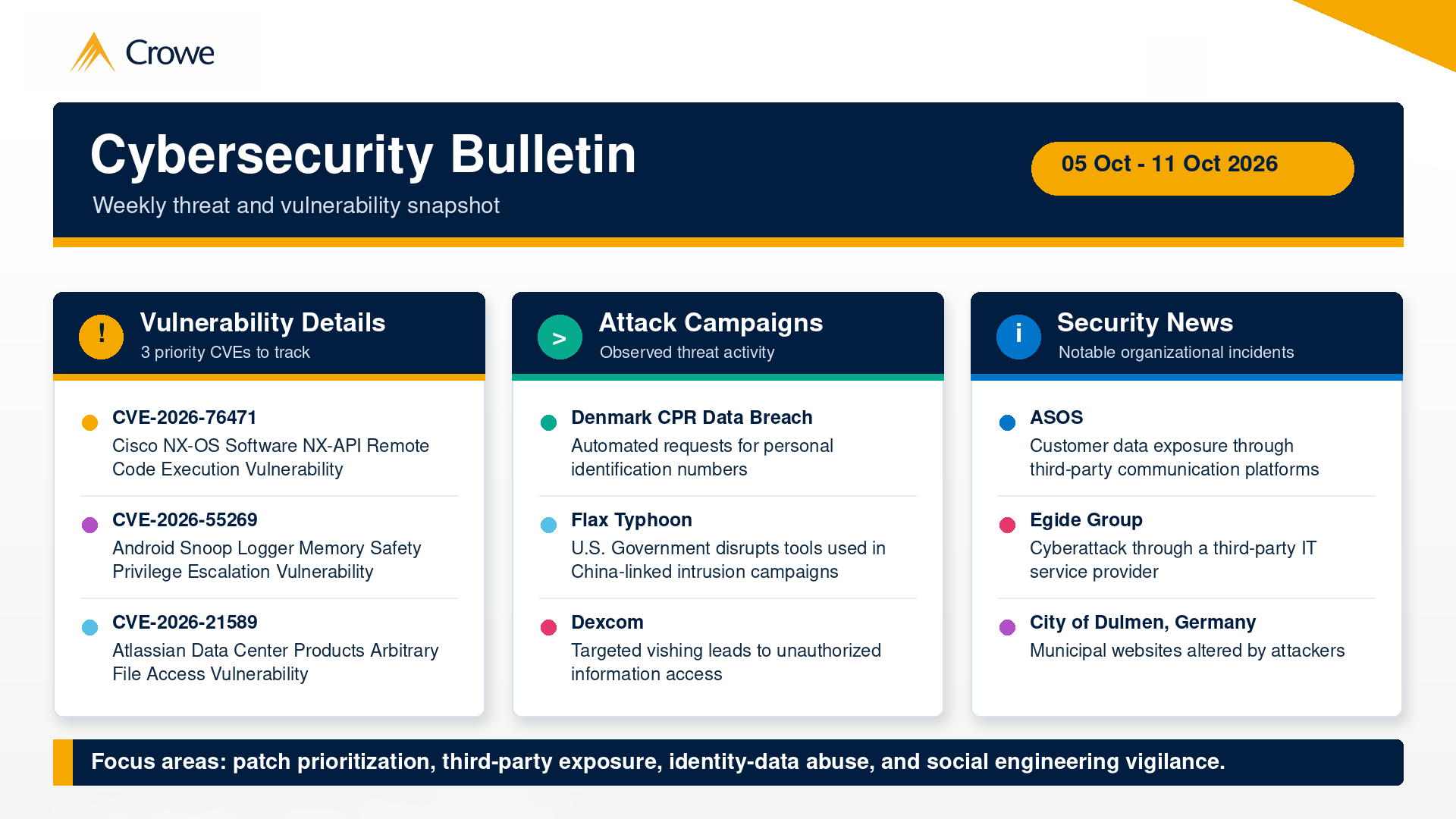
The global cybersecurity landscape continues to evolve as organizations face critical infrastructure vulnerabilities, sophisticated cyber espionage campaigns and third-party security incidents. Recent developments involving Cisco NX-OS, Android, Atlassian Data Center products, Flax Typhoon, Denmark's Central Person Register (CPR), Dexcom, ASOS, Egide Group and the City of Dülmen highlight the importance of proactive vulnerability management, identity protection, supply chain security and continuous threat monitoring.
Critical Vulnerabilities Demand Immediate Attention
Organizations using Cisco networking infrastructure should prioritize remediation of CVE-2026-76471, a critical Cisco NX-OS Software NX-API Remote Code Execution (RCE) vulnerability that could allow attackers to execute arbitrary commands on affected systems.
Android users and enterprises should also address CVE-2026-55269, a memory safety privilege escalation vulnerability affecting the Android Snoop Logger component. Successful exploitation could enable attackers to gain elevated privileges, increasing the risk of device compromise.
Additionally, CVE-2026-21589 impacts Atlassian Data Center products, allowing arbitrary file access that could expose sensitive information. Organizations relying on Atlassian environments should implement vendor-recommended security updates and mitigations without delay.
Attack Campaigns Highlight Identity, Espionage and Social Engineering Risks
Denmark's Central Person Register (CPR) experienced automated requests targeting personal identification numbers, raising concerns over identity theft and misuse of sensitive citizen information.
Meanwhile, U.S. authorities disrupted infrastructure associated with Flax Typhoon, a China-linked cyber espionage group known for targeting critical infrastructure and government organizations, reinforcing the ongoing threat posed by advanced persistent threat (APT) actors.
Healthcare technology provider Dexcom also disclosed unauthorized information access following a targeted vishing (voice phishing) campaign, demonstrating how attackers continue to exploit human trust to bypass traditional security controls.
Security Incidents Reinforce Third-Party Risk Management
Fashion retailer ASOS reported customer data exposure involving third-party communication platforms, highlighting the security challenges associated with external service providers.
Similarly, Egide Group experienced a cyberattack through a third-party IT service provider, further emphasizing the importance of vendor risk management and supply chain security.
In Germany, the City of Dülmen reported unauthorized alterations to municipal websites following a cyberattack, illustrating the persistent targeting of public sector organizations.
For organizations across the UAE, the Middle East and global markets, these developments reinforce the need to strengthen vulnerability management, timely patching, employee security awareness, third-party risk governance, endpoint monitoring and incident response capabilities to reduce exposure to evolving cyber threats.
For Cybersecurity and Cyber Threat Management consulting,
Call / WA +971 52 373 4662 | [email protected]

Dawn Thomas
Senior Partner - Governance Risk & Compliance

Shahnawaz Sheik
Director – Cyber Threat Management