Cybersecurity Bulletin
Critical Chrome Vulnerabilities, Ransomware Disruption and Emerging Phishing Threats 28 Sep – 04 Oct 2026
Reading Time: 3 Minutes
10/7/2026

The global cybersecurity landscape continues to evolve as organizations face critical browser vulnerabilities, ransomware, identity-system breaches and sophisticated phishing campaigns. Recent developments involving Google Chrome, KillSec, MSP360 and ScreenConnect, the Technical University of Denmark (DTU), Ikegami Tsushinki and Milk Dragon reinforce the importance of proactive vulnerability management, identity protection, threat monitoring and incident response.
Critical Google Chrome Vulnerabilities Require Attention
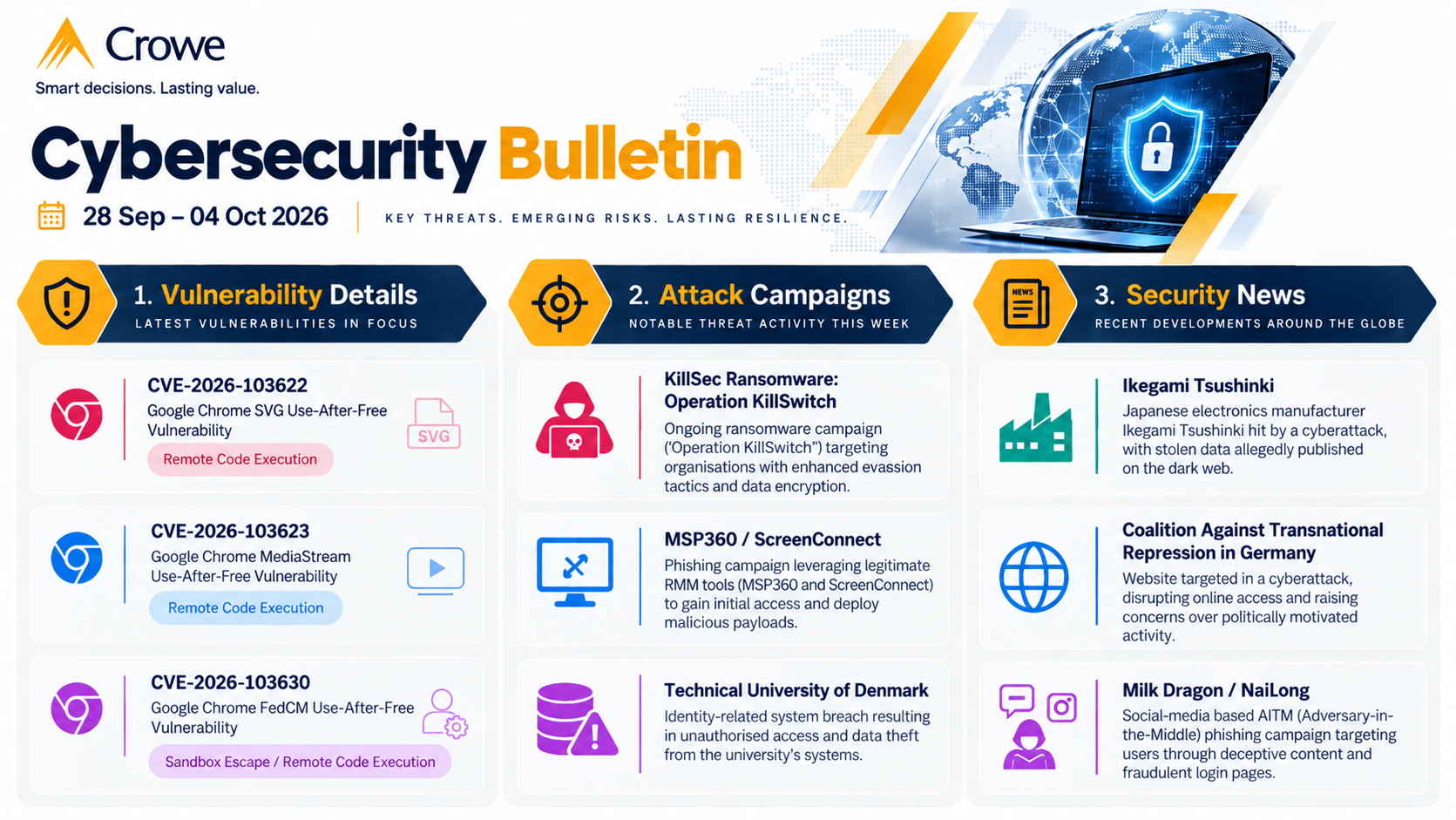
Three high-severity Google Chrome vulnerabilities highlight ongoing risks associated with memory-safety weaknesses. CVE-2026-103622 affects SVG functionality, while CVE-2026-103623 affects MediaStream. Both are use-after-free vulnerabilities that could allow a remote attacker to execute arbitrary code inside Chrome’s sandbox through a crafted HTML page. CVE-2026-103630, a use-after-free vulnerability in FedCM, could potentially enable arbitrary code execution outside the sandbox.
Organizations should prioritize Chrome security updates, maintain effective patch-management processes and continuously monitor endpoints to reduce exposure to browser-based attacks.
Attack Campaigns Highlight Ransomware, RMM and Identity Risks
Operation KillSwitch resulted in international law enforcement taking control of KillSec’s leak site, securing at least 110 TB of stolen data and provisionally arresting three suspects. The ransomware group was linked to around 1,000 suspected attacks worldwide.
Meanwhile, a phishing campaign abused legitimate MSP360 and ConnectWise ScreenConnect remote-management tools to establish persistent access, demonstrating how trusted administrative software can be misused for credential access and post-compromise activities.
The Technical University of Denmark (DTU) also disclosed an identity and access management system breach involving significant data theft, with information relating to up to 200,000 current and former users potentially affected.
Security Incidents Reinforce Data and Phishing Risks
Ikegami Tsushinki confirmed that information believed to belong to the company had been published on an attacker-controlled dark-web site following a cyberattack. The Coalition Against Transnational Repression in Germany also reported a cyberattack that took its website offline, with the scope and potential personal-data impact under investigation.
Additionally, Milk Dragon (NaiLong) demonstrates the growing sophistication of social-media phishing. The AiTM phishing kit uses social-media advertisements and impersonation techniques and can facilitate real-time interception of authentication information.
For organizations across the UAE, Middle East and global markets, these developments reinforce the need to strengthen vulnerability management, identity security, endpoint monitoring, phishing awareness, ransomware preparedness and incident-response capabilities.
For Cybersecurity and Cyber Threat Management consulting:
Call / WhatsApp: +971 52 373 4662 | Email: [email protected]

Dawn Thomas
Senior Partner - Governance Risk & Compliance

Shahnawaz Sheik
Director – Cyber Threat Management