Building a Digital Financial Services Landscape
A Digital Landscape Is Not a Project

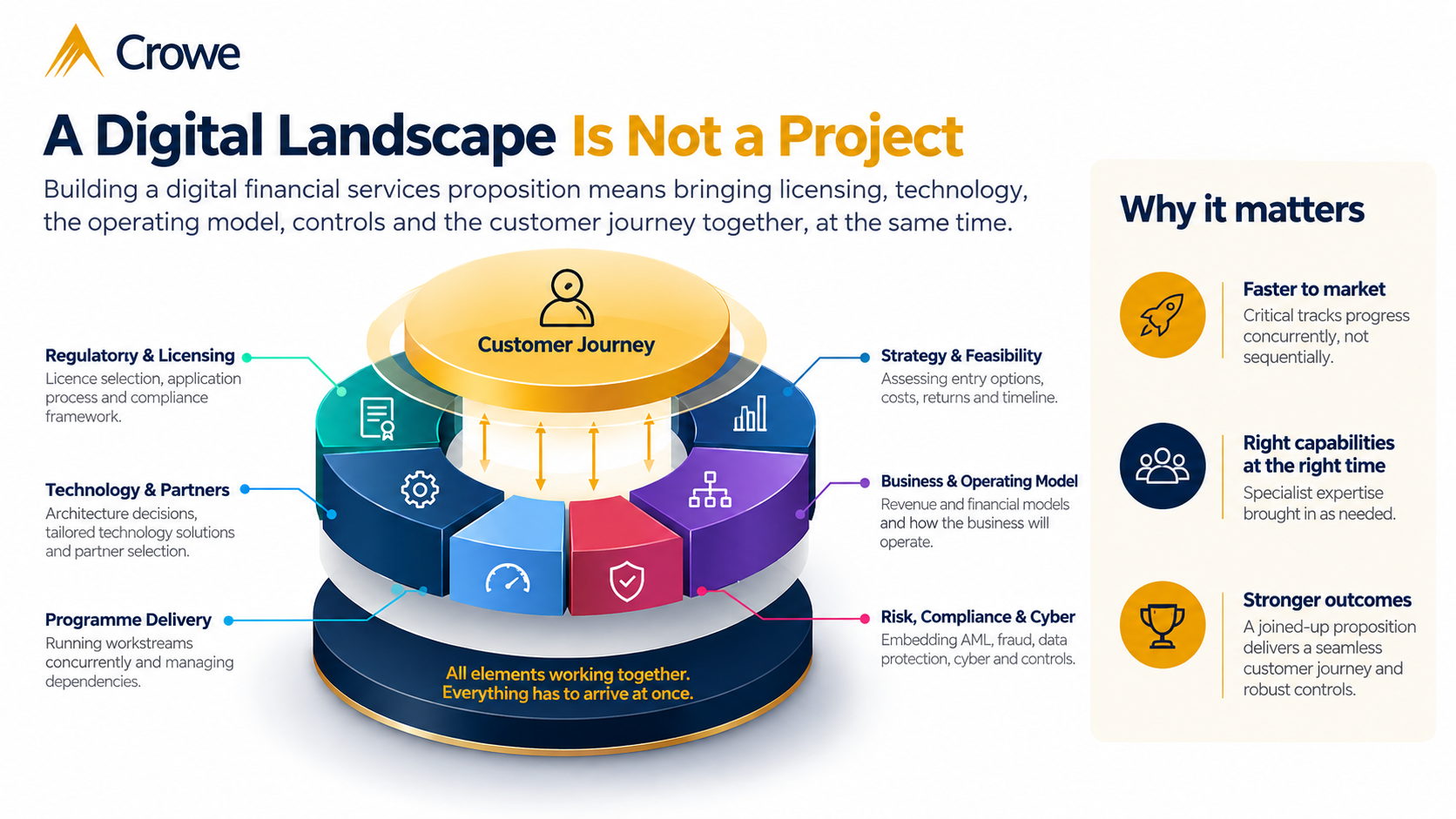
Building a digital financial services proposition means bringing licensing, technology, the operating model, controls and the customer journey together, at the same time.
Everything has to arrive at once
When a bank, exchange house, money transfer operator or fintech commits to a digital proposition, the board usually approves something shaped like a project: a budget, a launch date and a steering committee.
The work that follows does not behave that way.
A digital landscape is a set of capabilities that depend on each other. The licence determines which products can be offered and which partners may be required. Those partners influence the technology estate. The technology estate shapes what the operating model must support, and the operating model determines whether the control framework holds once real customer volumes arrive.
The customer journey cuts across all of them.
Move one element and the others can shift with it.
The difficulty often appears at the seams. A decision taken early in the licensing track can invalidate an assumption the technology team has already built against. If that dependency is discovered only during integration, the result can be redesign, additional cost and lost time.
The challenge is therefore not simply delivering each workstream. It is ensuring they develop together.
Why it slows down inside the institution
Few institutions have all of these specialist capabilities sitting spare.
A traditional bank, exchange house or money transfer operator may not routinely need a payments licensing specialist, core architect or customer journey designer. When those capabilities suddenly become critical, there may be no established internal bench and often limited capacity to recruit and assess specialists quickly.
Hiring can address part of the problem, but the demand is uneven.
Licensing work may be intense for several months and then reduce. Vendor selection is concentrated into a particular phase. Customer journey design peaks around build and launch. Technology requirements change as the proposition matures.
Building permanent teams around temporary peaks can leave cost in the organisation long after the immediate requirement has passed.
The heavier consequence is sequencing.
When a small internal team has to carry every track, work naturally queues. Licensing is settled before architecture begins. Architecture comes before the operating model. The operating model is established before detailed launch planning starts.
No individual decision needs to be wrong for the programme as a whole to run beyond the window against which it was approved.
What faster organizations do differently
Faster organizations retain a small, senior core inside the business that owns the strategy, the customer and the key decisions, while bringing specialist capability alongside it for the phases that require it.
This allows critical tracks to progress concurrently rather than sequentially.
Licensing decisions can develop alongside architecture. The operating model can be designed while customer journeys are being developed. Risk, compliance and cyber requirements can be built into the proposition while the product itself is being built.
It also keeps specialist cost more closely aligned with actual demand rather than embedding every capability permanently within the cost base.
The commercial case ultimately rests on timing.
Bank partnership capacity can open and close according to another institution's priorities and project cycle. Regulatory processes carry their own timelines. Competitors continue to move.
An institution that reaches the market first can establish the benchmark against which customers judge those that follow.
How Crowe helps
Crowe UAE works with banks, exchange houses and money transfer operators, fintechs, and organisations entering financial services to build digital landscapes.
We work alongside internal teams across the connected workstreams.
- Strategy and feasibility. Assessing partner-led entry against direct licensing, what each route costs and earns, and developing a timeline against which delivery can be managed.
- Regulatory and licensing. Supporting licence selection, the application process, in-principle approval planning and the compliance framework that needs to be in place as the proposition develops.
- Business and operating model. Developing revenue and financial models and designing how the business will operate once customers start arriving.
- Technology and partners. Supporting architecture decisions, tailored technology solutions, bank and technology partner selection, and the commercial arrangements needed to translate partner commitments into delivery.
- Customer journey. Designing onboarding and servicing journeys, then measuring and improving them to identify and address the points where customers experience friction or leave the process.
- Risk, compliance and cyber. Embedding AML, fraud, data protection, cyber and control requirements into the proposition while it is being designed and built.
- Programme delivery. Running the workstreams concurrently and managing the decisions and dependencies that pass between them.
The connections matter as much as the capabilities
What matters as much as the individual workstreams is how they are joined.
A licensing decision made today should not create an operating model problem months later. A technology choice should not introduce unnecessary friction into the customer journey. A control requirement should be understood across operations, technology and customer experience before it is implemented.
Managing those dependencies is what turns separate workstreams into a functioning digital landscape.
As each track matures, the capability should transfer to the institution's own people, together with the documentation and decision history behind it.
The objective is not permanent dependence on external specialists. The capability stays within the organisation.
Most institutions could build any one of these capabilities. The difficulty is building all of them at the same time.
FIVE QUESTIONS FOR THE BOARD
- Do our licensing, technology, operating model, controls and customer journey plans work from the same assumptions?
- Which specialist capabilities do we genuinely need permanently in-house, and which do we need only during particular phases?
- Are our critical workstreams progressing concurrently, or is limited internal capacity forcing them into sequence?
- Who owns the dependencies between regulatory, technology, operational and customer decisions?
- What would a delay mean for regulatory timing, partner availability, competitive position and the commercial case?
To discuss digital banking, fintech transformation, regulatory readiness or building an integrated digital financial services proposition, contact Crowe UAE’s Fintech & Banking, Governance, Risk & Compliance team at +971 52 373 4662 or [email protected].
GRC Compass
GRC Compass is a curated weekly newsletter published every Thursday, delivering the most relevant insights and updates in Internal Audit, Governance, Risk & Compliance (GRC), Cyber Threat Management, Technology, and evolving training needs.
Designed for professionals navigating a dynamic business environment, GRC Compass helps you stay informed, prepared, and ahead of the curve.