Building a Cyber-Resilient Organization
Final Takeaways

Cybersecurity is no longer only about preventing attacks. It is about ensuring the organization can continue operating when an incident occurs.
Ransomware, supply chain compromises, cloud security incidents, and insider threats continue to challenge organizations of every size. While investment in security technology remains essential, technology alone does not create resilience.
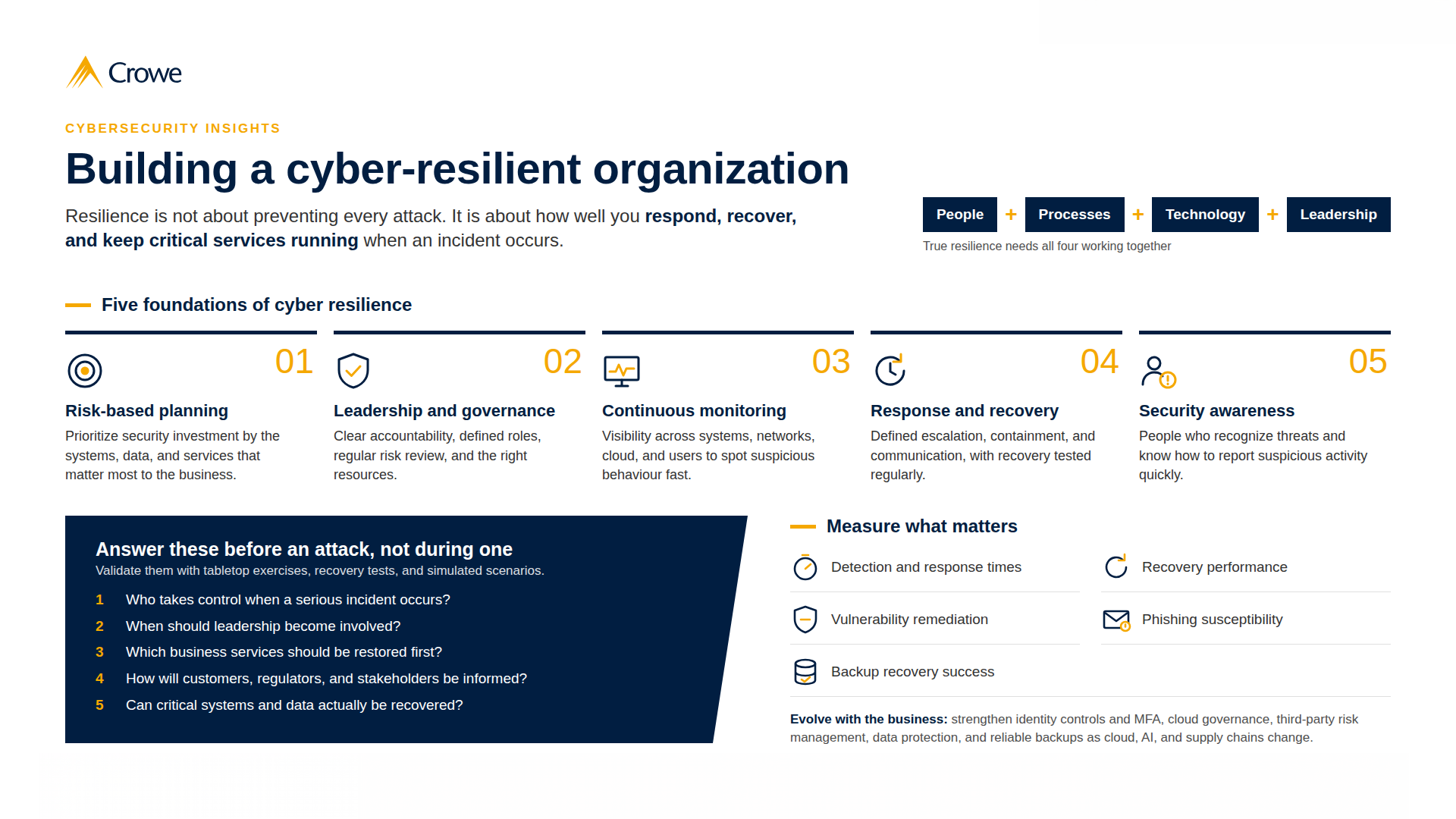
True cyber resilience requires people, processes, technology, and leadership to work together.
For business leaders, this means shifting the conversation from preventing every possible incident to understanding how effectively the organization can respond, recover, and continue delivering critical services when disruption occurs.
What Cyber Resilience Actually Requires
Cyber resilience combines cybersecurity with business continuity, risk management, disaster recovery, and organizational preparedness.
Rather than treating security as a standalone technical function, resilient organizations integrate cyber risk into broader business decisions.
Several foundations are particularly important:
1. Risk-Based Security Planning
Organizations should understand which systems, data, services, and processes matter most and prioritize security investments based on potential business impact.
2. Strong Leadership and Governance
Cyber risk requires clear accountability. Leadership should establish priorities, define responsibilities, review risk regularly, and ensure appropriate resources are available.
3. Continuous Monitoring
Organizations need visibility across critical systems, networks, cloud environments, and user activity to identify suspicious behaviour quickly.
4. Incident Response and Recovery
Plans should clearly define how incidents will be escalated, contained, communicated, and resolved. Recovery procedures should also be regularly tested.
5. Security Awareness
Employees should understand the threats they may encounter and know how to report suspicious activity quickly.
These elements are most effective when they operate together rather than as separate security initiatives.
Leadership and Governance Matter
- Cyber resilience starts at the top.
- A significant cyber incident can affect revenue, reputation, customers, regulatory obligations, and business operations. Cyber risk should therefore be treated as business risk.
- Boards and executive teams do not need to manage technical security operations, but they should understand the organization's exposure and readiness.
- Leadership should focus on aligning cybersecurity with business priorities, establishing accountability, supporting appropriate investment, reviewing resilience metrics, and ensuring response plans are tested.
- Governance provides the structure to make this happen.
Clear policies, responsibilities, risk tolerance, and oversight help prevent security initiatives from becoming fragmented. Collaboration between security, IT, legal, compliance, human resources, operations, communications, and leadership also ensures responsibilities are understood before a crisis occurs.
Build a Security-Aware Culture
Technology can reduce risk, but employees remain an important part of an organization's defence.
Phishing, social engineering, credential theft, and other attacks frequently target people rather than technical vulnerabilities.
Building a security-aware culture therefore requires more than annual compliance training. Organizations should provide practical and continuous education through phishing simulations, targeted training, executive workshops, clear reporting procedures, and regular communication about emerging threats.
The objective is not simply for employees to recognize cybersecurity risks. It is for them to know what action to take when something looks wrong.
Test Incident Response and Recovery
Even mature organizations can experience security incidents.
The difference between a manageable event and a major disruption often depends on how effectively teams can detect, contain, communicate, and recover.
Organizations should be able to answer:
- Who takes control when a serious incident occurs?
- When should leadership become involved?
- Which business services should be restored first?
- How will customers, regulators, or other stakeholders be informed?
- Can critical systems and data actually be recovered?
These questions should not be answered for the first time during an attack.
Tabletop exercises, recovery tests, and simulated scenarios help organizations determine whether documented plans can work under pressure and identify weaknesses before they create real business consequences.
Resilience Must Evolve with the Business
Cloud adoption, remote working, artificial intelligence, third-party services, and interconnected supply chains continue to change how organizations operate.
Resilience strategies need to evolve alongside them.
Depending on the organization's risk profile, priorities may include stronger identity controls, multi-factor authentication, cloud security governance, third-party risk management, continuous monitoring, data protection, reliable backups, and appropriate security automation.
Organizations should also measure whether these investments are improving resilience.
Indicators such as detection and response times, recovery performance, vulnerability remediation, phishing susceptibility, and backup recovery success can help leadership identify weaknesses and prioritize future investment.
The Strategic Questions Leaders Should Ask
Organizations looking to strengthen cyber resilience should consider:
- Do we know which business services and assets are most critical?
- Is accountability for cyber risk clearly defined?
- Can we detect and escalate significant incidents quickly?
- Have our incident response and recovery plans been tested?
- Can critical operations continue during a prolonged disruption?
- Do employees know how to identify and report potential threats?
- Are we adapting our security approach as the business and threat landscape change?
Final Thought
Cyber resilience is not a product or one-time initiative. It is an organizational capability built through leadership, governance, preparedness, technology, and continuous improvement.
The most resilient organizations are not necessarily those that prevent every cyber incident. They are those that understand what matters most, prepare for disruption, respond effectively, recover quickly, and improve based on what they learn.
Organizations that invest in these capabilities today will be better positioned to protect critical operations, maintain stakeholder trust, and continue delivering when future cyber challenges arise.
The author is Director, Cyber Threat Management at Crowe UAE and can be reached at [email protected] or +971 52 373 4662.
Cyber Shield
Stay ahead of emerging threats, vulnerabilities, and defense strategies with expert insights tailored for today’s digital risk landscape. Because in Cybersecurity, being informed is your first line of defense.
Detect. Defend. Recover.