The Board Assessment Is No Longer a Box to Tick
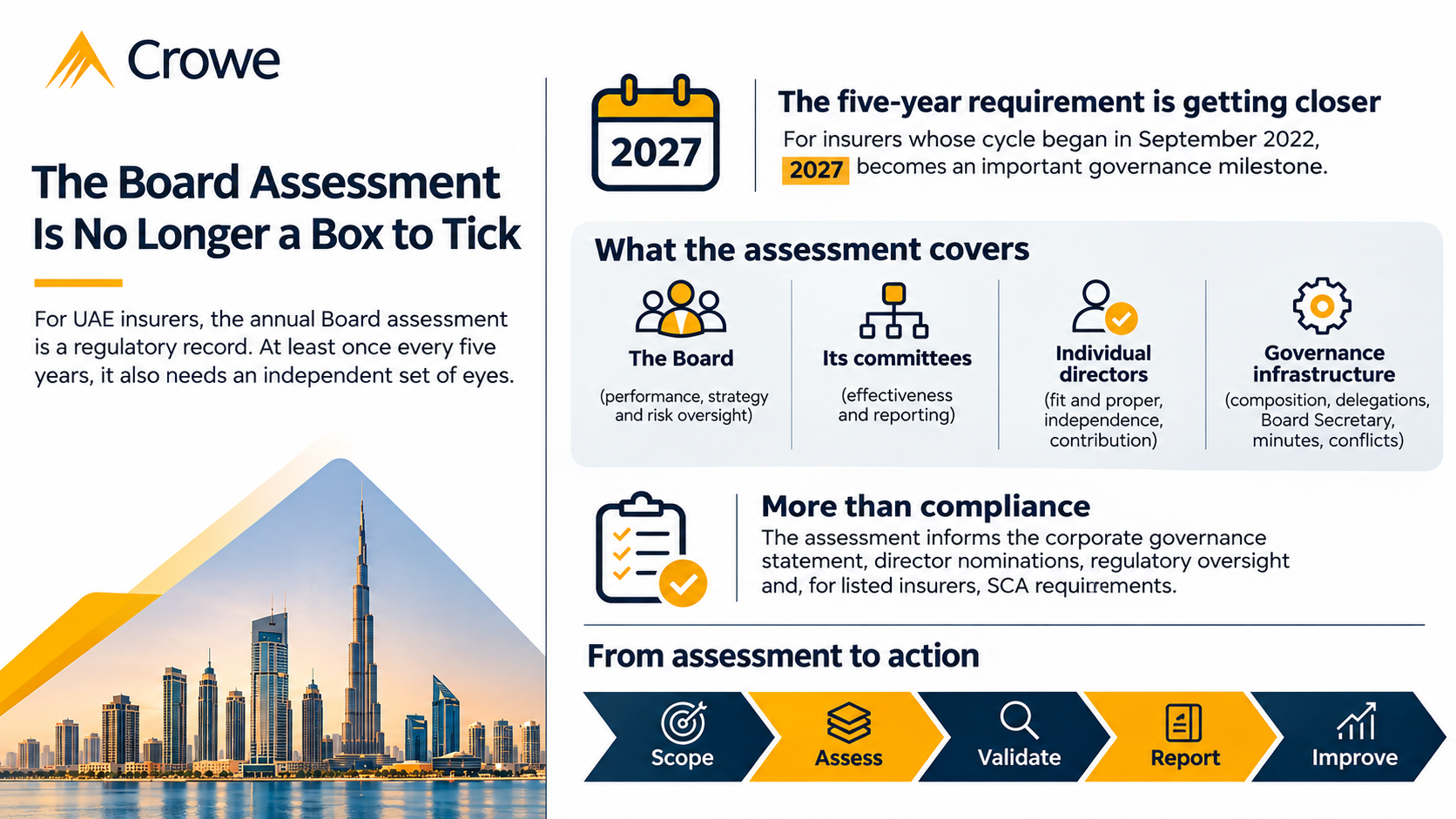
For UAE insurers, the annual Board assessment is a regulatory record. At least once every five years, it also needs an independent set of eyes.

The five-year requirement is getting closer
The Central Bank of the UAE's Corporate Governance Regulation for Insurance Companies (Circular 24 of 2022) and its accompanying Standards took effect in September 2022.
One requirement is particularly important for Boards.
Every year, the Board must assess its own performance, the performance of its committees and the contribution of individual directors. At least once every five years, that assessment must be carried out independently by an external third party.
For insurers whose five-year cycle began when the requirements took effect, 2027 becomes an important governance milestone.
Boards that have not yet planned their first independent external assessment may have less time than they think.
The issue is not simply whether an assessment has taken place. It is whether the Board can demonstrate that the assessment was sufficiently robust, covered the areas required by the Central Bank and resulted in meaningful action.
A questionnaire alone may not provide that evidence.
What the Central Bank expects
Article 5(12) requires an annual assessment of the Board as a whole, its committees and individual members. The assessment may be undertaken by the Board itself or with external experts.
Standard 5.16 goes further. At least once every five years, the assessment must be conducted independently by an external third party.
The Standards also establish what should be assessed.
For the Board, Standard 5.18 covers performance objectives, strategy and risk oversight, skills mix, relationships with committees and senior management, the quality and timeliness of information, and the effectiveness of meetings and agendas.
For individual directors, Standard 5.19 addresses fit and proper status, independence, active contribution, induction and training, and unexcused absences.
This means an effective assessment needs to go beyond asking directors how well they believe the Board is performing.
The evidence matters.
A questionnaire is only the starting point
One of the most common weaknesses in Board assessments is relying too heavily on self-assessment.
Directors complete a questionnaire. Scores are consolidated. The results are generally positive. The exercise is closed.
A stronger assessment tests those responses against the Board's actual governance records.
If directors believe sufficient time is spent on strategy, the agendas and minutes should support that conclusion. If a committee is operating effectively, its charter, meeting records and reporting to the Board should demonstrate it. If directors are considered suitably engaged, attendance, training and contribution should provide evidence.
For a UAE insurer, the assessment should therefore examine four connected areas: the Board itself, its committees, individual directors and the Chair, and the governance infrastructure supporting them.
That includes composition and skills, strategy and risk oversight, committee effectiveness, independence, attendance and time commitment, induction and training, delegations, Board Secretary arrangements, minutes, conflicts and related-party controls.
It should also consider whether findings from previous reviews or Central Bank examinations have actually been closed.
The assessment supports more than compliance
The results of a Board assessment do not exist in isolation.
Article 10 requires a corporate governance statement in the insurer's annual report. Board nominations require Central Bank non-objection, making evidence of individual suitability important. Governance breaches may also result in supervisory action under Article 14.
For listed insurers, the Securities and Commodities Authority's corporate governance requirements also need to be considered. A well-designed assessment can address both frameworks where the requirements are clearly mapped.
There is also a practical benefit.
An independent assessment establishes a baseline for Board effectiveness. Future annual assessments can then measure progress against agreed actions rather than repeating the same questionnaire each year.
For insurers approaching a new Board term, the assessment can also provide useful evidence when considering director nominations and succession.
How Crowe helps
Crowe UAE works with insurers and other regulated financial institutions on governance, Board effectiveness and regulatory readiness.
The Board retains ownership of the assessment, typically through its Nomination Committee. Crowe acts as the independent external assessor, reporting through the Chair and Nomination Committee Chair rather than management, subject to appropriate independence and conflict checks.
The process is designed to minimise the burden on directors.
Each director completes a focused online self-assessment and provides confidential feedback on fellow directors and the Chair. Crowe reviews the underlying governance records and compares what directors say with what the evidence demonstrates.
Every finding is mapped back to the relevant regulatory requirement.
The Board receives maturity assessments for the Board and its committees, a red-amber-green compliance matrix, confidential director feedback, a prioritised action plan with owners and target dates, and confirmation of the assessment's independence and scope.
From assessment to action
We structure the review over approximately six weeks.
- Scope. Confirm the assessment perimeter, respondents, regulatory requirements and information required.
- Assess. Review Board and committee records and complete the director questionnaires and peer assessments.
- Validate. Compare responses with documentary evidence and test practices against the applicable CBUAE requirements.
- Report. Present findings, maturity ratings, individual feedback and priority actions to the appropriate Board representatives.
- Improve. Agree owners and timelines so the Board can track progress through subsequent annual assessments.
The objective is not simply to produce another governance report.
It is to give the Board a defensible view of how effectively it operates, where the evidence supports that conclusion and what needs to improve.
FIVE QUESTIONS FOR THE BOARD
- Have we confirmed when our five-year independent external Board assessment is due?
- Does our annual assessment cover the Board, every committee and each individual director?
- Are our assessment conclusions supported by Board records and evidence, or mainly by questionnaire responses?
- Can we demonstrate that findings from previous assessments and regulatory examinations have been addressed?
- Would our current assessment provide sufficient evidence if the Central Bank asked to review it?
A Board assessment should do more than demonstrate that an annual exercise took place. It should provide evidence that the Board is effective, appropriately constituted and actively improving.
To discuss your annual Board assessment or five-year independent external review, contact Crowe UAE's GRC, Open Finance & Fintech Advisory team at
+971 52 373 4662 or [email protected].
GRC Compass
Designed for professionals navigating a dynamic business environment, GRC Compass helps you stay informed, prepared, and ahead of the curve.