Beyond Compliance
The Strategic Role of Internal Audit in VARA-Regulated Firms

Reading Time: 4 Minutes
Internal audit is becoming a strategic necessity for Virtual Asset Service Providers (VASPs) operating under the Virtual Assets Regulatory Authority (VARA) in Dubai. As the virtual assets sector matures, compliance is no longer about meeting licensing requirements once and moving on. It is about maintaining ongoing assurance, strengthening governance, and building trust in a fast-moving regulatory environment.
For firms operating in Dubai’s virtual asset ecosystem, internal audit has evolved from a back-office control function into a key enabler of resilience. A well-designed internal audit programme helps organizations identify control gaps early, test the effectiveness of policies and procedures, and provide leadership with independent assurance that regulatory obligations are being met consistently.
Why VARA compliance demands continuous assurance
VARA’s framework requires VASPs to demonstrate strong governance, transparency, operational discipline, and effective AML/CFT controls. These expectations go well beyond initial registration or licensing. They require firms to continuously monitor risks, adapt to regulatory updates, and evidence control effectiveness over time.
This is where internal audit becomes essential. By embedding independent assurance into the operating model, firms can give boards and senior management clear visibility over the strength of controls, the status of remediation efforts, and the overall maturity of the compliance environment. In a sector where risks can change quickly, continuous assurance is far more valuable than periodic, point-in-time reviews.
Core audit priorities for virtual asset firms
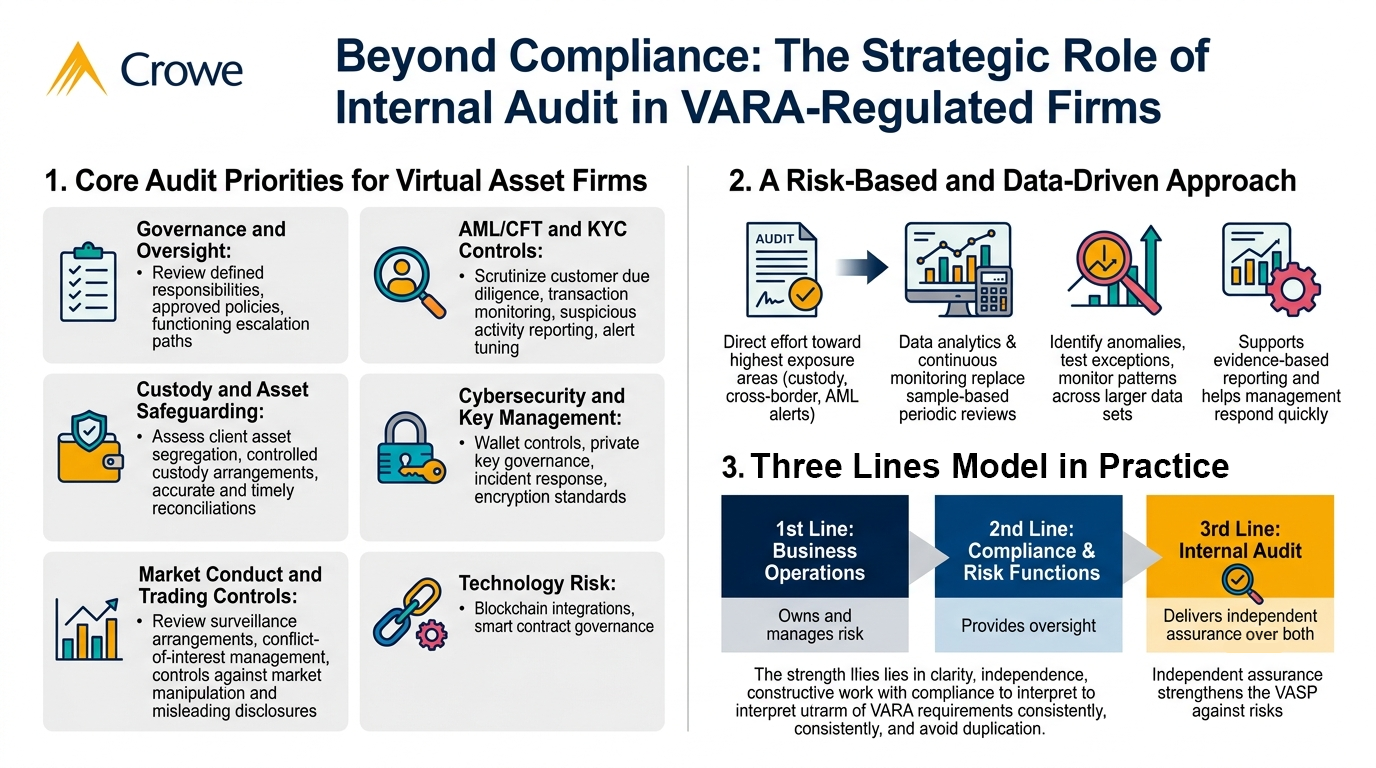
A VARA-aligned internal audit plan should be tailored to the specific risks faced by virtual asset businesses.
Governance and oversight should be reviewed to confirm that responsibilities are clearly defined, policies are approved and maintained, and escalation paths are functioning effectively.
AML/CFT and KYC controls deserve close scrutiny, including customer due diligence, transaction monitoring, suspicious activity reporting, and the tuning of alert thresholds.
Custody and asset safeguarding are also critical. Internal audits should assess whether client assets are properly segregated, whether custody arrangements are appropriately controlled, and whether reconciliations are performed accurately and on time.
Cybersecurity and key management are equally important. In a digital asset environment, weaknesses in wallet controls, private key governance, incident response, or encryption standards can quickly create material operational and regulatory exposure.
Market conduct and trading controls should not be overlooked. Firms should review surveillance arrangements, conflict-of-interest management, and controls designed to prevent market manipulation or misleading disclosures.
Technology risk, including blockchain integrations and smart contract governance, is another important dimension.
A risk-based and data-driven approach
The most effective internal audit functions in the virtual asset space use a risk-based methodology. This means directing audit effort toward the areas of highest exposure, such as custody, cross-border activity, AML alerts, and critical technology infrastructure.
Data analytics and continuous monitoring can significantly improve audit effectiveness. Rather than relying solely on sample-based, periodic reviews, internal audit can use technology to identify anomalies, test exceptions, and monitor patterns across a much larger data set.
For VARA-regulated entities, this approach is especially valuable because it supports evidence-based reporting and helps management respond quickly to emerging issues.
Three Lines Model in practice
VARA-compliant firms should maintain a clear three lines model structure.
The first line owns and manages risk through business operations.
The second line provides oversight through compliance and risk functions.
The third line, internal audit, delivers independent assurance over the effectiveness of both.
The strength of this model lies in clarity. Internal audit should remain independent, but it should also work constructively with compliance teams to ensure that VARA requirements are interpreted consistently, and that duplication of effort is avoided.
Why this matters beyond compliance
A strong internal audit function does more than reduce regulatory risk. It helps build a culture of discipline, transparency, and resilience. For virtual asset firms in Dubai, these qualities are increasingly tied to commercial credibility.
Investors, counterparties, and regulators all look for evidence that a firm can manage complexity responsibly. Internal audit helps create confidence by showing that risks are understood, controls are tested, and governance is active rather than symbolic.
As VARA continues to shape the future of virtual asset regulation in Dubai, firms that invest in robust internal audit capabilities will be better positioned to adapt, compete, and grow with confidence.
The author is Partner – Internal Audit & Governance Risk Compliance at Crowe UAE and can be reached at +971 52 373 4662 or [email protected]
GRC Compass
GRC Compass is a curated weekly newsletter published every Thursday, delivering the most relevant insights and updates in Internal Audit, Governance, Risk & Compliance (GRC), Cyber Threat Management, Technology, and evolving training needs. Designed for professionals navigating a dynamic business environment, GRC Compass helps you stay informed, prepared, and ahead of the curve.