AI Governance in UAE Financial Services
What the CBUAE Guidance Note Expects

Artificial intelligence (AI) is already influencing decisions that affect customers across the UAE financial services sector.
From credit scoring and fraud detection to insurance claims and customer service, AI and machine learning (ML) are becoming embedded in financial institutions. However, as adoption accelerates, an important question remains: who is accountable when an AI-driven decision affects a customer?
The Central Bank of the UAE (CBUAE) addresses this through its Guidance Note on Consumer Protection and the Responsible Adoption and Use of Artificial Intelligence and Machine Learning.
The message for financial institutions is clear: AI can support innovation, but accountability for its use and outcomes remains with the institution.
What the CBUAE Guidance Note Covers
The Guidance Note applies to CBUAE-licensed financial institutions (LFIs), including insurance providers, and establishes principles for the responsible adoption and use of AI and ML.
It focuses on areas including transparency, fairness and bias, ethics, accountability, explainability, data privacy, security, and consumer protection.
The Guidance Note should be considered alongside the CBUAE Model Management Standards (MMS), the UAE Charter for the Development & Use of AI, and relevant guidance on enabling technologies.
For LFIs, this means AI governance should form part of the broader risk and governance framework rather than operate as a standalone technology initiative.
Governance and Accountability Start at the Top
Responsibility for AI does not sit with the algorithm.
Boards and senior management remain accountable for AI systems and their outcomes, covering model selection and development through deployment, monitoring, and ongoing use.
Institutions should establish a documented AI governance framework proportionate to their size, complexity, and AI risk exposure. Governance should also align with relevant principles under the MMS.
Boards should receive appropriate reporting on AI performance and risk, while risk, compliance, and internal audit functions should understand AI-enabled processes sufficiently to provide effective challenge.
Importantly, institutions should maintain appropriate control over the AI models they use.
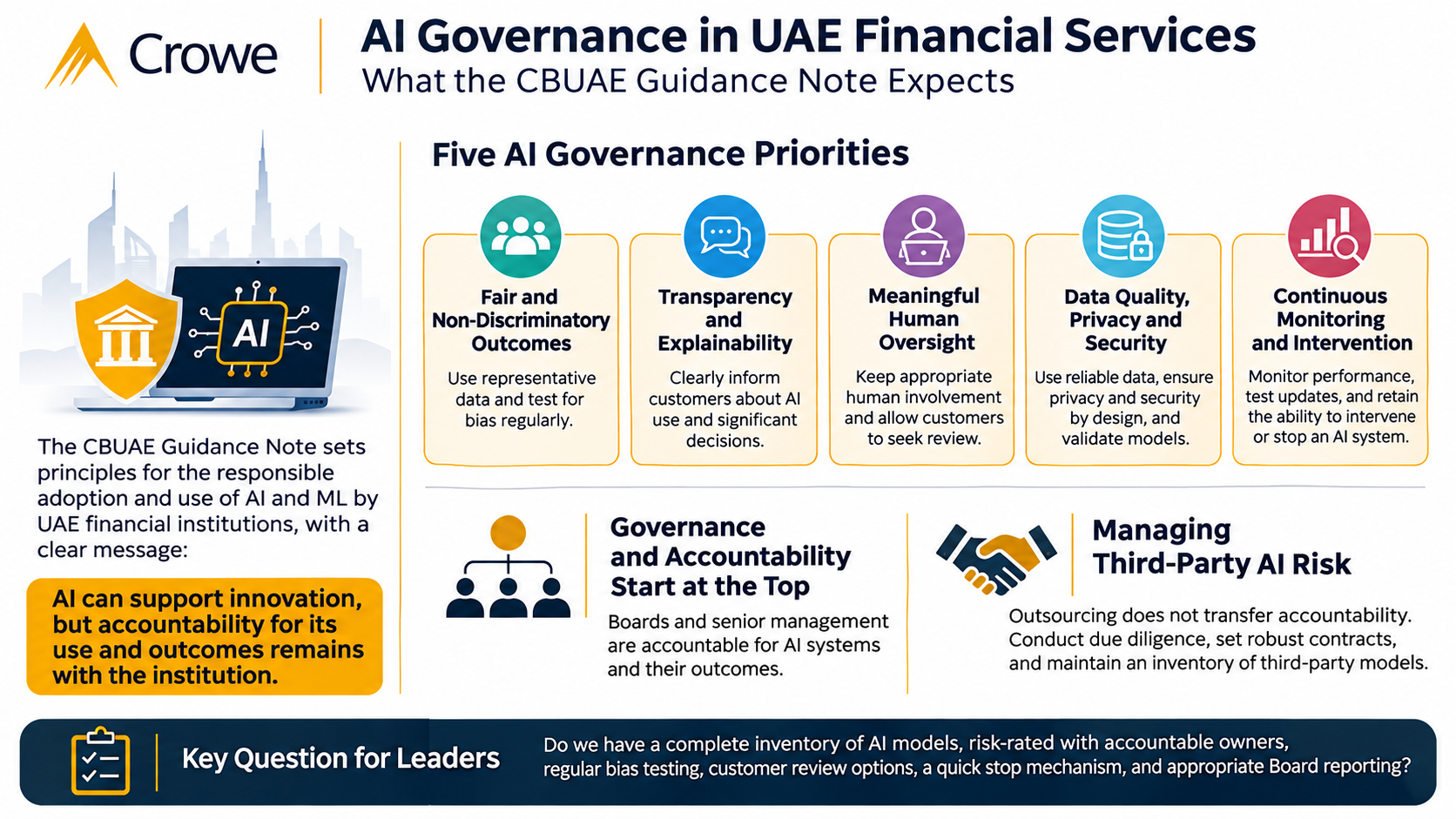
Five AI Governance Priorities for Financial Institutions
1. Fair and Non-Discriminatory Outcomes
AI systems should not produce discriminatory or manipulative outcomes. Training data should be accurate, relevant, and representative of the customers the model serves.
Models should also undergo AI bias testing at least annually and when models are newly introduced, upgraded, or materially changed.
2. Transparency and Explainability
Customers should be appropriately informed when interacting with AI, particularly where it contributes to significant decisions such as lending or insurance claims.
Disclosures should be clear, understandable, and provided in Arabic and English. Institutions should also consider whether customers should have the option to opt out of AI-driven decisions.
3. Meaningful Human Oversight
The level of human oversight should reflect the potential risk to the consumer.
The Guidance Note considers human-in-the-loop, human-on-the-loop, and human-out-of-the-loop approaches, with fully automated processes more appropriate for low-risk, non-material activities.
Customers should have mechanisms to seek human review or explanations, challenge decisions, and correct inaccurate information.
4. Data Quality, Privacy and Security
Responsible AI depends on reliable data.
Institutions should maintain appropriate data provenance and audit trails while embedding privacy-by-design and security-by-design into AI systems. Models should also be validated and stress-tested to assess whether they perform reliably across relevant scenarios.
5. Continuous Monitoring and Intervention
AI governance does not end when a model goes live.
Institutions should continuously monitor AI in line with the MMS. Updates should be appropriately tested to ensure they do not introduce unintended risks or bias.
Crucially, institutions should retain the ability to intervene and cease using an AI system when necessary.
Managing Third-Party AI Risk
Financial institutions increasingly rely on AI solutions developed, hosted, or supported by technology vendors, cloud providers, and other third parties.
Outsourcing does not transfer accountability.
Effective third-party AI risk management requires due diligence covering areas such as governance, cybersecurity, and data protection. Appropriate contracts should address information and audit rights as well as termination provisions.
The Guidance Note also calls for annual independent cybersecurity reviews of third-party AI providers and an inventory covering AI models developed or hosted externally.
Institutions should additionally consider concentration risk and avoid excessive dependency on a single AI provider.
The Strategic Questions Leaders Should Ask
Financial institutions assessing their readiness for responsible AI should consider:
- Do we have a complete inventory of AI models, including third-party models?
- Has every model been risk-rated and assigned an accountable owner?
- When was each model last tested for bias?
- Can customers request human review of significant AI-driven decisions?
- Can we stop an AI system quickly when necessary?
- Does the Board receive appropriate reporting on AI performance and risk?
If these questions cannot be answered confidently, the institution may have limited visibility over an increasingly important area of regulatory and consumer risk.
Final Thought
The CBUAE Guidance Note should not be viewed as a barrier to AI innovation. It provides a framework for adopting AI responsibly while protecting consumers and maintaining accountability.
For UAE financial institutions, effective AI governance and AI risk management will increasingly depend on knowing which models are being used, understanding the decisions they influence, assigning clear ownership, testing them appropriately, and maintaining meaningful human oversight.
Organizations that establish these foundations early will be better positioned to scale AI responsibly and respond as technology and regulatory expectations evolve.
Because in financial services, trust remains fundamental and responsible AI governance is becoming an important part of maintaining it.
The author is Director, Cyber Threat Management at Crowe UAE and can be reached at [email protected] or +971 52 373 4662.
Cyber Shield
Stay ahead of emerging threats, vulnerabilities, and defense strategies with expert insights tailored for today’s digital risk landscape. Because in Cybersecurity, being informed is your first line of defense.
Detect. Defend. Recover.