
Previously, in our Retirement Roadmap series, we discussed what a comfortable retirement looks like. Here, we focus on how you might achieve this.
Making the most of pension contributions is one of the most effective ways to build long‑term financial security. By understanding how tax relief works, taking full advantage of employer contributions, and managing annual allowances carefully, you can significantly enhance the value of your retirement savings.
Tax relief on contributions
Salary Sacrifice
Salary sacrifice is an arrangement where an employee agrees to give up part of their gross salary in exchange for a contribution to their pension pot. The main benefit is that contributions are made before income tax and National Insurance (NI) are calculated; therefore, employees save income tax and NI, while employers also save NI. Note that from April 2029, the government will implement a £2,000 cap on NI-exempt contributions.
Private pension contributions
Contributions into private pensions such as a SIPP (Self Invested Personal Pension) or RIA (Retirement Investment Account) also attract generous tax relief; however, as these are made out of your net income (after tax), the tax relief is not immediate.
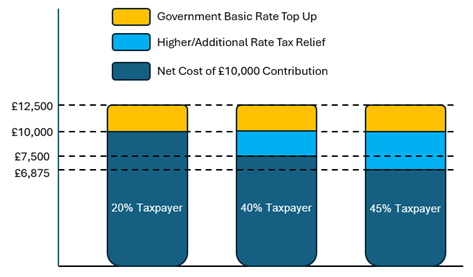
Following a contribution out of net income, the government will automatically top up any contributions with the basic rate tax. For example, if you were to make a £10,000 net contribution, the government would top up your pension pot by an additional £2,500.
For higher rate and additional rate taxpayers, they can claim the additional 20% and 25% respectively through the completion of a self-assessment tax return. Subject to the tax position of the individual, the additional tax relief will be repaid to the individual, effectively reducing the net cost of the £12,500 gross contribution.
Annual allowance
The annual allowance is the maximum amount that can be contributed to a pension each tax year while still benefiting from tax relief. In the UK, this includes personal contributions, employer contributions, and any increase in defined benefit pension benefits. The allowance is currently set at £60,000 gross for most individuals; however, it is gradually reduced for those earning over both a threshold income of £200,000 and an adjusted income of £260,000. Where the annual allowance is reduced, it can be tapered down to a minimum of £10,000 for 2025/26 and 2026/27.
Contributions above the limit may trigger an annual allowance tax charge, which effectively removes the tax relief on the excess. Unused allowance from the previous three tax years can often be carried forward, helping you make larger pension contributions where earnings allow.
Relevant earnings
Personal pension contributions that receive tax relief are generally limited to an individual’s relevant UK earnings for the tax year. This means contributions above earnings will not qualify for tax relief, although individuals with little or no earnings can still contribute up to £3,600 gross (£2,880 net) each year.
| Qualifying Relevant Earnings | Non-Qualifying |
|
|
Final thoughts
Maximising pension contributions is about balance: using tax relief effectively, capturing the full value of contributions and staying within annual allowances while also considering that the funds cannot be accessed until you reach age 55 (57 as of April 2028). With careful planning and regular review, contributions can be optimised throughout an individual’s working life so that they can achieve the ‘comfortable retirement’ they have in mind.


Get in touch
Call, email, sign up for our newsletter, or complete our contact us form to arrange a confidential consultation.


Meet our financial planning team
Our Financial Planning teams are based across our offices in Cheltenham, Kent, London, Manchester, Midlands and Thames Valley.
DisclaimerCrowe Financial Planning UK Limited is authorised and regulated by the Financial Conduct Authority (FCA) to provide independent financial advice. The Financial Conduct Authority does not regulate Trusts, Tax or Estate Planning. |


When it comes to drawing an income in retirement, the order you use your pension, ISA, investments and cash savings can make a significant difference.

It is important to consider death benefit designations in your financial plan. Learn why they are invaluable to your situation.

We look at where to place your Discounted Gift Trust comparing Discretionary vs. Bare Trusts.

Explore how Will planning, Trusts and life insurance could help manage Inheritance Tax on your home and the key points to consider.

Saving and investing can play different roles in a financial plan. Explore the key differences, potential risks and factors to consider.

Could your home play a role in Inheritance Tax planning? Explore the considerations around downsizing, equity release, gifting and shared occupation.
When it comes to drawing an income in retirement, the order you use your pension, ISA, investments and cash savings can make a significant difference.
It is important to consider death benefit designations in your financial plan. Learn why they are invaluable to your situation.
We look at where to place your Discounted Gift Trust comparing Discretionary vs. Bare Trusts.
Explore how Will planning, Trusts and life insurance could help manage Inheritance Tax on your home and the key points to consider.
Saving and investing can play different roles in a financial plan. Explore the key differences, potential risks and factors to consider.
Could your home play a role in Inheritance Tax planning? Explore the considerations around downsizing, equity release, gifting and shared occupation.