Your financial toolkit
A simple guide to the products and topics that support your financial journey.

A simple guide to the products and topics that support your financial journey.
Pensions play a vital role in securing your financial future, providing steady income during retirement. Understanding the different types of pensions and how they work is essential for effective financial planning.
The State Pension, provided by the UK Government, offers a foundational level of income in retirement. Eligibility is based on your National Insurance record.
Personal pensions are private plans managed by individuals to help build retirement savings. They offer flexibility and notable tax benefits.
SIPPs are a flexible type of personal pension, giving you greater control over how your savings are invested.
Also known as 'final salary' schemes, defined benefit pensions promise a specific income in retirement based on your salary and years of service
A General investment account (GIA) is a flexible investment option that enables individuals to invest in a wide variety of assets, including funds, shares, and bonds. This account is available to UK residents, and unlike ISAs or pensions, it does not offer specific tax advantages.
GIAs are particularly suitable for those who have already maximised their annual ISA and pension allowances, or for individuals seeking unrestricted access to their investments.
Guidance for protecting your legacy
Inheritance tax (IHT) can be a complex and often misunderstood aspect of estate planning. At its core, IHT is a levy paid on the value of an individual’s estate when it is passed on after their death. This includes property, money, and possessions. The amount that may be due depends on the size of the estate and the relationship between the deceased and their beneficiaries.
IHT is charged on estates that exceed a certain threshold, known as the nil-rate band. In the UK, for example, this threshold is currently set at £325,000, and the residence nil-rate band (RNRB) adds an additional £175,000 if a qualifying residence is passed to direct descendants. These thresholds have been frozen until at least 2030, meaning they will not rise with inflation.
If unused, both bands can be transferred to a surviving spouse or civil partner, allowing up to £1 million to be passed on tax-free. Estates exceeding £2 million begin to lose the RNRB through a tapering mechanism. The freeze on thresholds, combined with rising property values, is expected to increase the number of estates subject to IHT in coming years.
IHT is typically charged at a rate of 40%. There are, however, several exemptions and reliefs, and not all estates will result in an IHT bill. Typically, assets left to a spouse, civil partner, or charity are exempt.
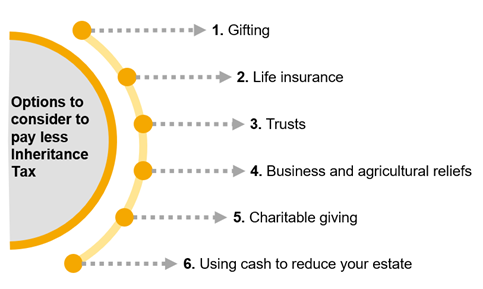
Some assets, such as shares in qualifying businesses or agricultural property, may be eligible for special reliefs. Business Relief (BR) and Agricultural Property Relief (APR) can allow these assets to be transferred without incurring IHT.
These reliefs have specific conditions, making them particularly beneficial for business owners and farmers, but careful planning and compliance with HMRC regulations are essential to take full advantage.
Please note: The rules governing Business Relief and Agricultural Property Relief are scheduled to change from April 2026, which may impact eligibility and the potential tax benefits available.
April 2025
The UK moved from a domicile-based to a residence-based IHT regime. Individuals who are UK tax resident for 10 of the previous 20 tax years are now treated as long-term UK residents, bringing their worldwide assets into scope for IHT. A 'tail' rule applies after leaving the UK, keeping worldwide assets liable to IHT for three—10 years depending on prior residence. The old deemed domicile rules apply only to transfers or deaths before this date.
April 2026
Government proposals include introducing caps on Business Relief (BR) and Agricultural Property Relief (APR). Current proposals suggest 100% relief on the first £1 million of qualifying assets per individual, with 50% relief above that. Any value above this threshold will receive only 50% relief, resulting in an effective IHT rate of 20%.
Unlisted shares, including those on markets like AIM, will only qualify for 50% relief, regardless of previous eligibility.
April 2027
Most unused pension funds and death benefits will be brought within the scope of IHT. Currently, discretionary pension schemes allow individuals to pass on pension wealth tax-free. Under the new rules, these unused funds will be treated as part of the deceased’s estate and taxed accordingly, and inherited pensions will become taxable from April 2027.
IHT laws are intricate and subject to change.
Tailored advice ensures that your estate is structured in the most tax-efficient way possible, helping to protect your legacy and provide for your loved ones. Our experienced team can help you navigate the rules, identify opportunities to reduce liability, and give you peace of mind for the future.
Planning ahead is crucial; by taking action now, you can ensure more of your wealth is preserved for the people and causes you care about most.
Investment bonds are a flexible way to grow your money over the medium to long term, all within a tax-efficient structure. They’re popular for building wealth, planning your legacy, and providing easy access to your funds if you need them.
Onshore bonds
Offshore bonds
With-Profits bonds
Investment bonds can be a powerful addition to your financial plan but you should make sure you are fully aware of the risks and any disadvantages.
We recommend discussing your financial goals and unique circumstances with one of our Consultants who will provide you with fully independent advice as to whether these investments are suitable for you.
When it comes to financial planning, having the right protection policies in place is essential for securing your future and providing peace of mind for yourself and your loved ones. Below, we outline the main types of protection policies available, helping you make informed decisions that suit your unique circumstances.
Individual Savings Accounts (ISAs) offer a straightforward, tax-efficient way to save and invest for your future. Here’s what you need to know to make the most of your ISA options:
Considering high-risk investment opportunities? Vehicles such as Venture Capital Trusts (VCTs), the Enterprise Investment Scheme (EIS), and shares in the Alternative Investment Market (AIM) can open new avenues for growth and offer attractive tax advantages. These options provide access to innovative, fast-growing companies, yet they come with unique risks and complexities that are important to understand. In this guide, we outline the essential features and benefits of these three high-risk investment strategies, helping you make confident, well-informed decisions.
VCTs are publicly listed investment companies in the UK, specifically created to support small, early-stage, or emerging businesses not listed on the main stock exchange. Established in 1995, VCTs aim to stimulate investment in the UK’s entrepreneurial sector by offering incentives to investors.
Currently, AIM-listed shares qualify for 100% Business Relief (BR) from IHT if held for at least two years. However, from April 2026, this relief will be reduced to 50%, meaning the effective IHT rate on AIM shares will change to 20%. This change significantly alters the attractiveness of AIM investments for IHT mitigation, although they still offer:
Importantly, EISs are not affected by the April 2026 cap on BR for AIM shares. They retain their full IHT relief status, making them increasingly attractive as part of estate planning strategies. The government’s commitment to these schemes signals their continued role in supporting innovation and small business growth while offering investors robust tax incentives.
This table compares the tax benefits of EIS, VCT, and AIM-listed shares. It highlights key features relevant to income tax, capital gains tax, inheritance tax, and other considerations.
| Feature | EIS | VCT | AIM shares (with BR) |
| Income tax relief | 30% on up to £1 million (£2 million for KICs) | 30% on up to £200,000 |
None |
| Capital gains tax (CGT) |
Deferral plus exemption after three years |
Full exemption | Standard CGT applies |
| Dividend tax |
Taxable | Tax-free | Taxable |
| IHT relief (BR) | Yes, after two years | No | Yes, after two years* |
| Loss relief |
Yes (against income or CGT) | No |
No |
| Minimum holding period | Three years | Five years | Two years for BR |
| Investment type | Direct in unquoted companies | Indirect via listed trust |
Direct in AIM-listed shares |
| Risk level |
High (single company exposure) | Medium (diversified portfolio) | High (small-cap volatility) |
*see changes in legislation regarding BR and AIM.
VCTs, EIS, and AIM all offer exciting opportunities for investors seeking higher returns, tax benefits, and access to the UK’s most dynamic sectors. Each comes with its own set of risks and complexities, so it’s important to:
High-risk investments like VCTs, EIS, and AIM can add value to a diversified portfolio, particularly for those looking to benefit from tax incentives and the growth of UK innovation. While the potential rewards are considerable, so are the risks. Informed decision-making, ongoing review, and prudent planning are essential for maximising benefits and managing downside exposure. If you’re interested in exploring these opportunities further, our team is here to guide you every step of the way.
| Risk disclaimer: High-risk investments such as VCTs, EIS, and AIM-listed shares may not be suitable for all investors. The value of investments can fluctuate significantly, and investors may lose some or all of the capital invested. Past performance is not a reliable indicator of future results. Tax treatment depends on individual circumstances and may be subject to change. Prospective investors should carefully consider their own financial situation and seek independent professional advice before making any investment decisions. |
Call, email, sign up for our newsletter, or complete our contact us form to arrange a confidential consultation.


