Draft EUDR Act in Poland: company obligations, due diligence, tax and customs risks
What will you learn from this article?
- What is EUDR and to whom does it apply?
- What obligations does the Polish draft law introduce for companies?
- Who is the operator and who is the trader – and why does it matter?
- How to prepare for the implementation of new responsibilities?
- When will the new regulations come into effect?
What is EUDR and to whom does it apply?
EU Regulation (EU) 2023/1115, commonly known as the EU Deforestation Regulation (EUDR ), aims to reduce the impact of the EU market on global deforestation and forest degradation. In practice, this means that businesses are required to prove that the goods they import are "deforestation-free" – meaning they do not originate from land deforested after December 31, 2020 – and that they were produced in accordance with the laws of the country of origin.
The regulation covers seven relevant goods:
- cattle, cocoa, coffee, oil palm, rubber, soybeans and timber, as well as a wide range of products made from them (in accordance with Annex I to the EUDR). This applies to both imports into and exports from the EU.
Key responsibilities for companies cover three areas:
- firstly, identification of products covered by the EUDR using CN/HS codes;
- secondly, collecting data on origin, including the geolocation of the plots on which the goods were produced;
- thirdly, submitting a due diligence statement (DDS) in the EU IT system, which was launched on 4 December 2024.
Read also: EUDR Regulation – new obligations for entrepreneurs
Schedule of entry into force
The EUDR was originally scheduled to apply from 2025, but an amendment postponing the deadline was adopted in December 2025. The full application of the regulations will begin on December 30, 2026. Micro and small businesses were given an additional six-month buffer. At the same time, some simplifications were adopted, including the exemption of some printed products, and a review of further simplifications by the European Commission was announced.
Polish draft law UC101 – what does it introduce?
The EUDR, as an EU regulation, is directly applicable, but leaves important issues to Member States to regulate on their own: designation of competent authorities, organization of inspections, and the list of sanctions. Poland is implementing these obligations through a draft law on protecting the market and competitive economy from products and goods causing deforestation and forest degradation.
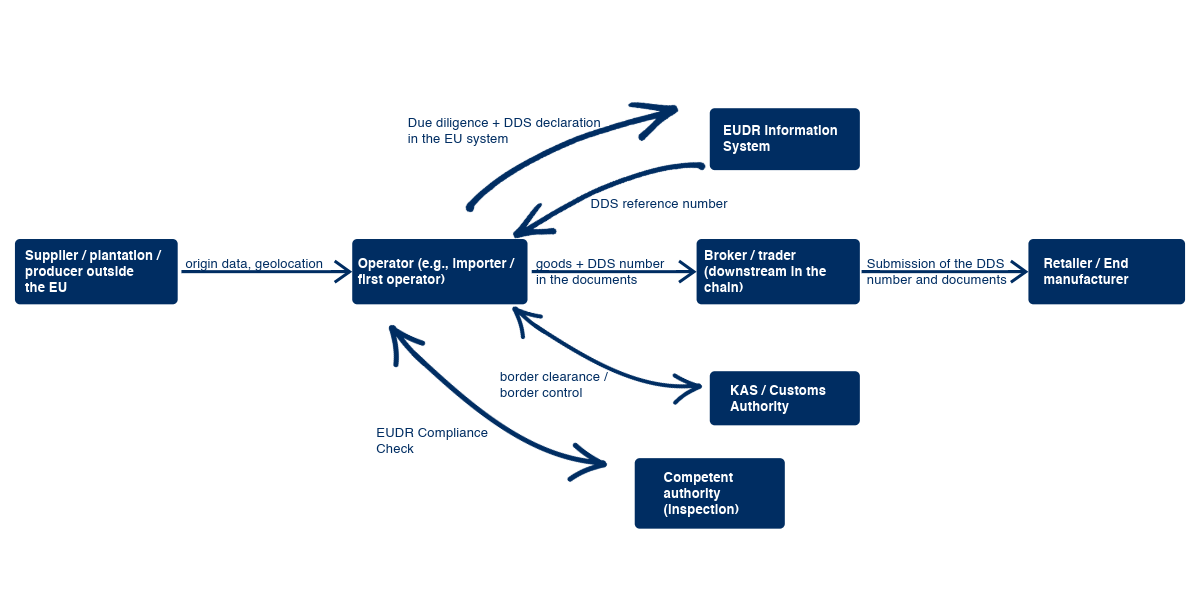
The project has three main goals. The first is to designate the competent authorities and the control model, including a significant role for the National Revenue Administration (KAS). The second is to integrate the EUDR into border procedures, i.e., integrate it with customs systems for the clearance of imported goods. The third, and potentially most damaging for businesses, is a broad catalogue of administrative and criminal sanctions, up to 10% of a business's annual turnover, as well as the possibility of introducing business bans.
The project also introduces an additional practical requirement: the requirement to use the DDS reference number in offers and commercial documents. This requires integration with ERP systems and e-commerce processes.
Differences between SMEs and large companies
Small and medium-sized enterprises have fewer resources for geolocation, supplier auditing, and system integration, but at the same time, in line with the EUDR timeline, they benefit from longer implementation times and additional buffers. It is crucial for SMEs to focus on product identification and building a simple DDS procedure, rather than immediately investing in expensive systems.
Large companies should approach EUDR as a transformational project: conduct a full product map, implement due diligence in purchasing processes, integrate EUDR with customs and controlling systems, and establish risk monitoring at the level of production countries and regions. The target model is "audit-ready" supply chain management – ready for audits at any time.
Who is the operator and who is the trader – and why does it matter?
The EUDR distinguishes between two types of actors in the supply chain, and the scope of responsibilities of each is different.
Three practical scenarios
- Coffee importer from outside the EU.
- Furniture manufacturer purchasing wooden boards in the EU.
- E-commerce store selling products with rubber, soy or wood elements.
A company acting as a "first mover" is an operator in the full sense. Before customs clearance, it must submit a DDS declaration in the EU system. The DDS number should be consistent with the clearance documentation – the draft Polish law provides for verification of this consistency by customs authorities.
Even if a company does not import directly, it may be a trader (or, in certain business models, a downstream operator). This means ensuring that the documents accompanying the goods include a DDS reference number and that the company is able to present it during an inspection.
The risks here are particularly significant: ambiguity in assigning the competent authority, difficulty collecting data from multiple suppliers, and the potential for product mix. This is one of the most frequently cited points of contention in consultations on the draft Polish law.
How to prepare? Implementation checklist
It is worth implementing EUDR in two parallel tracks: environmental compliance and customs and tax compliance. Below are seven key steps.
-
Step 1 – Product Identification.
-
Step 2 – Supply chain mapping.
-
Step 3 – DDS procedure and IT integration.
-
Step 4 – Integrate with customs clearance and import VAT.
-
Step 5 – Update commercial contracts.
-
Step 6 – Audit trail for KAS audits.
-
Step 7 – Contingency Plan.
Review your product range and raw materials by EUDR category and corresponding CN/HS code. Determine whether you are an operator or trader for each item.
For each product item, define the supplier, country of production, and required data (including parcel geolocation). Assign "data owners" within the organization – purchasing, logistics, compliance.
Determine who and in what process will submit the declaration in the EUDR system. Prepare a document repository with retention rules.
Add ex-ante (pre-shipment/clearance) checks to ensure the DDS number exists and matches the documents. Implement validations in the ERP to avoid costly delays and border holdups.
Include clauses requiring suppliers to provide EUDR data, specifying liability for false data, and audit conditions. Include cost allocation in the event of goods being detained.
Treat EUDR documentation as evidence for customs and tax audits. Data consistency should include: contractor, country of origin and production, quantities, values, transport documents, and DDS number.
Prepare a procedure in the event of an incident: suspending sales, withdrawing goods, notifying authorities, correcting documents, and quickly assessing tax (VAT, CIT) and contractual consequences.
How can we help?
As part of our EUDR support, we offer comprehensive services, including:
FAQ – the most important questions from companies
No. The regulation also covers products related to cocoa, coffee, soy, rubber, and cattle, among others.
Yes. The obligations also cover distance selling, including e-commerce.
Medium-sized and large companies – by December 30, 2026, micro and small companies – by June 30, 2027.
Fines, confiscation of products and revenue, exclusion from public procurement, and bans on the sale or export of products are possible.
In many cases, yes. It will be necessary to collect data from suppliers and analyse deforestation risk.