AI in the company under control: AI Governance, accountability, and new organisational obligations
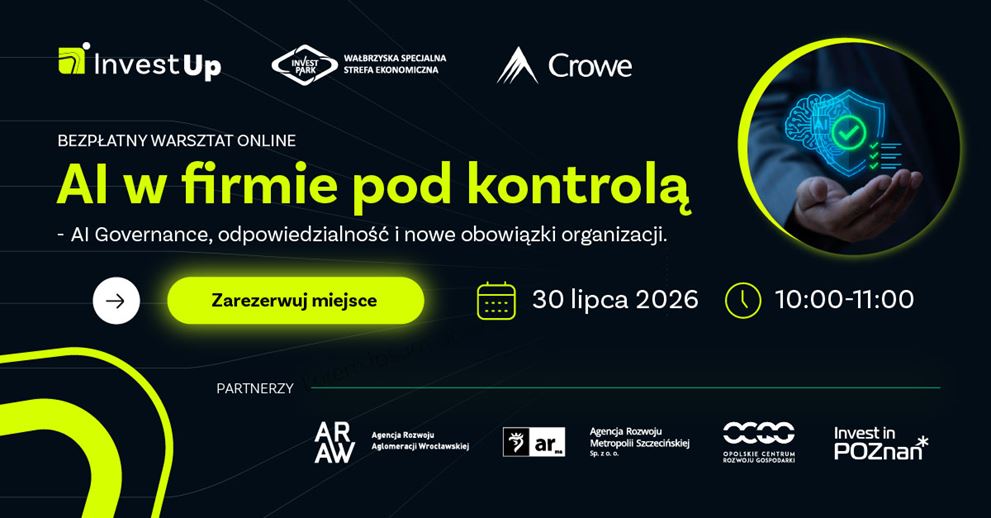
Crowe Poland and the Wałbrzych Special Economic Zone “INVEST-PARK”, with the support of the Szczecin Metropolitan Development Agency, the Wrocław Agglomeration Development Agency, the Investor Services Office of the City of Poznań, and the Opole Centre for Economic Development, invite you to watch webinar entitled “AI in the Company Under Control: AI Governance, Accountability, and New Organisational Obligations”, which took place on 30 July 2026.
There is a common misconception that AI Governance simply means implementing artificial intelligence solutions within an organisation. This is one of the most common and costly mistakes, potentially exposing businesses to significant financial risks.
If your company uses AI systems in recruitment, HR, sales, finance, or other business processes, or if employees use tools such as ChatGPT or Microsoft Copilot, your organisation is also subject to specific legal obligations. Failure to comply may result in organisational liability, substantial financial penalties, and reputational risks.
Why is AI Governance important for the entire organisation?
AI Governance is not an AI implementation project. Rather, it is a framework that ensures compliance with the European AI Act and provides oversight and control over the use of artificial intelligence within an organisation.
From 2 August 2026:
During the webinar, Crowe experts will demonstrate how to manage AI responsibly and securely across an organisation from the perspectives of management boards, HR, and compliance teams. Participants will gain practical insights into the obligations arising from new regulations, learn how to mitigate legal, operational, and reputational risks, and discover how to implement AI policies that support innovation while maintaining regulatory compliance.
Topics covered during the webinar
- What obligations employers have towards employees in the context of AI.
- How regulations (the AI Act, labour law, and GDPR) impact the day-to-day use of AI.
- How to establish clear rules: what is permitted, what is prohibited, and who is accountable in case of violations.
- How to implement AI Governance as a system of practical rules, roles, and processes.
Who should attend?
This webinar is designed for professionals responsible for organisational security, people management, and decision-making processes, including:
- Board members and Managing Directors
- HR Directors and Managers
- Operations and Compliance Directors
- Leaders responsible for innovation and automation initiatives
- Professionals responsible for internal policies and risk management
If your organisation is asking questions such as:
“Can employees use ChatGPT at work?” “What data is safe to share?” “Who approves AI tools?” “How should AI be regulated within HR?”, then this webinar is for you.
Why watch?
By watching this material, you will:
Agenda
| Punkt | Temat | Zakres |
|---|---|---|
| 1 |
Your employees are already using AI. Do you have control over it? |
|
| 2 |
AI regulations in the workplace: what do management and HR need to know? |
|
| 3 |
AI Governance |
|
| 4 |
How should employee use of AI be regulated? |
|
| 5 |
Q&A session |
|
Speakers:
 |
Milena Kowalik-Szeruga |
Director of Consulting, Crowe Poland |
 |
Violetta Matusiak |
Data Protection Officer, Crowe Poland |
 |
Jacek Włodarczyk |
Senior Manager, Crowe Poland |
Frequently Asked Questions (FAQ)
AI Governance helps organisations answer questions such as:
- Can employees use ChatGPT at work?
- What data can be entered into AI tools?
- Who is responsible for incorrect decisions made with the support of AI?
- How should an AI usage policy be developed?
- How can compliance with the AI Act and GDPR be ensured?
- How can legal and reputational risks associated with AI use be reduced?
The AI Act applies not only to AI system providers but also to organisations that use AI in their operations. Obligations may include ensuring adequate AI system oversight, conducting risk assessments, maintaining transparency towards users, and implementing appropriate internal procedures.
Yes. However, AI tools should be used in accordance with the organisation’s internal policies and applicable regulations, including the AI Act and GDPR. Employers should define which tools are approved, what data may be entered, and what responsibilities apply to employees using AI systems.
The most common risks include:
- Disclosure of confidential information
- Violations of personal data protection regulations
- Incorrect or biased decisions generated by AI systems
- Liability arising from improper AI use by employees
Implementing AI Governance principles can significantly reduce these risks.
The first step is to identify the AI tools being used within the organisation and assess the associated risks. Organisations should then develop an AI usage policy, define roles and responsibilities, train employees, and implement procedures for monitoring compliance with applicable regulations.
The webinar is intended for:
- Board members
- HR Directors and Managers
- Compliance professionals
- Security and data protection specialists
- Innovation leaders
- Individuals responsible for risk management, internal policies, or AI deployment within organisations
Through a practical approach, participants will learn how to balance AI-driven innovation with legal requirements and organisational security.