Get the latest report on trends, market conditions, and the most current information in the industry
July 20, 2026
Automotive Weekly

Image: Shutterstock
Who would you trust to change a flat tire?
As it turns out, there’s something generational about one of the simplest roadside automotive tasks: changing a flat tire. At some point, a lifelong motorist will almost certainly encounter a pesky flat, which may often be due to an errant nail or an oversized pothole. But research suggests that people place more faith in some generations than others when it comes to changing that wheel and tire. According to new international research, 67% of Americans feel that Gen X is the generation they would most trust for the task, with Gen Z receiving a staggering 0%. But there’s much more to the story than meets the eye and these numbers may have also their roots within both technological development and shifting lifestyle factors.
Source: CarBuzz
Top 15 delivered vehicles (in Australia) classed as private sales
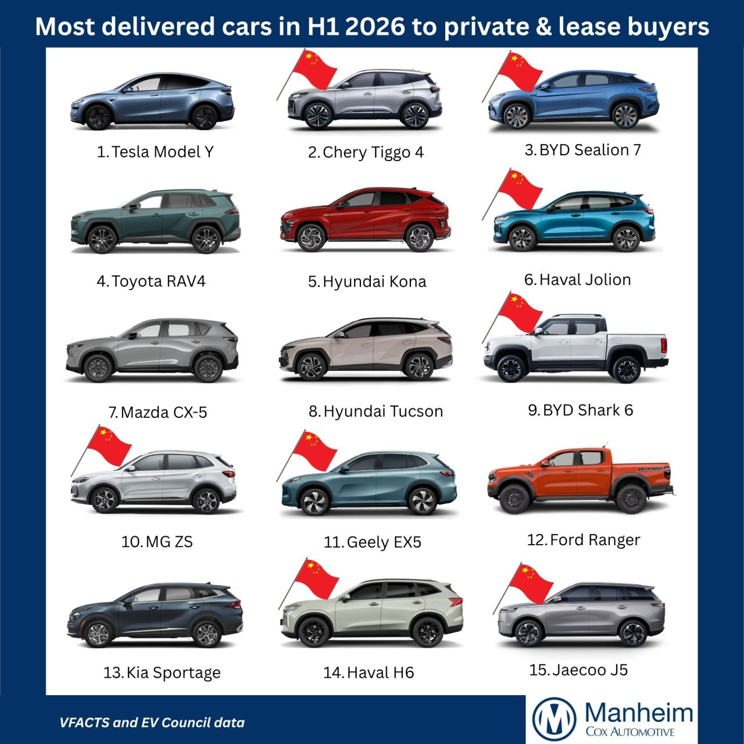
Above are the top 15 delivered vehicles classified as private sales YTD, meaning no business, rental or government cars. The vehicles Australian households favour are overwhelmingly small and mid-sized SUVs, plus two utes.
You will note more than half of the top 15 models are from Chinese brands, reflecting cost-of-living constraints changing consumer behaviours. On this note, Chinese brands own 35% of market, only slightly behind Toyota Motor Corporation Australia on 12.2%.
Source: Manheim Auctions
No color: More than 80% of vehicles on market now grayscale
Whether it's dealers or consumers playing it safe, the color choices for vehicles are now lacking vibrant hues, with an iSeeCars study showing that more than 80% of cars being sold are white, black, gray, or silver. Going gray: Over the past thirty years, the percentage of grayscale vehicles (white, black, gray, or silver) has nearly doubled from 47.3% in 1996 to 80.4% in 2025.
Source: Car Dealership Guy
Nearly 5 million vehicles need Takata airbags replaced
Twelve years after the initial recall of the Takata airbags, more than 4.8 million vehicles remain on the road without the replacement of the defective inflators, according to CARFAX data. Driving the news: The National Highway Traffic Safety Administration issued the recall of the Takata airbags in 2014, impacting more than 40 million vehicles between the model years 2001 and 2015.
Source: Car Dealership Guy
VW CEO outlines up to 50,000 more job cuts to hit savings goals
Volkswagen Group CEO Oliver Blume outlined a plan to eliminate as many as 50,000 more jobs globally as he attempts a far-reaching overhaul to reduce costs at the automaker. The German company’s overhead is higher than competitors’ by roughly one-fifth, Blume said in an interview published on VW’s intranet. Reaching parity implies a “theoretical deduction” of about 50,000 positions, on top of a similar amount that’s part of a cost-savings effort launched in 2024, he said.
Source: Bloomberg via Automotive News
Ford CEO Jim Farley implies quality culture at American plants lacking
In recent months, a hot topic of discussion has revolved around the concept that vehicles built in other countries outside of the U.S. typically have superior quality. We've seen this with Lexus, as many have pointed out that models built in Japan have better fit and finish compared to their American-produced counterparts, in fact. Ford CEO Jim Farley previously chimed in and stated that Chinese vehicles have better quality than those from the west, though The Blue Oval is also making progress in closing that gap.
Now, Farley is doubling down in that regard, stating that plants in places like China and Mexico have a more consistent quality culture and tend to achieve some of the highest results in certain key metrics, according to The Detroit News. In spite of the fact that those facilities typically lack independent labor unions, those plants are building a long-term, sustainable culture that prioritizes quality. "Consistently, our China and Mexico plants are the most compliant with process and have the deepest problem-solving skill," Farley said. "We're going to have different cultural norms, and even with a great quality operating system, cultural norms are headwinds or tailwinds, depending on where you are, on delivering the quality operating system." "What I found is that we were on the wrong side of the invisible line for the dignity of workplace," Farley said about taking over as CEO of Ford. "How could we expect our American workers to beat the Japanese and South Korean imported workers, so to speak, in quality, if they didn't have the proper tools, or even felt pride in post-coronavirus to share their workspace?"
Over the years, Farley has visited a number of plants around the globe, which he says shifted his perception of what sort of culture is needed to improve quality. "What I'm looking for is: Are my teammates tied to some greater responsibility than just winning awards?" he said. "Are they trying to do this for our customers? Are they trying to do this for the Ford family?
Source: Ford Authority
Some Canadian car dealerships - second thoughts about Chinese brands
Canadian car dealerships that initially rushed to explore franchise opportunities with Chinese automakers are taking a more cautious approach as questions about profitability, dealer support, and long-term viability begin to outweigh early enthusiasm. Canada reopened its market to Chinese-built electric vehicles in January under a quota system that allows 49,000 imports in 2026, with the annual cap increasing by 6.5 percent thereafter. Automakers including BYD, Chery, and Geely quickly began laying the groundwork for Canadian retail networks, with showroom openings expected ahead of vehicle sales next year. Interest from dealers followed just as quickly, but that enthusiasm has cooled as more details have emerged.
“The bloom is off the rose,” Samir Akhavan, managing director of buy-sell brokerage Templeton Marsh, told Automotive News. While he praised the vehicles themselves, he questioned whether the broader business model is ready for Canadian retailers. “What about OEM relations? What about getting your warranty paid? What about service? What about a business plan? There are so many things that are even today undefined that I just can’t see this being a worthwhile proposition – not now.” The concerns extend well beyond the products. Dealers worry about limited inventory under Canada’s import quota, uncertain franchise agreements, and the prospect of operating at a loss for several years while new brands establish themselves. Those issues became more apparent after approximately 70 dealers participated in a Canadian Automobile Dealers Association trip to China earlier this year.
“Everyone was bullish when we landed. But by the time they heard all the news and learned all the details … a lot of them were quite the opposite – I would say more than half,” said Michael MacGillivray, CEO of Century Auto Group. He added that dealers were warned to expect “two or three years of losses” before seeing meaningful returns. Even so, some retailers continue to view Chinese brands as a long-term opportunity. “I’d be excited to become a dealer. I think some things you invest in,” MacGillivray said. Analysts believe the equation could change significantly if Chinese automakers establish vehicle assembly operations in Canada. Local production would ease supply constraints while signaling a deeper commitment to the market. “If they do that, things will change,” Akhavan said.
Dan Hearsch, global co-leader of AlixPartners’ automotive practice, believes Canada represents a strategic foothold for Chinese manufacturers seeking future access to North America. “You’re basically betting that there’s an advantage to being an early mover, to becoming established, and you’re betting that eventually that these trade barriers will come down.”
For now, many Canadian dealerships appear willing to watch and wait rather than commit immediately, balancing the promise of emerging EV brands against unresolved financial and operational risks.
Source: GM Authority and Automotive News
Pricing transparency raises OEM website satisfaction, JD power finds
Automakers that provide clearer pricing information on their websites are seeing bigger gains in customer satisfaction and purchase consideration, according to the latest JD Power 2026 U.S. Manufacturer Website Evaluation Study (MWES). Overall satisfaction with original equipment manufacturer (OEM) websites rose 18 points wave over wave among mass market brands and 13 points among premium brands, on a 1,000-point scale. Shopper purchase consideration after visiting a website also climbed, reaching 52% among mass market shoppers and 54% among premium shoppers.
Source: CBT News