
Not long ago, passing an audit was treated as the finish line - a checkbox that told an organization it was secure. That assumption still lingers in a lot of boardrooms.
Today, breaches keep happening at organizations that were fully compliant at the time. PCI DSS certified companies get breached. ISO 27001 certified companies get breached. Organizations that passed every SOC 2 audit still end up in the headlines. Compliance didn't fail them by accident - it was never designed to do what people assumed it was doing.
The result isn't a rare exception worth a footnote. It's a pattern worth paying attention to.
Compliance is neither useless nor sufficient. Its value depends on understanding exactly what it does - and, just as importantly, what it doesn't.
Why Compliance and Security Aren't the Same Thing
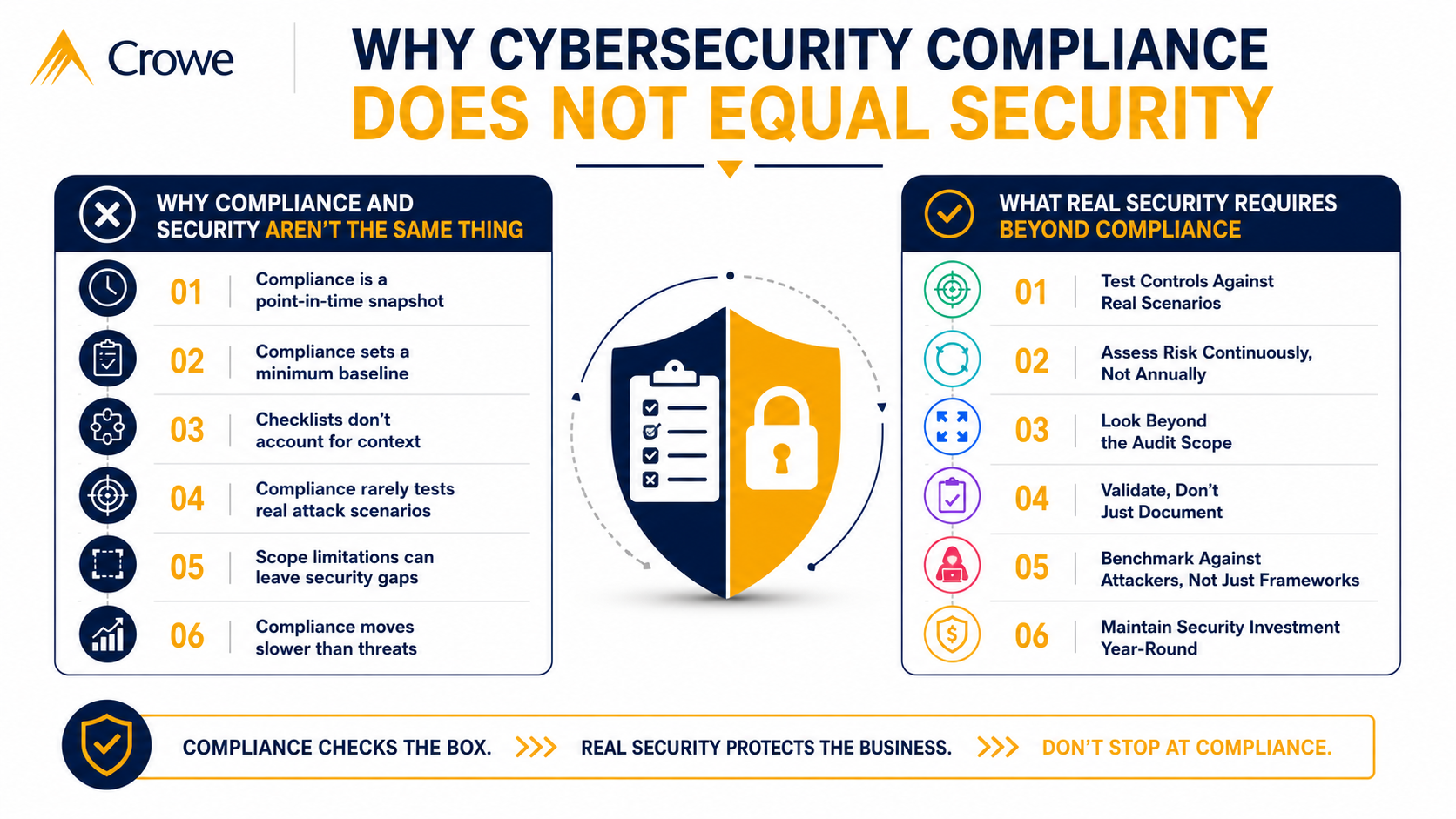
- Compliance Is a Point-in-Time Snapshot An audit measures whether controls were in place on the day it was conducted. Security is a continuous state that has to hold up every day in between. A network can be compliant on audit day and misconfigured a week later - and nothing about the certification changes that.
- Compliance Defines a Minimum, Not a Ceiling Regulatory frameworks are built to apply across entire industries, which means they set a baseline broad enough to fit almost everyone. That baseline is rarely enough to stop a determined, targeted attacker - it was never designed to be the hardest bar to clear, just a common one.
- Checklists Don't Account for Context A control that's appropriate for one organization's risk profile may be inadequate for another's. Compliance frameworks ask "is this control in place?" far more often than they ask "is this control enough for what you're actually protecting?" Two organizations can pass the same audit with very different real-world exposure.
- Compliance Rarely Tests Real Attack Scenarios Most frameworks focus on documentation, policy existence, and control configuration - not on whether those controls actually withstand a realistic attack. An organization can have a fully documented incident response plan that has never been tested against anything resembling a real incident.
- Scope Limitations Leave Gaps Compliance assessments are usually scoped to specific systems, data types, or environments. Everything outside that scope - a shadow IT system, an overlooked subsidiary, a legacy application - can remain completely unexamined while the certified environment looks pristine.
- Compliance Moves Slower Than Threats Regulatory frameworks are updated on a schedule; attackers are not. By the time a control requirement catches up to a new attack technique, that technique may already be widely used. Compliance tends to describe yesterday's risk landscape more reliably than today's.
Why This Gap Persists
Organizations don't fall into this gap out of negligence. It typically happens because of: Treating compliance as the security program itself, rather than one input into it Budget and attention concentrated around audit cycles rather than continuous improvement Assuming a passed audit means leadership can stop asking hard questions Confusing "documented" with "effective"
What Real Security Requires Beyond Compliance
- Test Controls Against Real Scenarios - Run penetration tests and red team exercises that go beyond what the audit checklist requires.
- Assess Risk Continuously, Not Annually - Treat risk assessment as an ongoing process, not an event tied to renewal dates.
- Look Beyond the Audit Scope - Identify systems, vendors, and data that fall outside certification boundaries and assess them anyway.
- Validate, Don't Just Document - Confirm that policies on paper reflect what actually happens operationally.
- Benchmark Against Attackers, Not Just Frameworks - Measure security posture against current threat intelligence, not only against last year's regulatory requirements.
- Maintain Security Investment Year-Round - Avoid concentrating budget and effort only around audit deadlines.
The Strategic Question Leaders Should Ask
Before assuming compliance equals protection, organizations should ask:
- Have we tested our controls against realistic attack scenarios, or only documented them?
- Do we know what falls outside our compliance scope - and have we assessed it anyway?
- Would we still feel confident in our security if the next audit were six months away instead of tomorrow?
- Are we treating compliance as the goal, or as one input into a broader security strategy?
- If a sophisticated attacker targeted us specifically, would our compliant controls actually hold?
- If your last audit passed with no findings, would that tell you anything about whether you'd survive a real attack?
Final Thought
Compliance and security exist to answer different questions. Compliance asks whether an organization met a defined set of requirements. Security asks whether that organization can actually withstand an attack.
Both matter. But only one of them keeps an organization safe when it counts.
The organizations that hold up under real pressure aren't the ones with the cleanest audit reports. They're the ones that used compliance as a floor to build on - not a finish line to stop at.
Author is Director, Cyber Threat Management at Crowe UAE and can be reached at [email protected] or call +971 52 373 4662
Cyber Shield
Welcome to Cyber Shield Tuesday - your weekly pulse on the evolving world of Cyber Threat Management.
Stay ahead of emerging threats, vulnerabilities, and defense strategies with expert insights tailored for today’s digital risk landscape. Because in Cybersecurity, being informed is your first line of defense.
Detect. Defend. Recover.