Third-Party & Supply Chain Risk
Your Vendors Could Be Your Weakest Link
I regularly ask security leaders a question that produces a surprisingly consistent reaction: "How many third-party vendors have access to your critical systems, data, or infrastructure right now?"
Most pause. Some estimate. Very few know the precise answer.
And when I follow up "Of those vendors, how many have you assessed for cyber resilience in the last twelve months?" the room usually goes quiet.
This is one of the most significant and consistently underestimated exposures in organizations today.
Your perimeter may be hardened. Your internal controls may be mature. But if a vendor with privileged access to your environment has a weak security posture, an unpatched system, or a compromised credential your defenses become secondary.
The attacker does not need to break through your front door if a vendor has left a window open.
The Dependency We Have Built
The modern enterprise operates through an ecosystem of interdependencies that would have been unimaginable a decade ago.
Cloud platforms host critical workloads. SaaS applications manage finance, HR, customer data, and operations. Managed service providers maintain infrastructure, security tools, and network connectivity.
Outsourced business process providers handle functions that were once entirely internal. System integrators build and maintain the digital architecture that organizations run on. This model delivers real value agility, scalability, specialized expertise, cost efficiency.
But it also creates a fundamental security reality that many organizations have not fully reckoned with:
Your security posture is no longer determined solely by what you control. It is determined by the collective security posture of every organization with access to your environment.
And most organizations have very limited visibility into that collective posture.
How Supply Chain Attacks Unfold
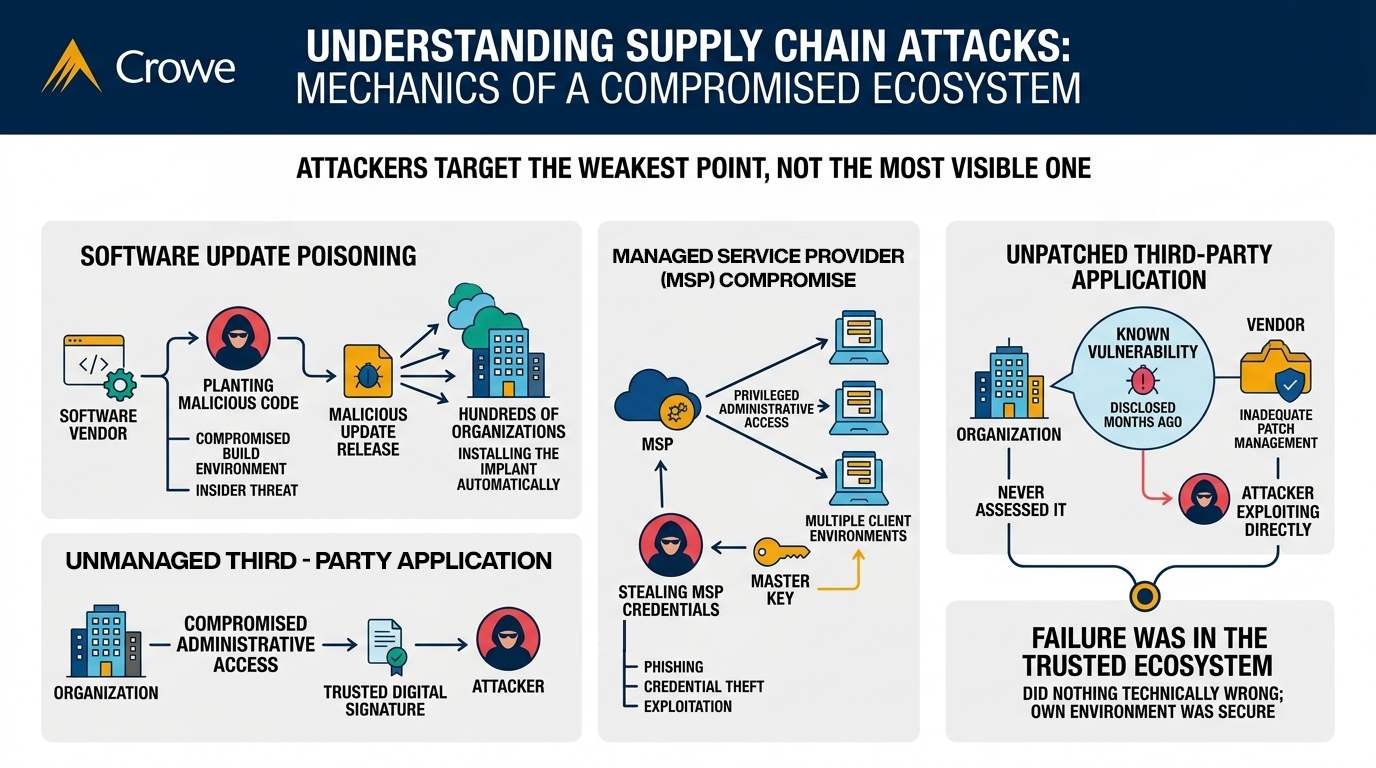
The mechanics of a supply chain attack follow a logic that makes it particularly dangerous: attackers target the weakest point in a connected ecosystem, not the most visible one.
A software vendor used by hundreds of organizations releases an update. Embedded within that update is malicious code planted either through a compromise of the vendor's build environment or through a sophisticated insider threat. Every organization that applies the update installs the implant automatically, trusting the vendor's digital signature.
A managed service provider has privileged administrative access to multiple client environments. An attacker compromises the MSP's own credentials through phishing, credential theft, or exploitation of an unpatched system. They now have a master key to every client environment the MSP services
A third-party application integrated into an organization's core systems contains a vulnerability that has not been patched. The vulnerability was disclosed months ago. The vendor's patch management program is inadequate. The integrating organization never assessed it. The attacker exploits it directly.
In each scenario, the organization that suffers the breach did nothing technically wrong. Their own environment was secure. The failure was in the ecosystem they trusted.
The UAE & GCC Context: Why This Risk Is Amplified
Several characteristics of the UAE & GCC business environment make supply chain risk particularly acute.
High Vendor Dependency: UAE organizations particularly in financial services, government, real estate, and logistics have aggressively outsourced technology and business process functions. The efficiency gains are real. But the security interdependencies created are often poorly mapped and rarely assessed.
Free Zone Complexity: Organizations operating across mainland UAE and multiple free zones frequently work with different vendors, system integrators, and service providers across jurisdictions each with potentially different security standards, contractual obligations, and oversight mechanisms.
Regional Vendor Ecosystems: Many technology vendors serving the UAE market are regional entities with smaller security teams, less mature security programs, and fewer resources to respond rapidly to emerging threats. The assumption that a vendor's security posture matches your own is rarely validated.
Regulatory Expectations Are Increasing: Frameworks including NESA, ADGM FSRA requirements, and sector-specific guidance are increasingly explicit about third-party risk management obligations. The question is no longer whether organizations should assess vendor security - it is whether organizations can demonstrate that they have.
Part 2 will be continued on 9 June 2026, Tuesday
Author is Director, Cyber Threat Management at Crowe UAE and can be reached at [email protected] or call +971 52 373 4662
Cyber Shield
Welcome to Cyber Shield Tuesday - your weekly pulse on the evolving world of Cyber Threat Management.
Stay ahead of emerging threats, vulnerabilities, and defense strategies with expert insights tailored for today’s digital risk landscape. Because in Cybersecurity, being informed is your first line of defense.
Detect. Defend. Recover.