Deepfake & Social Engineering 2.0
The Executive Impersonation Threat
Imagine receiving a voice message from your CEO.
The tone is familiar. The urgency is clear. The request is specific: authorize an emergency wire transfer before end of business today. The details check out. The voice is unmistakably his.
Except it isn't.
It is a synthetic voice cloned from publicly available audio in under an hour and your finance team has just been socially engineered into one of the costliest attack vectors in modern cybercrime.
This is not a hypothetical scenario. It is happening to organizations right now.
Social Engineering Has Graduated
For a long time, social engineering meant phishing emails with grammatical errors, fake login pages that looked slightly off, and phone calls from callers with implausible stories.
Security awareness training was built around recognizing these signals.
That playbook is obsolete.
The emergence of AI-powered voice synthesis, deepfake video generation, and large language models capable of mimicking communication styles has created a new class of threat one that bypasses technical controls entirely by targeting the most exploitable vulnerability in any organization: human judgment.
Attackers are no longer trying to break through your firewall. They are calling your CFO directly in your CEO's voice.
The New Social Engineering Toolkit
Voice Cloning
Publicly available audio earnings calls, conference presentations, media interviews, LinkedIn video posts provide sufficient training data for AI models to synthesize a convincing replica of an individual's voice. In documented cases, attackers have used cloned voices in real-time phone calls to authorize fraudulent transactions, bypass verification protocols, and extract sensitive access credentials.
The region’s high concentration of publicly visible executives in financial services, real estate, and government entities creates a significant pool of exploitable voice data.
Deepfake Video
Video calls have become a standard verification mechanism for high-value transactions and sensitive decisions. Deepfake technology can now generate real-time video manipulation placing a synthesized face over an attacker's face during a live call. Organizations that have moved to video verification as a security control may be providing a false sense of protection.
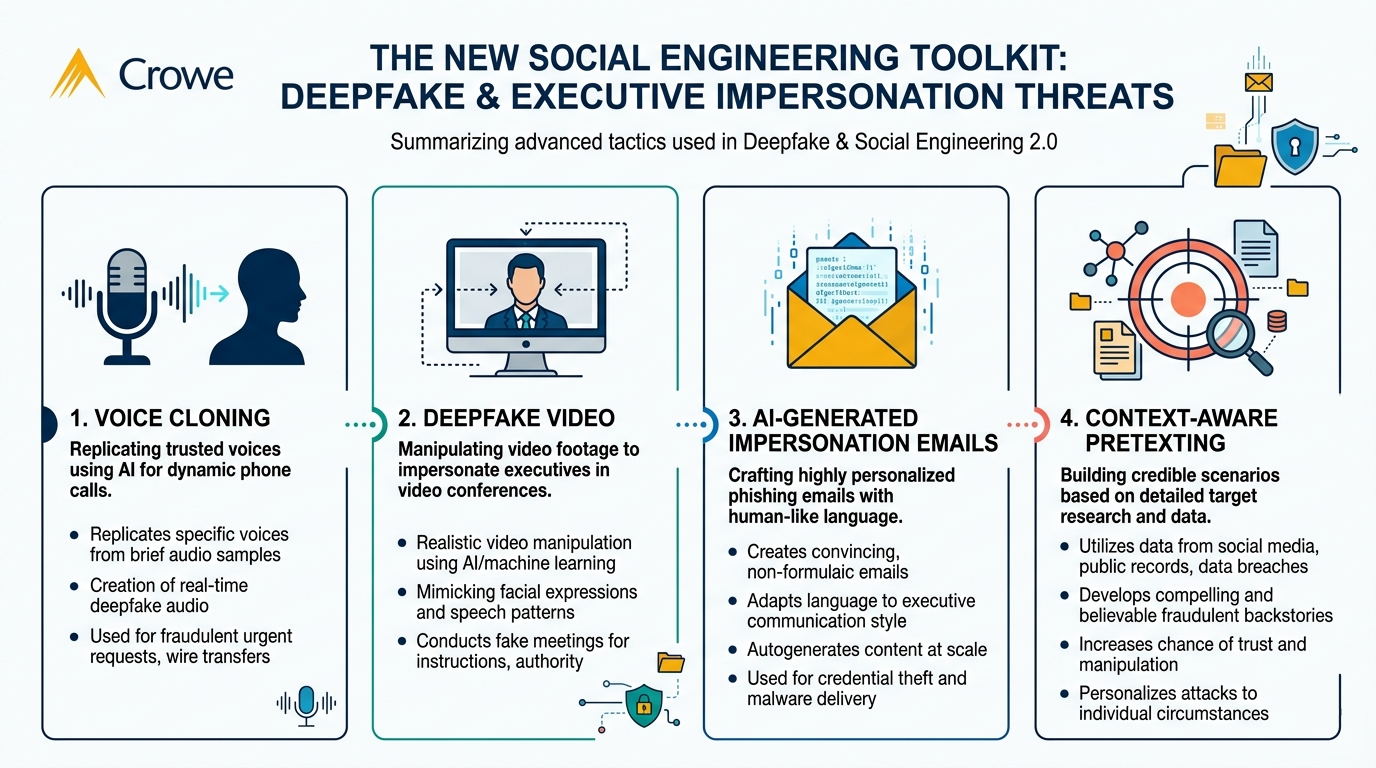
AI-Generated Impersonation Emails
Large language models trained on publicly available communications can replicate writing styles with precision. An attacker who has studied an executive's LinkedIn posts, press releases, and published communications can generate emails that match that individual's tone, vocabulary, and communication patterns making traditional indicators of phishing nearly invisible.
Context-Aware Pretexting
Modern social engineering attacks are researched operations. Attackers spend weeks mapping organizational structures, understanding key relationships, identifying ongoing projects, and learning the internal language of a target organization. When the attack comes, it arrives with the right context, the right terminology, and the right emotional framing to override scepticism.
Why Organizations Face Elevated Risk
The business culture carries specific characteristics that attackers understand and deliberately exploit.
Hierarchical decision-making structures mean that requests from senior leadership carry significant authority and challenging them feels professionally uncomfortable. Attackers exploit exactly this dynamic: create urgency, invoke seniority, and compress the time available for verification.
The region's role as a global financial hub means high-value transactions are routine. A request for an urgent wire transfer does not automatically trigger alarm. In context, it can appear entirely normal.
And the region’s profile as a hub for international business means executives regularly interact with new contacts, new organizations, and new voices reducing the natural scepticism that comes from exclusively dealing with familiar counterparts.
What These Attacks Look Like in Practice
A regional bank's finance director receives an urgent call from what sounds exactly like the Group CFO. An acquisition is closing early. Regulatory approval has been accelerated. A deposit needs to be transferred within two hours to avoid losing the deal. The caller provides the account details and requests that the transaction be kept confidential until the announcement.
A government procurement officer receives a video call from what appears to be a senior official, directing an amendment to a supplier contract under time pressure.
A technology company's IT administrator receives an email from what appears to be the CTO written in his exact style, referencing an ongoing project by name requesting that a new user account be provisioned with domain administrator privileges for an external consultant.
In each case, the attacker has done their research. The impersonation is convincing. And the pressure to act quickly is engineered to prevent the verification steps that would expose the fraud.
Building Defenses Against Attacks That Target Human Judgment
Every high-value or sensitive request regardless of how legitimate it appears must be verified through a separate, pre-established communication channel. Not a callback to the number provided. Not a reply to the email received. A call to a known, independently verified number. This single control eliminates a significant percentage of impersonation attacks.
Wire transfers, contract amendments, credential provisioning, and data access requests above defined thresholds should require multi-party authorization with at least one party physically present or verified through a secure, independent channel. No single voice call or email, however convincing, should be sufficient.
The public availability of executive voice and video content is a supply chain for impersonation attacks. Organizations should assess what audio and video is publicly available for their senior leadership and consider whether it creates exploitable training data for adversaries.
Traditional phishing simulations are insufficient. Organizations must simulate deepfake voice calls, AI-generated email impersonations, and video call scenarios creating muscle memory for the verification behaviors that protect against these attacks, not just the cognitive ability to recognize them in theory.
Create an explicit organizational norm: requests that combine unusual urgency, requests for secrecy, and deviation from standard process are red flags regardless of who appears to be making them. Empower employees to pause, verify, and escalate without fear of professional consequence.
The Leadership Dimension
Social engineering attacks succeed when organizational culture prioritizes responsiveness over verification, and when challenging senior leadership feels more professionally risky than complying with a suspicious request.
Boards and executive teams have a direct role in changing this dynamic by explicitly communicating that verification is always appropriate, that no legitimate request will punish an employee for following proper authorization procedures, and that the cost of a successful impersonation attack vastly exceeds the cost of a brief delay in any transaction.
Security culture is ultimately a reflection of leadership behavior.
The Question Organizations Must Sit With
If someone called your finance team today in your CEO's voice, with the right context, with the right urgency how confident are you that your people would pause to verify rather than act?
If the answer requires any hesitation, the gap is already there.
Attackers are counting on it.
The question is whether your defenses have raised their ceiling to match.
Cyber Shield
Stay ahead of emerging threats, vulnerabilities, and defense strategies with expert insights tailored for today’s digital risk landscape. Because in Cybersecurity, being informed is your first line of defense.
Detect. Defend. Recover.