Crypto Regulation in the UAE
The Rise of a Multi-Regulator Risk Framework
The UAE has become one of the world’s most sophisticated virtual asset jurisdictions because it is not trying to regulate crypto with a single rulebook. Instead, it is building a risk-segregated architecture in which each regulator supervises the risks that fall within its mandate, from payments and stablecoins to market integrity, investor protection, custody, prudential resilience, and systemic oversight.
That distinction matters for firms entering or expanding in the market. A business model that touches payment tokens, trading, custody, brokerage, advisory, issuance, staking, or asset promotion may trigger different obligations depending on whether activity sits under the Central Bank of the UAE, VARA in Dubai, the DFSA in DIFC, the FSRA in ADGM, or the emerging federal capital markets perimeter like CMA.
The CBUAE’s Payment Token Services Regulation, issued in 2024, is especially important for stablecoin and payment-use cases. It sets out licensing and registration expectations for payment token issuance, conversion, custody, and transfer, and makes clear that payment token activity directed to persons in the UAE cannot proceed without CBUAE authorization. For firms, this means the first question is not “Is this crypto?” but “Does this activity function as a payment instrument, and therefore belong inside the payments perimeter?”
Dubai’s VARA Rulebook takes a different approach by focusing on market conduct, custody, operational controls, disclosures, and licensing for virtual asset activities. Recent updates have reinforced market integrity, issuer disclosure, and restrictions around anonymity-enhanced cryptocurrencies, signalling that Dubai is shaping a commercial framework that prizes transparency and supervision over loosely defined innovation. For issuers and intermediaries, the message is clear: product design, token promotion, wallet controls, and surveillance standards are regulatory issues, not afterthoughts.
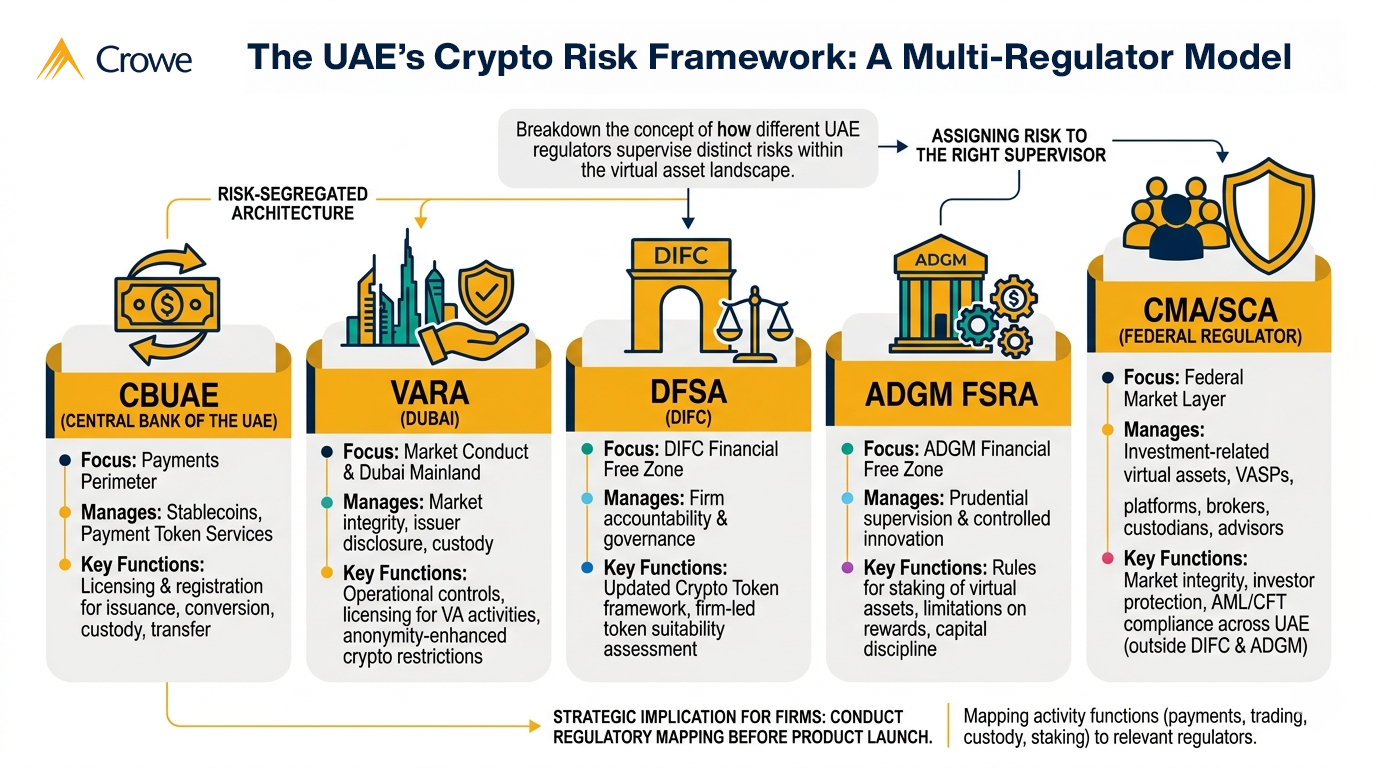
In DIFC, the DFSA’s updated Crypto Token framework has moved the conversation further toward firm accountability. As of January 2026, firms must make a reasoned and documented assessment of whether a token meets the DFSA’s suitability criteria, rather than relying on a regulator-published list of recognized tokens. That change raises the governance bar significantly, because token due diligence, recordkeeping, and product oversight now sit squarely with the regulated firm.
Abu Dhabi’s ADGM FSRA regime continues to set a high benchmark for prudential supervision and controlled innovation. The FSRA has refined its digital asset framework and, in April 2026, finalized rules for staking of virtual assets, including limitations on rewards and clearer disclosure obligations. This reflects a broader ADGM philosophy: virtual assets are financial activities that require governance, capital discipline, and documented controls rather than experimental treatment.
The federal direction is also becoming more visible. UAE capital markets regulation is increasingly converging around a more comprehensive framework for virtual asset activities, with recent developments pointing to clearer modules for conduct, prudential standards, AML/CFT, and trading controls. For market participants, that suggests the UAE is not fragmenting regulation; it is specializing it.
Another regulator in the virtual asset area is the Securities and Commodities Authority (SCA), the UAE’s federal market regulator, called as Capital Market Authority (CMA), effective 1 January 2026 under Federal Decree-Laws No. 32 and 33 of 2025. In the virtual asset space, CMA/SCA rules primarily govern investment-related virtual assets, VASPs, trading platforms, brokers, custodians, portfolio managers, and advisory activity outside DIFC and ADGM, while payment tokens remain under the Central Bank and Dubai mainland activity is coordinated with VARA.
Its role in UAE crypto regulation is to provide the federal risk layer for market integrity, investor protection, AML/CFT compliance, custody controls, listing standards, and prudential governance. In practical terms, CMA/SCA helps separate payment-token risk from investment-token risk, sets conduct and licensing expectations for virtual asset businesses, and supports a more credible, institutionally oriented digital asset market across the UAE.
For firms, the practical implication is simple. Success in the UAE crypto market depends on regulatory mapping before product launch, not after. Teams should identify whether each activity touches payments, issuance, custody, trading, brokerage, staking, promotion, or advice, then align governance, legal entity structuring, AML controls, technology safeguards, and customer disclosures to the relevant regulator’s expectations.
The bigger lesson is that the UAE is building a mature digital asset market by assigning risk to the right supervisor. That approach gives the market clarity without compromising control. In a sector where misclassification can create legal, prudential, and reputational exposure, the UAE’s model is increasingly becoming the regional standard for responsible crypto growth.
The author is Rajeev Nanda, Partner – Internal Audit & GRC at Crowe UAE and can be reached at [email protected].
GRC Compass