Cloud Security Mistakes That Still Expose Organizations to Risk
The Shared Responsibility Misconception
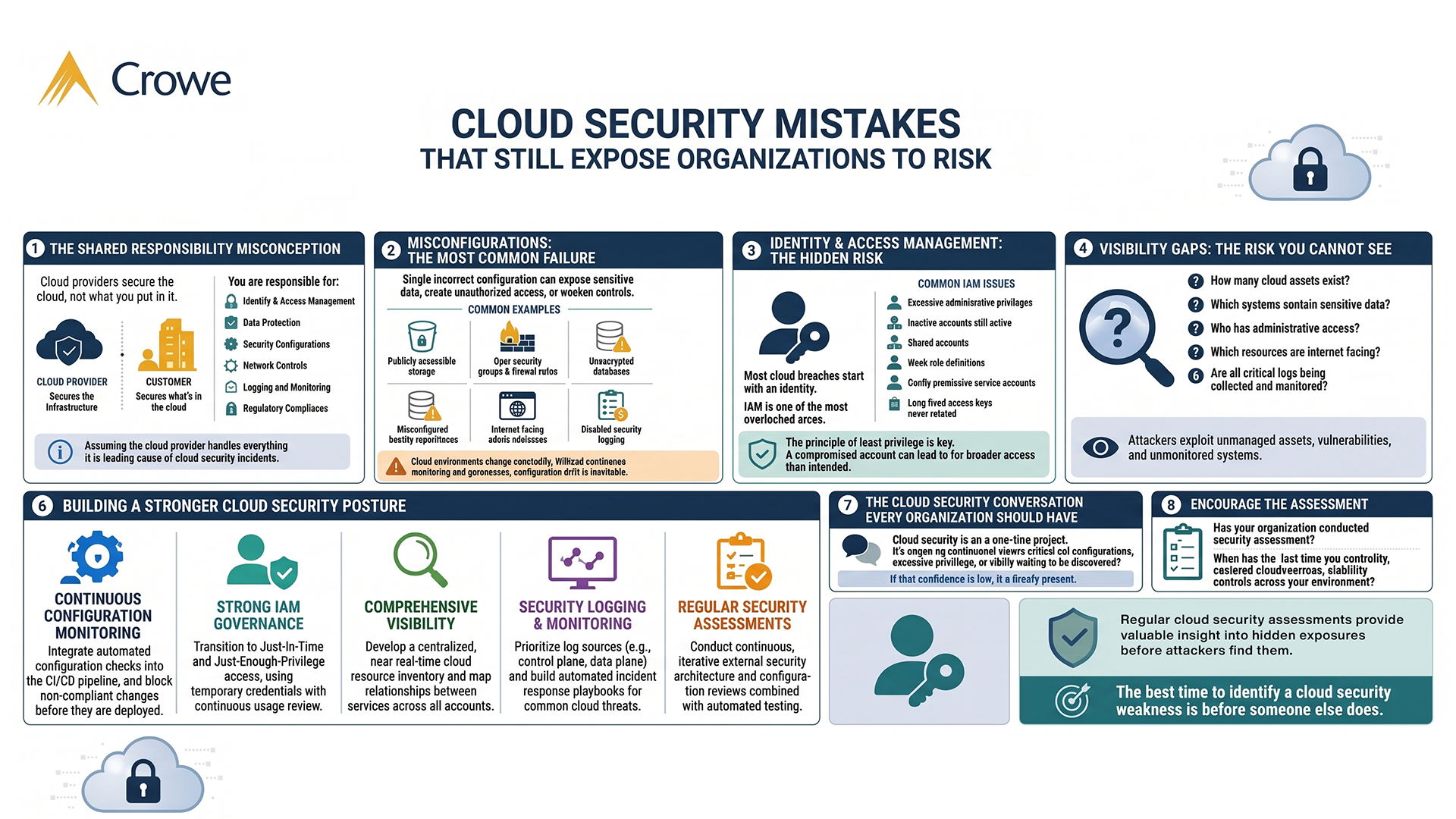
One of the most common misunderstandings in cloud security involves the shared responsibility model.
Cloud providers invest heavily in securing the infrastructure that supports their services. However, securing what organizations place inside that infrastructure remains the customer's responsibility.
Many organizations assume that because their workloads reside on a trusted cloud platform, they automatically inherit comprehensive security protection.
They do not.
While the cloud provider secures the underlying platform, organizations remain responsible for:
- Identity and access management
- Data protection
- Security configurations
- Network controls
- Logging and monitoring
- Regulatory compliance
The misconception that security is "handled by the cloud provider" continues to be a significant contributor to cloud-related incidents.
Misconfigurations: The Most Common Cloud Security Failure
If there is one cloud security issue that consistently appears across assessments, it is misconfiguration.
Cloud platforms offer tremendous flexibility, but flexibility also creates complexity.
A single incorrect configuration can expose sensitive data, create unauthorized access paths, or weaken security controls without immediate visibility.
Common examples include:
- Publicly accessible storage repositories
- Open security groups and firewall rules
- Unencrypted databases
- Misconfigured backup repositories
- Internet-facing administrative interfaces
- Disabled security logging
The challenge is that cloud environments change constantly.
New resources are deployed, configurations are modified, and development teams move quickly to meet business objectives.
Without continuous monitoring and governance, configuration drift becomes inevitable.
Identity and Access Management: The Hidden Risk
Cloud security today is largely identity security.
Most successful cloud compromises begin with a user account, service account, API key, or privileged identity that has been improperly managed.
Unfortunately, Identity and Access Management (IAM) remains one of the most overlooked areas of cloud security.
During cloud assessments, organizations frequently discover:
- Excessive administrative privileges
- Dormant accounts that remain active
- Shared accounts
- Weak role definitions
- Overly permissive service accounts
- Long-lived access keys that are never rotated
The principle of least privilege is often discussed but not consistently enforced.
The result is an environment where a compromised account may provide attackers with far broader access than intended.
Visibility Gaps: The Risk You Cannot See
Perhaps the most dangerous cloud security issue is the one organizations are unaware exists.
Many cloud environments have grown rapidly over time, often across multiple business units, subscriptions, accounts, and regions.
As environments expand, visibility becomes increasingly difficult.
Questions that should have simple answers often become surprisingly complex:
- How many cloud assets currently exist?
- Which systems contain sensitive data?
- Who has administrative access?
- Which resources are internet-facing?
- Are all critical logs being collected and monitored?
If organizations cannot answer these questions confidently, they may already have significant visibility gaps.
Attackers actively exploit unmanaged assets, forgotten workloads, and unmonitored services because they know these resources frequently escape routine security oversight.
Visibility is not merely an operational concern.
Why These Mistakes Persist
Cloud security challenges rarely arise because organizations are careless.
They arise because cloud environments evolve faster than traditional governance processes.
Development teams prioritize speed.
Business units demand agility.
New services can be deployed in minutes.
Meanwhile, security teams are often tasked with maintaining oversight across increasingly complex environments.
Without automated governance, continuous monitoring, and regular security assessments, security debt accumulates quickly.
What begins as a minor exception can evolve into a significant exposure over time.
Building a Stronger Cloud Security Posture
Reducing cloud risk does not require eliminating every vulnerability.
It requires focusing on the areas that consistently contribute to security incidents.
Organizations should prioritize:
- Continuous Configuration Monitoring
Implement automated controls to identify misconfigurations before they become exploitable weaknesses. - Strong IAM Governance
Review permissions regularly, enforce least privilege principles, and remove unnecessary administrative access. - Comprehensive Visibility
Maintain accurate inventories of cloud assets, identities, data repositories, and internet-facing resources. - Security Logging and Monitoring
Ensure cloud-native logging is enabled and integrated into security monitoring and incident response processes. - Regular Security Assessments
Periodic independent reviews help identify exposures that internal teams may overlook and validate the effectiveness of existing controls.
The Cloud Security Conversation Every Organization Should Have
Cloud adoption continues to deliver tremendous business value.
But organizations must recognize that cloud security is not a one-time implementation exercise.
It is an ongoing process of validation, monitoring, and improvement.
The question is not whether your organization has invested in cloud security.
The question is whether those investments are effectively reducing risk today.
If a cloud security assessment were conducted tomorrow, would you be confident that there are no critical misconfigurations, excessive privileges, or visibility gaps waiting to be discovered?
For many organizations, that confidence may be lower than expected.
Encourage the Assessment
Has your organization recently conducted a cloud security assessment?
When was the last time you reviewed cloud configurations, IAM permissions, and visibility controls across your environment?
Regular cloud security assessments provide valuable insight into hidden exposures before attackers find them.
Author is Director, Cyber Threat Management at Crowe UAE and can be reached at [email protected] or call +971 52 373 4662