Leveraging AI for a Sustainable Future
Revolutionizing ESG and Climate Risk Management
Artificial intelligence is rapidly becoming a practical tool for sustainability, ESG, and climate risk management. As organizations face pressure from regulators, investors, and customers, AI can help turn fragmented environmental data into timely insights, sharper decisions, and measurable action. From climate forecasting to ESG reporting, AI is helping businesses move from reactive compliance to proactive resilience.
The AI Revolution in ESG Reporting
The convergence of Artificial Intelligence (AI) and Environmental, Social, and Governance (ESG) frameworks has shifted from a futuristic concept to a mechanical necessity. As global markets, particularly within the UAE’s Green Agenda 2030, move toward stricter transparency and decarbonization, AI is the engine powering this transition. From predicting volatile weather patterns to automating complex compliance reporting, AI is no longer just a tool; it is the architect of sustainable business resilience.
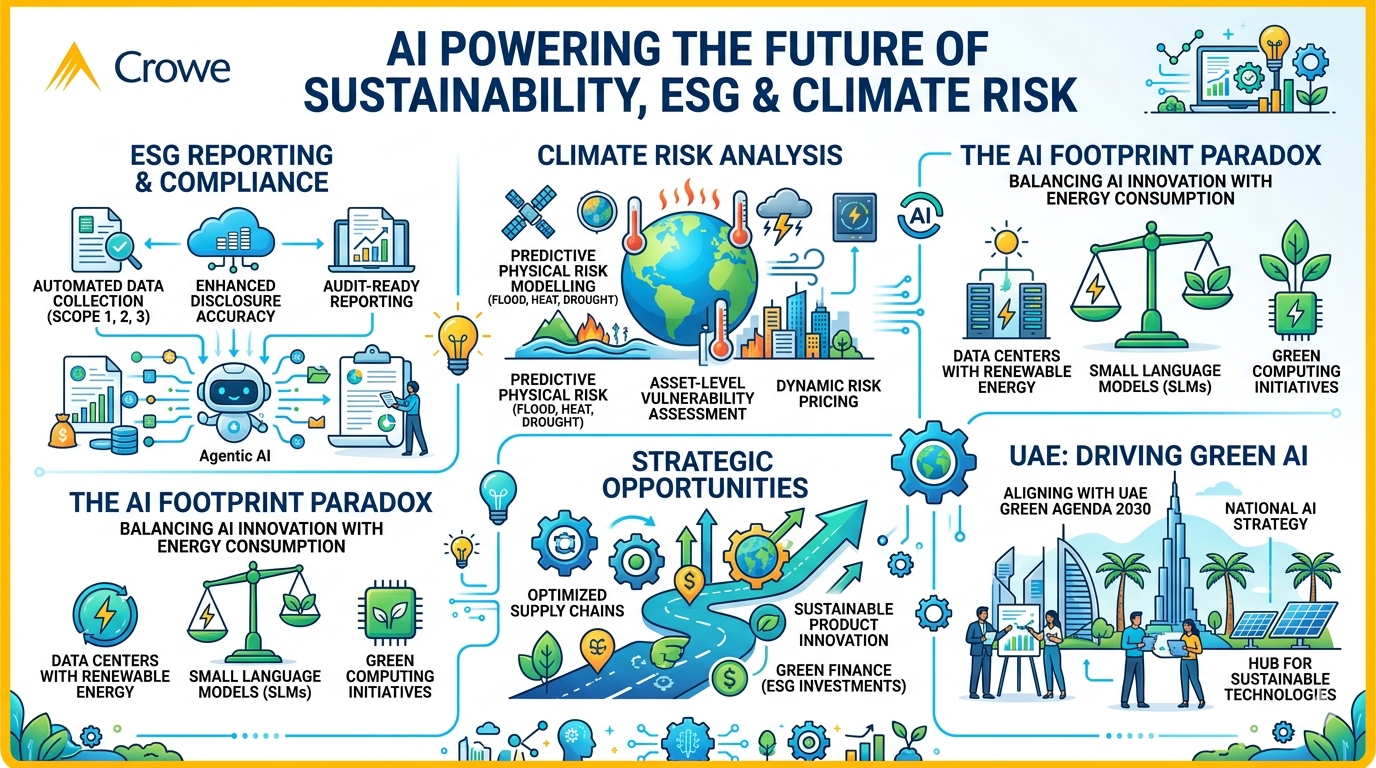
For years, ESG reporting was a manual, spreadsheet-heavy burden prone to "greenwashing" risks and human error. In 2026, the landscape has changed. Generative and Agentic AI now streamline data collection across global supply chains, ensuring that Scope 1, 2, and 3 emissions are tracked with unprecedented precision.
Real-Time Data Integration: AI systems can now pull live telemetry from IoT sensors in factories and logistics hubs, providing a continuous feed of carbon metrics rather than static annual snapshots.
Audit Readiness: By identifying data anomalies and gaps early, AI-driven platforms ensure that disclosures are compliant with international standards like the CSRD and local UAE regulations from the CBUAE and Securities and Commodities Authority (SCA).
Predictive Analytics for Climate Risk
Climate risk management is another area where AI is making a major impact and perhaps the most critical application of AI in the current financial landscape. Financial institutions and real estate developers in jurisdictions like DIFC and ADGM are increasingly utilizing AI to model "physical risks", such as extreme heat, flooding, and water stress, on their asset portfolios.
Predictive analytics and scenario modelling can help businesses estimate the financial and operational effects of floods, heatwaves, droughts, and supply chain disruption. AI-driven models can also support transition risk analysis by assessing how changes in regulation, carbon pricing, and customer expectations may affect long-term business performance. This allows leaders to make better investment, insurance, and resilience decisions.
Using high-resolution satellite imagery and historical weather datasets, AI models can now forecast the impact of climate events down to a single square meter. This allows for:
- Dynamic Insurance Pricing: More accurate risk assessment leads to fairer premiums and incentivizes investments in resilient infrastructure.
- Infrastructure Adaptation: Planning for a "net-zero" future requires knowing exactly where sea levels or temperatures will rise, allowing for proactive urban engineering.

The "AI Paradox": Balancing Progress with Footprint
One of the biggest advantages of AI in sustainability is its ability to process large volumes of data at speed. Companies can use AI to track energy use, identify emissions hotspots, monitor supply chain risks, and detect patterns that are difficult to spot manually. This is especially valuable for organizations operating across multiple markets, where climate exposure and reporting requirements can vary significantly.
While AI solves sustainability challenges, it also introduces new ones. The energy demand of data centers is projected to grow significantly. To remain truly "sustainable," the next wave of AI must be energy efficient. We are seeing a shift toward sustainable AI infrastructure, utilizing liquid cooling, renewable energy sourcing, and "small language models" (SLMs) that provide high performance with a fraction of the carbon footprint.
UAE: A Global Hub for Green AI
The UAE leads in merging AI with sustainability and ESG efforts. Events like the World Future Energy Summit and AI zones for clean energy highlight its commitment to balancing tech progress with environmental care. By embedding AI into national strategies, the UAE shows these priorities are interconnected.
For UAE, GCC, and Middle East companies, AI addresses key challenges: rapid urban growth, high energy needs, water shortages, and extreme heat. It enables building energy optimization, smart water systems, efficient logistics, and robust climate risk planning. In fast-evolving markets, this boosts competitiveness and compliance.
Yet AI's own environmental impact - via energy-hungry data centers, training, and cloud use - demands responsible design. Firms should prioritize efficient models, minimize excess processing, and tie AI to ESG goals to avoid contradictions.
Best outcomes arise from integrating AI into governance, risk, and sustainability frameworks. Define targeted use cases, ensure data quality, engage compliance teams early, and oversee ethics, transparency, and bias. This builds credible strategies and stakeholder trust.
As demands grow, AI shifts from trend to necessity, enhancing reporting, resilience, and low-carbon opportunities. It unifies sustainability, ESG, and climate risk into a cohesive path for enduring value.
The author is Partner – Internal Audit & Governance, Risk & Compliance at Crowe UAE and can be reached at [email protected] for more discussions.
GRC compass