Investment, confidence and growth: What businesses need from Budget 2027
Is now the right time to invest, acquire or expand?

Are businesses waiting for the perfect moment?
Over the past decade, Irish businesses have faced a succession of challenges and, in many cases, emerged stronger because of them.
Brexit changed trading relations, the pandemic disrupted the global supply chain, and conflicts in Europe, the Middle East and other regions have brought into sharp focus just how connected today’s world is.
Information and capital move across borders more rapidly, and businesses can access customers on either side of the globe more easily. Yet, this connectivity has proved a double-edged sword, as a shock in one part of the world can send unexpected ripples through different markets, industries and geographies.
Making Work Pay
As uncertainty continues to shape the global economy, Ireland’s economic fundamentals tell an encouraging story.
The Irish economy has shown a long-standing resilience to withstand external shocks. The Summer Economic Statement 2026 includes a heatmap of Ireland’s macroeconomic indicators from 2009 to 2025. This heatmap below shows that Ireland's macroeconomic position has improved substantially since the financial crisis.
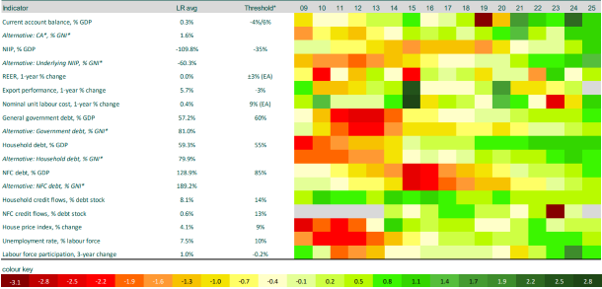
The government’s continued focus in Budget 2027 on making work pay – an initiative designed to reward workers’ efforts - has the potential to strengthen business confidence. Measures aimed at improving household disposable income and easing cost-of-living pressure may provide a modest but important boost to consumer spending. This incremental increase can create a positive cycle of demand, investment and job creation.
Additionally, the government’s continued commitment to tackle the perennial housing challenge and continue infrastructure investment addresses a significant growth constraint.
Ireland’s AI Opportunity
Beyond these traditional economic growth drivers, the shifts in the technology landscape with artificial intelligence presents other opportunities and challenges. Some analysts continue to warn that parts of the technology sector may be vulnerable to market corrections following years of strong growth. On the other hand, job cuts associated with AI adoption has impacted Ireland’s technology sectors.
Notwithstanding, Ireland is well positioned to capture the gains AI presents. The Government's Digital and AI Strategy shows a clear ambition for Ireland to become a leading global hub for AI innovation, adoption and talent. This positioning is supported by recent research. The Expert Group on Future Skills Needs published a report in August 2026 on “The Irish Labor Market and AI in 2026”. Ireland is generating AI-related jobs at 2 to 3 times relative to many of its peers, while also ranking among Europe's leading countries for AI skills and adoption.
What Businesses Need from Budget 2027
With strong economic fundamentals, infrastructure investment, a possible increase in household disposable income, growing AI ecosystem, skilled workforce and relative policy stability, Ireland provides an attractive environment for business growth.
Budget 2027 should seek to reinforce these strengths and provide the confidence businesses need to act.
While uncertainty has become a permanent feature of the global economy, Ireland’s economic outlook suggests there are compelling reasons to move forward.