Jim Power's Budget 2027 preview
The economic outlook shaping Budget day
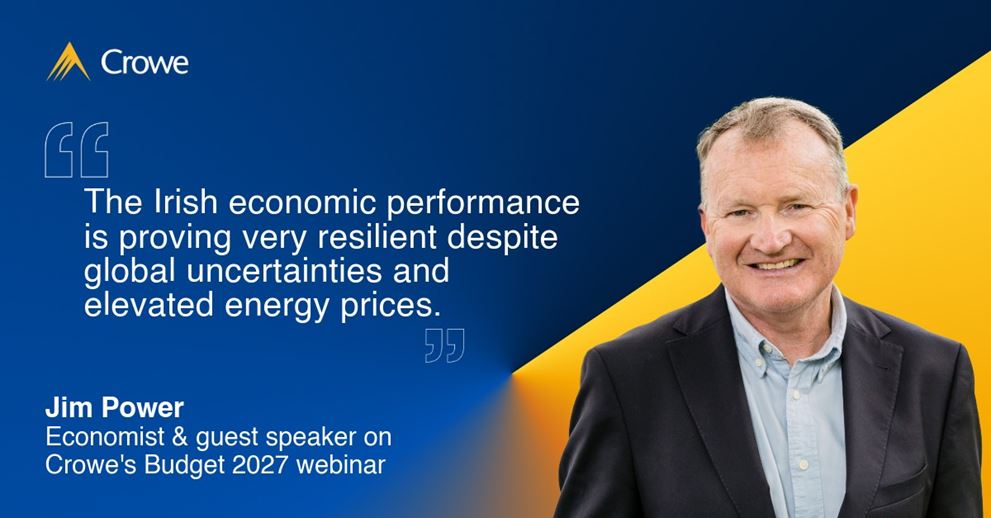
From global uncertainty and energy prices to tax changes, housing supports and cost of living measures, Jim Power examines the key forces influencing Budget 2027
The background against which Budget 2027 is being prepared and presented is mixed. The international backdrop is clouded by intense geo-political uncertainty and conflict, most visibly manifested in the war in Ukraine which has been going on since February 2022, and the conflict in Iran and the Gulf region which commenced on February 28th, 2026. However, despite these issues, the global economy continues to prove quite resilient. Domestically, the economy is also characterised by resilient, but elevated energy prices are leading to significant cost of living challenges.
The global backdrop
The world has been dominated by intense global political turmoil and disruption since the US attack on Iran in February. The most obvious manifestation of this has been seen in energy markets, where intense volatility has been the defining characteristic. Year to date, Brent crude oil prices are up 71.4%, and European natural gas prices are up by 155.3%.
One of the features of the global economic performance has been resilience. Despite the intense global disturbances and radical uncertainty, particularly tariffs, higher energy costs, inflation and intense global geo-political tensions, the global economy has proven to be quite resilient in 2026, as was the case in 2025.
The AI investment boom is continuing, and business confidence surveys are quite upbeat. The Euro Zone Composite PMI (Purchasing Manager Index) hit a 9-month high of 52.1 in August; the UK reading was 52.5; the German PMI hit 54.1; and the US PMI hit 54.6. With PMIs, a reading above 50 signals more businesses are expanding than contracting, and a reading below 50 means more businesses are contracting than expanding. The latest PMI readings are quite upbeat.
Inflation has ticked up everywhere, and the ECB increased interest rates by 0.25% in June and September, and the US Federal Reserve increased rates by 0.25% in September. Central bankers are uncomfortable with the fact that inflation remains stubbornly above 2% in most jurisdictions and are intent on anchoring inflation expectations and preventing an inflationary psychology becoming entrenched. The risk bias for interest rates is very much on the upside now. The ECB could well increase rates by a further 0.25% - 0.5% over the coming months. It depends on how inflation behaves, which in turn will be significantly determined by global geo-political developments and energy prices.
Despite the continued economic resilience, bond markets are under significant pressure, with yields rising strongly. Concerns about elevated government debt levels in many countries, persistent inflation and the response of central bankers are causing bond yields to rise. 10-year yields in many jurisdictions are attaining multi-year highs. This bond market weakness is a cause for concern and will feed through to general borrowing costs for business and the personal sector, will further pressurise already challenging fiscal situations in many countries, and could threaten the stability of global equity markets. Unfortunately, the concerns about debt and inflation are not about to go away anytime son.
From the perspective of the small open Irish economy, while the global backdrop is resilient, there is considerable uncertainty now. In setting Budget 2027, the Government needs to be mindful of the external risks and intense uncertainties.
The domestic backdrop
The domestic economic backdrop against which Budget 2027 is being presented is still solid and the Irish economic performance is proving very resilient despite the global uncertainties and elevated energy prices.
- In the first half of the year, GDP was 7% lower than the first half of 2025. However, the more representative measure of real economic activity, Modified Final Demand was 3.1% higher than the first half of 2026. This is indicative of an economy growing at a steady pace.
- The unemployment rate in August stood at 5% of the labour force, and employment reached a record high of 2.84 million in the second quarter.
- In the first 7 months of 2026 exports of goods were 26.2% down on the first 7 months of 2025. Exports to the US down by 60.7%, exports to the EU were down by 8.9%, and exports to the UK increased by 30.7%. Exports of Food & Live Animals declined by16%, exports of Machinery & Transport Equipment increased by 59.5%, and exports of Chemicals & Related Products declined by 47.2%. It was inevitable that export growth would slow substantially in 2026 following the tariff-driven surge in 2025, and this will impact on the GDP growth rate in a significant way. However, the underlying export performance is still solid.
The public finances
An Exchequer deficit of €1.8 billion was recorded in the first 8 months of the year. This is down from a surplus of €3.2 billion in the same period in 2025. Last year’s revenues were impacted by the Apple Tax receipts, which totalled €1.7 billion, and when this and the contribution of €4.9 billion to the Future Ireland Fund and the Infrastructure, Climate & Nature Fund are considered the underlying situation is stronger.
In the first eight months of the year:
- Tax receipts of €66.3 billion were collected, which was 3.4% or €2.6 billion higher than last year. When the once-off receipts of the Apple Tax are excluded from 2025, tax revenues were €3.9 billion or 6.2% ahead of the equivalent period in 2025.
- Income tax receipts were 7.7% or €1.8 billion ahead of last year. This is indicative of the ongoing strength and health of the labour market.
- VAT receipts were 7.3% or €1.1 billion ahead of last year. This is indicative of a solid level of consumer spending.
- Excluding the Apple Tax receipts, corporation tax was €1.4 billion or 8.3% ahead of last year.
In relation to expenditure:
- Total gross voted expenditure was 7.5% ahead of last year. Gross voted current expenditure was 8% ahead of last year. Gross voted capital expenditure was 4.1% ahead of last year.
The overall Exchequer returns are indicative of an economy that is still generating considerable tax revenues, and where Government expenditure is still growing strongly. On the expenditure side, the pressure on Government to provide further aid is intensifying as energy prices remain elevated.
Cost of living pressures
The rate of inflation has been increased so far in 2026, largely due to the impact of the Iran war on energy prices. The inflation rate stood at 3.7% in August, and the inflation rate has averaged 3.4% in the first 8 months of the year.
Inflationary pressures have intensified over the past 6 years. Table 1 shows the annual rate of inflation for a range of goods and services in August 2026 and the increase in prices over the past 6 years. Between August 2020 and August 2026, average consumer prices increased by 27.9%. This is feeding into business costs and is pressuring consumer spending power. The impact of the Iranian war is feeding through strongly, and this would be more pronounced but for the intervention of Government in cutting excise duties on motor fuels. This is the manifestation of the so-called cost of living crisis, that will be hugely influential in Budget 2027.
| Annual % change (August 26) | % change August 20 to August 26 | |
| All items | 3.7% | 27.9% |
| Food | 0.1% | 26.2% |
| Clothing and footwear | 3.1% | 0.8% |
| Private rents | 4.0% | 42.6% |
| Mortgage interest | 10.2% | 99.7% |
| Electricity | 8.1% | 80.6% |
| Gas | 2.3% | 100.6% |
| Health | 1.8% | 11.4% |
| Motor cars | -0.1% | 26.1% |
| Petrol | 8.9% | 36.1% |
| Diesel | 15.1% | 54.3% |
| Home heating oil | 44.6% | 174.7% |
| Restaurants, cafes and the like | 3.5% | 36.1% |
| Accommodation services | 1.7% | 48.1% |
| Hairdressing | 4.0% | 29.9% |
| Insurance connected with health | 8.7% | 41.6% |
| Motor car insurance | -7.6% | -11.2% |
Source: CSO PxStat
Budget 2027
The Summer Economic Statement 2026 (July 22nd, 2026) indicated a total budget package of €8.5 billion, with a spending package of €7 billion and a taxation package of €1.5 billion. Of the €7 billion spending package, which is equivalent to growth of 5.9% in public spending, current expenditure was pencilled in to increase by €5.9 billion, and capital expenditure to increase by €1.1 billion.
The budget package to be delivered on October 6th may not necessarily stick to these parameters, because it is now clear that corporation tax receipts will significantly out-perform the projections from the Department of Finance. In addition, the cost-of-living crisis has been exacerbated by the elevated level of energy prices, and this situation does not look like improving anytime soon.
Budget 2027 is likely to be dominated by the following issues:
- The cost of living crisis – the Minister for Finance has stated that no government in the world can absorb all of the impact of the global energy shock, but that the Government is looking into a number of issues that would provide certainty when it comes to energy costs this winter. An extension of the excise duty cuts is likely to be the minimum delivered. The approach to carbon taxes will be interesting in the context of the intensifying climate change crisis.
- The housing challenge – it appears likely that the Renters’ tax credit will be increased further, but other measures may also be considered to boost housing supply and help buyers and renters.
- Make work pay has been the mantra over recent months – the focus is likely to be increasing the standard rate threshold by up to €2,000 to €46,000 for one worker, and from €53,000 to €55,00 for a dual income household. These measures could cost around €490 in a full year.
- Possible indexation of tax credits and allowances, which did not happen last year.
- Details of the new investment product will be announced. The Low Pay Commission recommended increasing the national minimum wage by 79 cent to €14.94, which is an increase of 5.6%. It remains to be seen if this full increase will be announced, as there is intense lobbying for a lower increase.
- Measures to help the SME sector – there was nothing substantial last year, so the hope is that more will be done this year.
- The expenditure package will be generous and will basically ignore warnings from IFAC.
Of course, between now and budget day there will be intense lobbying and negotiation and inevitably there will be some surprises.