Jim Power's Budget 2027 analysis
Overall assessment of Budget 2027
Budget 2027 was set against a background of intense global geopolitical uncertainty, elevated energy prices, higher inflation, global economic resilience, a reasonably robust domestic economy, and buoyant tax revenues, particularly corporation taxes. However, there are justifiable concerns about the concentration risk emanating from the fact that 10 multinationals pay 57% of corporation tax and the multinational sector pays around 87% of corporation tax. In addition, there are concerns about the inflationary impact of pumping €8.65 billion into an economy that is growing quite strongly. Government would argue that some of the indirect taxation measures will help reduce the rate of inflation. The reality is that external factors are largely responsible for Ireland’s elevated level of inflation, rather than domestic demand factors. Budget 2027 per se is not likely to overheat the economy, but external pressures are continuing to drive inflation higher, with the rate in September coming in at 4.1%.
The other reality is that every budget is heavily driven by political considerations. The alternative budgets presented by opposition parties were very expansionary and inevitably Government has been accused of not doing enough to alleviate cost-of-living pressures. There has also been some criticism over the tax cuts, but last year’s budget resulted in a real increase in tax rates due to the failure to widen the bands and income tax credits, so it is appropriate that middle-income workers should see some reduction in what is a heavy income tax burden.
The budget was constrained by the commitment to limit growth in Government expenditure to 6%, and the commitment given in the Summer Economic Statement in July to deliver a budget-day package of €8.5 billion, comprising an expenditure package of €7 billion and a tax package of €1.5 billion. On Budget Day the tax package was lifted by €150 million to €1.65 billion, and spending was lifted slightly above €7 billion.
The key pressures on Government included the cost-of-living pressures after more than five years of elevated inflation, the high level of energy costs heading into the winter, the cost of childcare, the cost of disability, reductions in the personal tax burden following no concessions in Budget 2026, the ongoing housing challenge, public sector wage disruption, and the usual pressures on social welfare spending.
While the overall budget package is significant, it is spread thinly across the economy and society. For the SME sector, there was not a lot in the budget, and the 5.6% increase in the minimum wage will further increase costs in hospitality and retail particularly. Increasing the minimum wage is socially progressive, but it does increase the cost of labour. When positive Government measures such as the minimum wage and Auto-Enrolment are introduced, Government needs to do more to alleviate the cost pressures on business.
The cut in the CGT rate from 33% to 31% is positive and hopefully it is the beginning of a process. The changes to the treatment of R&D are also welcome, as is the detail on the investment accounts that will be launched 1 July 2027. There was little of any real consequence to boost housing supply.
Overall, Budget 2027 is expansionary and will help support economic activity in 2027. While the domestic outlook remains positive for 2027, the ongoing war in Iran, high energy prices, and a generally high level of geopolitical and geoeconomic uncertainty will need to be watched closely.
What the Department of Finance is projecting after Budget 2027
The following are the economic assumptions underlying Budget 2027. The Department is forecasting reasonable levels of real domestic growth out to 2030, increasing employment, and low levels of unemployment. These forecasts look realistic, but of course there are always risks and unexpected shocks lurking in the background.
Table 1: Economic forecasts underlying Budget 2027
| 2026f | 2027f | 2028f | 2029f | 2030f | |
| GDP | -0.7% | 3.8% | 3.4% | 3.3% | 3.2% |
| Modified Domestic Demand | 3.7% | 3.0% | 3.3% | 3.1% | 2.9% |
| Modified Gross National Income (GNI*) | 3.1% | 3.5% | 2.1% | 2.4% | 2.4% |
| Inflation (HICP) | 3.3% | 3.0% | 2.1% | 2.0% | 2.1% |
| Personal consumption | 2.9% | 2.4% | 2.4% | 2.3% | 2.3% |
| Government consumption | 4.2% | 2.9% | 2.4% | 2.3% | 2.0% |
| Modified investment | 5.1% | 4.4% | 5.8% | 5.5% | 4.8% |
| Exports goods & services | 2.6% | 4.3% | 3.4% | 3.2% | 3.1% |
| Employment (000s) | 2,839 | 2,892 | 2,927 | 2,958 | 2,987 |
| Unemployment rate | 5.0% | 5.0% | 5.0% | 5.1% | 5.1% |
| Compensation of employees | 5.9% | 5.7% | 5.0% | 4.8% | 4.6% |
Source: Department of Finance, Budget 2027, 6 October 2026
The medium-term fiscal projections underlying the budget, project strong surpluses out to 2030, apart from a blip in 2029, and a steady decline in the government debt/GNI* ratio. The vulnerability of the public finances to what the Department of Finance regards as windfall corporation tax receipts should be noted.
Despite the concerns about the vulnerability of corporation tax receipts, the take under this heading is anticipated to remain strong out to 2030.
Table 2: Fiscal projections underlying Budget 2027
| 2026f | 2027f | 2028f | 2029f | 2030f | |
| General Gov. balance (€m) | 6,725 | 9,470 | 4,695 | 935 | 5,730 |
| General Gov. balance (% GNI*) | 1.9% | 2.5% | 1.2% | 0.2% | 1.3% |
| Gen Gov. debt (€bn) | 207.9 | 214.0 | 225.3 | 236.4 | 243.2 |
| Gen Gov. debt (% GNI*) | 58.5% | 56.4% | 56.3% | 56.2% | 54.9% |
| Tax revenues (€bn) | 110.5 | 119.1 | 123.8 | 127.6 | 136.8 |
| Corporation tax (€bn) | 34.1 | 39.1 | 39.8 | 39.6 | 44.7 |
| Estimated windfall CT | 18.8 | 22.9 | 22.8 | 21.7 | 26.0 |
Source: Department of Finance, Budget 2027, 6 October 2026
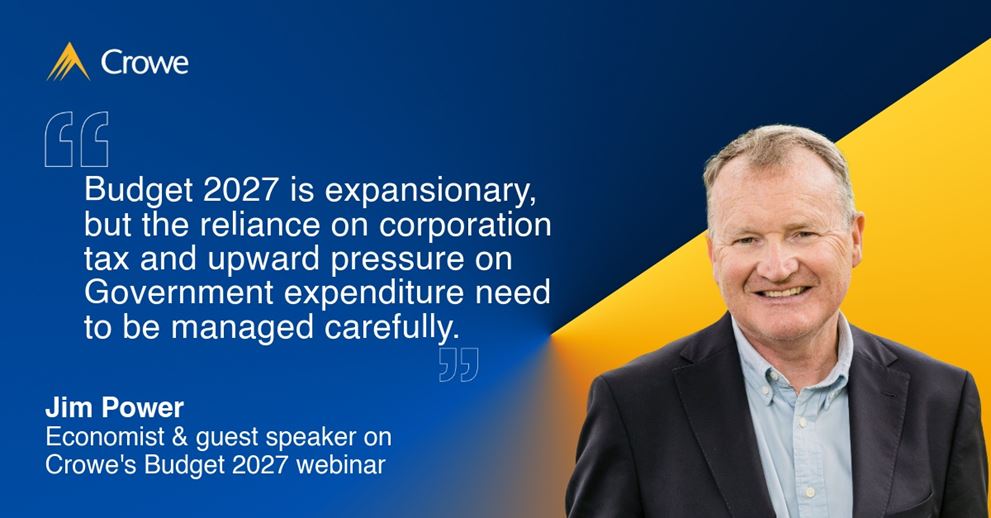
All in all, the Irish economy and the public finances are in a relatively strong position, but the reliance on corporation tax and the incessant upward pressure on Government expenditure need to be managed carefully. Minister Chambers appears adamant that he will control spending and push for better value for money for expenditure. These are positive aspirations, but the current public sector union unrest highlights the difficulties.