One of two things happens when people hear Performance Management: perked ears or rolling of their eyes.
For the latter, they picture forms, ratings, a rushed discussion in December, and maybe a salary adjustment if they're lucky. What they don't picture is strategy, meaningful conversations, or growth.
But, performance management should be one of the most powerful tools a business has:
- to translate strategy into day-to-day work
- to make sure people know what "good" looks like
- and to support their development, not just judge it.
The problem isn't that we don't have KPIs. The problem is what they measure, how they're set, and what gets left out.
In this article, I want to do three things:
- Show how to use a cascading model for KPIs so that goals actually link to company strategy (drawing on Kaplan and Norton's Balanced Scorecard work).
- Introduce Key Development Indicators (KDIs), a concept developed by Dr Bob Aubrey, to bring people development into the same conversation as performance.
- Show how KPIs and KDIs can live together in one simple system.
First fix: stop setting KPIs in isolation
Here's what happens in many organisations:
- Strategy is discussed in the boardroom.
- KPIs are agreed in a separate HR or finance cycle.
- Individual goals are set by managers copying last year's template and tweaking numbers.
By the time the process is done, the connection between "what we're trying to achieve as a business" and "what I'm measured on" is weak at best.
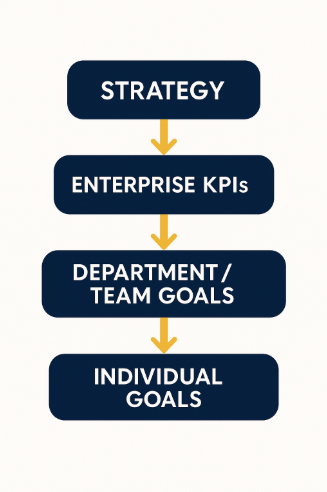
A cascading approach tackles exactly this. You start with strategy and deliberately cascade it down to functions, teams and individuals so that there's a clear line of sight from top to bottom.
In practice, that looks like this:
- At the top, you have a small set of strategic objectives: the few things that truly matter in the next 1-3 years.
- For each objective, you identify a handful of enterprise KPIs - how you'll know if you're succeeding.
- Those KPIs are then translated into department goals, then team goals, and only then into individual targets.
It sounds obvious. But when you do it with discipline, something important shifts: people can see how their work contributes to the bigger picture. You move from "I need to hit these numbers" to "this is how my work moves the strategy forward."
What the cascading model actually looks like (without the jargon)
Let's take a simple strategic objective:
"Increase profitable, repeat business from our existing customers."
At the top level, the company might track:
- Customer retention rate
- Percentage of revenue from returning customers
- Net profit margin
That's the strategic view.
Now we cascade:
- For Sales, this might increase the percentage of existing customers with an active contract and, average value of renewal deals.
- For Operations, it might be: on-time delivery, quality issues per order.
- For Customer Service, it could be: first-time resolution rate, customer satisfaction after interactions.
Finally, for an individual service agent, their performance contract might include:
- Maintaining a specific customer satisfaction score
- Resolving a certain percentage of queries without escalation
- Handling a set number of quality customer interactions per day or week
Nothing here is revolutionary. But now if you ask that agent, "How does your role support the strategy?", they have a concrete answer.
That's the power of a cascading model: it aligns everyone around the same story.
But KPIs alone can be insufficient.
Here's the uncomfortable truth: KPIs on their own can quietly damage your organisation by creating disengagement or fear.
When you measure only what gets delivered, without looking at how people grow and how the organisation develops them, you can get:
- short-term wins at the cost of long-term capability
- burnout and disengagement
- high turnover in critical roles
- and a culture where people optimise for numbers, not for value.
This is where Key Development Indicators (KDIs) are so useful. Dr Bob Aubrey has been a leading voice in shifting organisations from a purely "human resources" view to a human development view, asking not just, "What did the person contribute?" but also, "How did this experience develop the person?".
Suppose KPIs tell you whether the business got what it needed. In that case, KDIs tell you whether the person is getting what they need to grow and thrive, and whether the organisation is actually deliberately investing in that growth.
Introducing KDIs: putting development on the same page as performance
Think of KDIs as the missing half of performance management.
Where a KPI might say:
- "Increase customer satisfaction from 4.2 to 4.5."
A KDI sits next to it and asks:
- "What will this person (or team) need to learn, practise or experience to make that possible, sustainably?"
A few examples:
- If a KPI is about quality, a KDI might track the person's progress in problem-solving skills or process knowledge.
- If a KPI is about sales, a KDI might track mastery of a consultative selling approach or the number of quality coaching sessions completed.
- If a KPI is about leading a team, a KDI might track how often the leader holds one-to-ones or progress on a defined leadership development plan.
At the organisational level, KDIs could include:
- percentage of employees with active development plans aligned to strategic capabilities
- internal promotion rates for critical roles
- participation in cross-functional projects or innovation initiatives
- progress on specific human development priorities (for example, building digital skills or coaching capability).
The point isn't to create more admin. It's to make development visible and non-negotiable, instead of something we talk about in theory and quietly ignore when things get busy.
| KPI (Key Performance Indicator) | KDI (Key Development Indicator) | |
|---|---|---|
| Purpose | Match Business performance goals to organisational/individual objectives. | Match Business development goals to organisational/individual development |
| Indicators |
|
|
| Time |
|
|
| ROI |
|
|
| Assessment Cycle |
|
|
Credit: Measure of Man: Leading human development, Dr Bob Aubrey
Designing KPIs and KDIs together
If you want a performance system that truly aligns with strategy and supports people development, the design conversations need to change.
Instead of asking only:
- "What should we measure this person on?"
We ask two connected questions:
- 1. What outcomes matter most from this role, given our strategy?
-
- → These become the KPIs.
- 2. What development needs to happen in this role over the next 12-24 months for us to stay competitive?
-
- → These become the KDIs.
You can build this into your existing cycle without reinventing everything:
- When you review or set KPIs at each level (organisation, function, team, individual), add a parallel section for KDIs.
- Make sure KDIs are not just "completed a training course" but reflect real capability shifts (for example, "applied X skill in Y project," "co-facilitated a client meeting," "mentored a junior colleague").
- Train managers to treat KDIs as part of the same conversation as KPIs, not a separate HR exercise.
The result is a performance contract that might look something like this:
KPI: Reduce stock losses by 15% over the next year.
KDI:
- Complete practical training on root cause analysis and lead one improvement project.
- Demonstrate competence in using the company's new reporting dashboard.
- Mentor one junior team member on standard operating procedures.
Now you're not just saying, "Hit this target." You're saying, "Here's how we'll help you grow so that hitting this target becomes part of your capability, not just this year's goal."
Aligning all of this back to the company strategy
This only works if KPIs and KDIs are anchored in the same place: your strategy.
That means:
- Strategic themes and priorities are clear.
- You've identified the critical capabilities the organisation needs to build over the next few years (not just the numbers it wants to hit).
- Your performance templates, conversations and systems reflect both outcomes (KPIs) and development (KDIs).
When that alignment is in place, performance management stops feeling like an annual audit and starts to feel like what it should have been all along: a structured way to keep strategy, results and human development in the same conversation.
Where to start
If this feels like a big shift, you don't have to change everything at once. You can start with three simple moves:
- Pick one strategic objective and map its cascade: from enterprise KPIs down to one or two teams.
- Add KDIs for those same roles: ask, "What do these people need to learn or become in the next year to deliver this sustainably?"
- Test the conversation: run a performance discussion that explicitly includes both KPIs and KDIs and ask people how it feels different.
Over time, you'll build a performance system where:
- People know how their work links to the strategy.
- Managers are accountable not only for results, but for developing their teams.
- The organisation can show, in real measures, how it is investing in human development, not just extracting human resources.
That's when performance management stops being something everyone dreads, and starts being one of the most powerful levers you have for both business performance and people growth.