Most companies do not set out to "change culture".
Culture changes anyway, because the business changes.
In most cases, many teams operate like a family in the early days. People pitch in where needed. Everyone knows what is happening. Decisions are made quickly because you are sitting close enough to feel the impact. It is the kind of environment where trust, loyalty, and flexibility carry you.
In culture language, that is close to a clan culture. Strong relationships. High involvement. A lot of informal coordination. It is also often the stage where people feel most connected to the purpose and to each other.
Then the business grows.
More clients. More staff. More complexity. More risk. More need for consistency. More need for reliability.
And this is where many leaders feel the tension.
Because the behaviours that helped you grow can become the behaviours that stifle your ability to respond to the external and internal levers.
Flexibility becomes confusion. "We all help" becomes "nobody owns it." Decisions that used to be fast become inconsistent. Standards depend on who is on shift or which manager is present. People start saying, "That is not my job," not because they are lazy, but because the organisation has outgrown informal agreements.
At this stage, structure is not the enemy. Structure becomes stability.
You start needing clearer roles, clearer decision-making, clearer standards, and clearer rhythms. The organisation naturally becomes more hierarchical, not necessarily in a negative sense, but in the sense that you need defined accountability so the business can run without everything depending on one or two people holding it together.
Then the market changes again.
Competitors get sharper. Margins tighten. Customers demand more. The business needs to push numbers, protect efficiency, and drive output. Some organisations shift strongly into a market culture, where the focus becomes targets, performance, delivery, and competitiveness.
And now you have a different tension.
Because while that push can be necessary, it can also start to erode the relational glue that kept people committed in the first place. If everything becomes about numbers, people stop feeling seen. Managers become reactive. Pressure becomes the culture. Turnover rises. Quality slips. Trust thins out.
This is the leadership challenge that most growing organisations face, even when they cannot quite name it.
How do we balance the cultures we need, without losing ourselves in the process?
Why culture becomes a leadership balancing act
A useful way to think about culture is not as one fixed identity, but as a set of priorities that need to shift as the business matures.
At different stages, different priorities keep the organisation healthy.
You need the connection and belonging of "family" culture so people stay engaged and aligned.
You need the stability and clarity of a hierarchical culture so the business runs consistently.
You need the drive and competitiveness of market culture so performance keeps pace with the environment.
You also need some innovation and adaptability so you can respond to change without panic.
The problem is not that one culture is good and another is bad. The problem is when leaders keep leading from one cultural default while the business has moved into a different reality.
That is when you see "growth pains" that look like people problems, but are actually leadership and system problems.
Managers say, "No one is accountable."
Employees say, "Everything keeps changing."
HR says, "Training is not sticking."
Leaders say, "We need results, but morale is dropping."
Often, what is really happening is this: The organisation has outgrown its old culture, but has not intentionally built the new behaviours needed for the next stage.
What balance looks like in real leadership behaviour
Balancing culture is not a values poster exercise. It shows up in very practical daily behaviour.
It is how leaders communicate when priorities shift.
It is how decisions get made and how fast.
It is what leaders tolerate when standards slip.
It is whether managers coach, rescue, or avoid.
It is whether people feel safe to speak up, and whether performance is
still non-negotiable.
It is whether change feels deliberate, or chaotic.
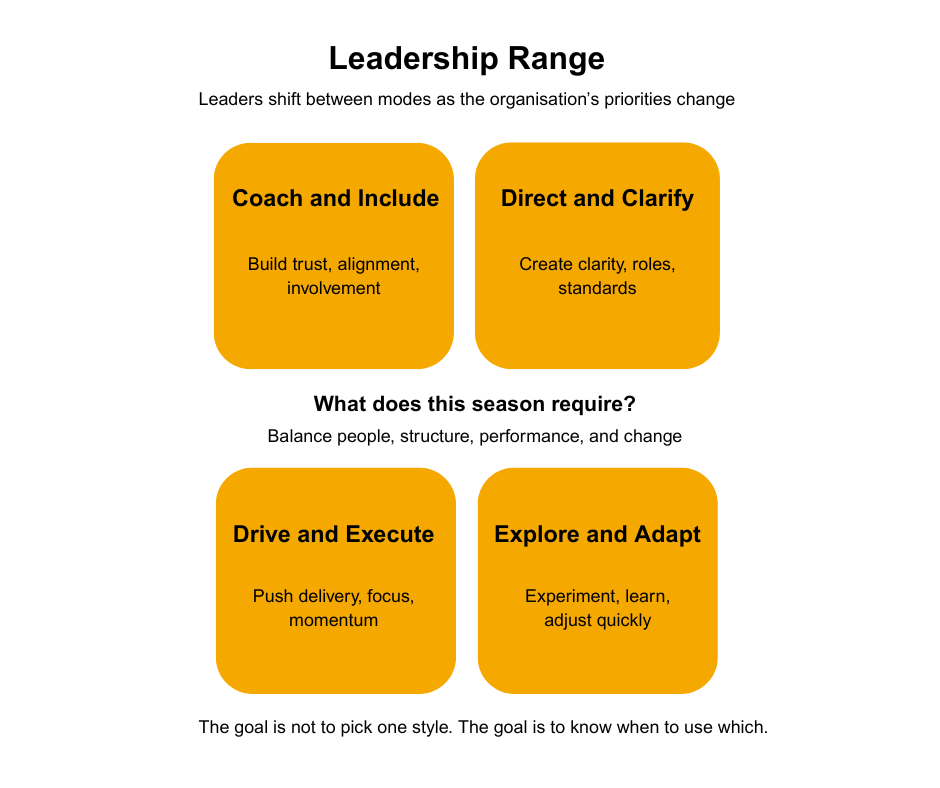
In a growing business, leadership needs range. Not a new personality, but a wider leadership toolkit.
There are times you lead with inclusion, listening, and collaboration.
There are times you lead with clarity, boundaries, and standards.
There are times you lead with urgency and performance focus.
There are times you lead with innovation and experimentation.
The key is being intentional about which mode you are in, and making sure the team understands why.
The risk when culture shifts are unmanaged
When culture shifts happen without guidance, people fill the gaps with assumptions.
They assume leadership has changed its mind.
They assume the business no longer cares about people.
They assume they will be blamed if they make a mistake.
They assume their effort is invisible.
They assume the rules are unfair because they are inconsistent.
That is why unmanaged growth is often experienced as emotional instability inside the organisation, even if the strategy makes perfect sense on paper.
The fix is not to "go back" to the early culture. You cannot reverse growth. The fix is to build the next stage culture on purpose.
What companies can do to manage culture shifts with less pain
The most effective organisations treat cultural shifts like any other business shift. They diagnose what is happening, define what is needed next, and then build the behaviours and systems to support it.
Start with clarity on what must stay true
Most growing businesses do not need to abandon their human culture. They need to protect it while they build the structure.
Define your cultural non-negotiables. The behaviours you refuse to lose, even as you become more structured and performance-driven.
Then define what must change for the next stage
This is where leaders often avoid being specific because it feels uncomfortable. But specificity is what reduces conflict and confusion.
What decisions must move closer to the work, and what decisions must
remain central?
What standards must be consistent across teams?
What meetings, routines, and check-ins must exist so execution does not
depend on heroic effort?
What does "good performance" look like in observable behaviour, not only
in results?
Once that is clear, leadership needs to model the shift
People take their cues from what leaders do repeatedly, not what leaders say once.
If you want more structure, then leaders must stop rewarding last-minute firefighting and start rewarding planning, clarity, and follow-through.
If you want accountability, then leaders must address underperformance early and fairly, not only when the issue becomes unavoidable.
If you want a stronger market focus, then leaders must create targets that are understood, resourced, and tracked, not thrown at teams in a way that creates anxiety.
And if you want to keep the "family" culture strengths, then leaders must protect trust and belonging through how they speak, how they give feedback, and how they handle pressure.
Choosing the right people for the next stage
Growth often reveals a second truth that many leaders avoid.
Not everyone wants the next stage.
Some people love the early-stage flexibility, where they do a bit of everything. Some people thrive in structure, where expectations are clear and execution matters. Some people are naturally competitive and target-driven. Some people are strong relationship builders and team connectors.
None of these profiles are wrong.
But they create very different team dynamics, especially in times of change.
This is where the right psychometrics can be powerful, when used properly.
Not as a label. Not as a shortcut. Not as a way to justify bias.
But as a tool to understand behavioural preferences, team roles, leadership tendencies, and how people respond under pressure. It helps you place people more accurately, develop managers more intentionally, and reduce the conflict that comes from expecting everyone to behave the same way.
It also helps with recruitment, because hiring for the next stage requires more than technical competence. It requires behavioural fit for the environment you are building.
Making change easier through tools and environment
Even great leaders struggle if the environment fights them.
If your systems are unclear, people will interpret things differently.
If your processes are inconsistent, people will do what is easiest.
If your communication is reactive, people will feel insecure.
If your tools are manual and messy, managers will avoid the work that
matters, like coaching and performance conversations.
Change becomes less painful when the environment supports the behaviour you want.
That includes practical tools, like clear role profiles, decision-making guidelines, performance rhythms, and simple templates that managers can actually use. It also includes supporting the change properly, with a real change management approach that tells people what is changing, why it is changing, what is staying the same, and what support they will get while they adjust.
When organisations get this right, they do not lose their culture as they grow. They mature it.
A final thought for leaders
If you are feeling the tension between being people-centred, structured, and performance-driven, you are not failing. You are leading through growth.
The work is not to pick one culture and force it everywhere. The work is to build a leadership team and a system that can hold multiple priorities at once, without losing clarity or humanity.
If you want a practical way forward, start by identifying which cultural priorities your business is leaning into right now, and which ones you may be neglecting. That conversation alone often explains a lot of what you are seeing in performance, morale, and execution.
From there, it becomes much easier to build the behaviours, tools, and team capability needed for the next stage, with less friction and more confidence.