Succession Planning
for Family and Owner-Managed Businesses in Kuwait
For many businesses in Kuwait, the founder is more than a shareholder. He or she may be the principal decision-maker, bank signatory, relationship owner, negotiator, guarantor and informal custodian of the company’s history. This strength can become a major risk when the business has no clear succession plan.
Succession planning is not merely a document prepared for inheritance purposes. It is a practical business-continuity framework that answers three critical questions: who will own the business, who will manage it, and how decisions will be made when the current owner or senior generation is no longer able to lead. For family companies and personal businesses, planning early can protect the business, preserve family relationships, reassure employees and lenders, and support a smooth transfer of value to the next generation.
Why succession planning is especially important in Kuwait
Kuwait has a strong tradition of family ownership and relationship-driven commerce. Many companies have grown through the reputation, personal network and direct involvement of the founder. Over time, however, the business may include several legal entities, real estate assets, investment portfolios, bank facilities, personal guarantees, government registrations, supplier arrangements and family members with different expectations. If succession is not planned, a temporary absence, illness or death can create delays in signing contracts, renewing licenses, collecting receivables, paying employees or dealing with banks and regulators.
There is also an important distinction between ownership succession and management succession. Heirs may become owners under applicable legal and inheritance rules, but this does not automatically mean they are ready to manage the business. Similarly, a capable manager may be able to operate the company, but may not have the authority, trust or governance structure needed to make strategic decisions. A strong plan connects legal ownership, corporate authority, financial control and management responsibility in one coordinated framework.
For Kuwaiti family businesses, the issue is not only continuity after death. It is also about preparing for generational change, reducing disputes between heirs, professionalising management, protecting confidential information, and ensuring that family wealth is not weakened by unclear roles or competing instructions. A well-prepared succession plan helps convert a founder-led business into an institution that can continue beyond one individual.
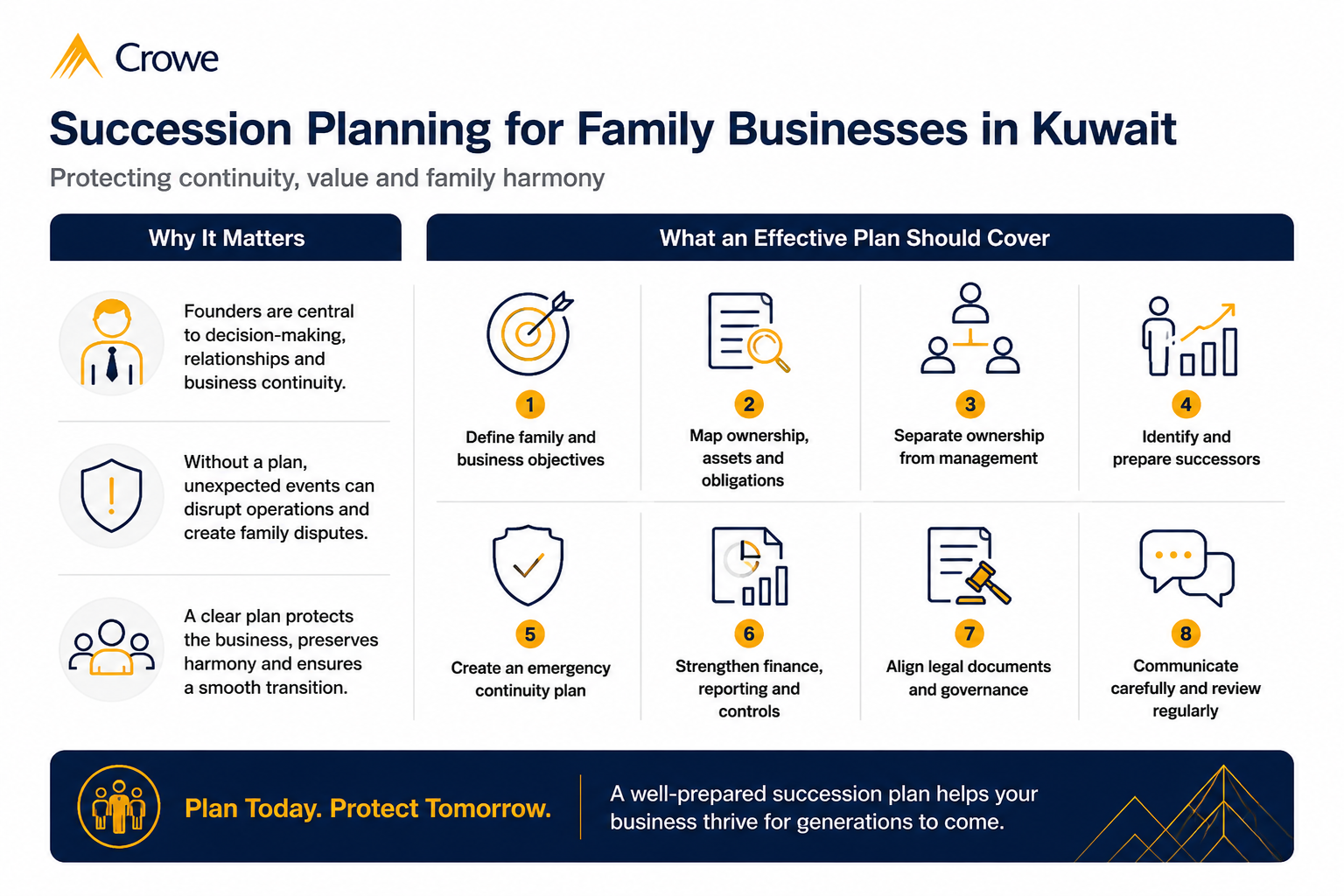
What an effective succession plan should cover
Common mistakes to avoid
The most common mistake is waiting until a crisis. Other frequent issues include assuming that family members will naturally agree, keeping ownership and personal expenses mixed together, relying on verbal understandings, failing to document guarantees and related-party balances, giving authority without accountability, and appointing successors without adequate training. Another mistake is preparing a legal document without fixing the operational weaknesses of the business. Succession works best when legal, financial, governance and management arrangements are developed together.
How Crowe Kuwait can support
Crowe Kuwait can assist family and owner-managed businesses by facilitating succession-readiness reviews, mapping financial and operational risks, improving reporting and internal controls, supporting business valuations, preparing governance frameworks, documenting authority matrices, and helping families convert informal arrangements into practical business processes. We also work alongside legal advisers to ensure that financial, accounting, tax and governance considerations are properly coordinated with the legal structure.
A successful succession plan should not be viewed as a sensitive conversation about the end of leadership. It should be seen as a responsible investment in continuity. The real objective is to protect the founder’s legacy, provide clarity for the family, preserve business value, and ensure that employees, customers, banks and partners continue to have confidence in the business. In simple terms, the next generation should not inherit a problem; they should inherit a system.
Contact Us