Estimating provisions under IAS 37: when should expected value be used, and when should the most likely outcome be used?
An entity that sells products with warranty terms, or is a defendant in litigation that has not yet been adjudicated, or has an environmental restoration obligation to be fulfilled in the future may need to determine the amount of a provision to be recognised in the financial statements. Under IAS 37, an entity measures a provision on the basis of the best estimate of the expenditure required to settle the present obligation and selects an estimation method appropriate to the nature of the obligation and the range of possible outcomes. The two methods commonly considered are the expected value and the most likely outcome. The entity needs to consider and assess the characteristics of each specific obligation to determine the appropriate estimation method.
Key conclusions
- The amount recognised as a provision is the best estimate of the expenditure required to settle the present obligation at the end of the reporting period (IAS 37.36).
- For an obligation involving a large population of items (typically warranties), the best estimate is determined using expected value—the probability-weighted average of the outcomes (IAS 37.39).
- For a single obligation (typically litigation), the best estimate is normally the most likely outcome, but other outcomes must still be considered (IAS 37.40).
- IAS 37 requires long-term provisions to be discounted to present value when the time value of money is material, and VAS 18 contains a similar requirement. Circular 99/2025, which replaces Circular 200/2014, also provides more specific guidance on determining the effective interest rate used in discounting and strengthens the disclosure requirements.
- IAS 37 requires the discount rate to be a pre-tax rate that reflects the risks specific to the liability and does not double-count risks already incorporated into the cash flows (IAS 37.47); the unwinding of the discount in each period is recognised as a borrowing cost (IAS 37.60).
- Provisions differ from contingent liabilities (not recognised, but disclosed) and from ordinary accruals—the boundary lies in the degree of certainty surrounding the obligation and its timing and amount.
- On transition to IFRS in Vietnam, the difference between the provision measured under IFRS and its tax base gives rise to a temporary difference and deferred tax.
Recognition criteria for provisions and distinction from contingent liabilities and accruals
A provision is recognised only when all three of the following conditions are met: the entity has a present obligation (legal or constructive) as a result of a past event; it is probable that an outflow of resources embodying economic benefits will be required to settle the obligation; and a reliable estimate can be made of the amount of the obligation (IAS 37.14). If any one of these conditions is not met, no provision is recognised.
The condition that there is a “present obligation as a result of a past event” is the distinguishing criterion. A past event that gives rise to a present obligation must be an event that leaves the entity with no realistic alternative to settling the obligation (IAS 37.17). This is why expenditure expected to arise from future operations, such as the cost of maintaining machinery in a subsequent period, is not provided for: the entity can still avoid that expenditure by changing its method of operation, and therefore no present obligation exists (IAS 37.18–19).
Three concepts that are frequently confused in practice need to be distinguished:
First, a contingent liability is a possible obligation whose existence will be confirmed only by the occurrence or non-occurrence of one or more uncertain future events not wholly within the control of the entity; or a present obligation that does not satisfy the criterion that an outflow is probable or for which the amount of the obligation cannot be measured with sufficient reliability (IAS 37.10). A contingent liability is not recognised in the financial statements but is disclosed, unless the possibility of an outflow of resources is remote (IAS 37.27–28). The boundary between a provision and a contingent liability normally lies at the probability threshold: if an outflow is probable, a provision is recognised; if it is merely possible, the item is a contingent liability.
Second, accruals are liabilities to pay for goods or services that have been received or supplied but have not been paid, invoiced or formally agreed with the supplier. The difference from provisions is the degree of uncertainty about timing or amount: accruals are generally far more certain in both respects and therefore are not presented as provisions (IAS 37.11). Misclassifying an accrual as a provision distorts both its presentation and the applicable disclosure requirements.
Why does IAS 37 draw this boundary instead of allowing all possible expenditure to be recognised? The objective of the Standard is to ensure that only obligations that genuinely exist are recognised, using consistent recognition criteria, and to prevent provisions from being used to smooth profits between periods—a practice that the Standard was designed to prevent.
Best estimate: expected value and most likely outcome
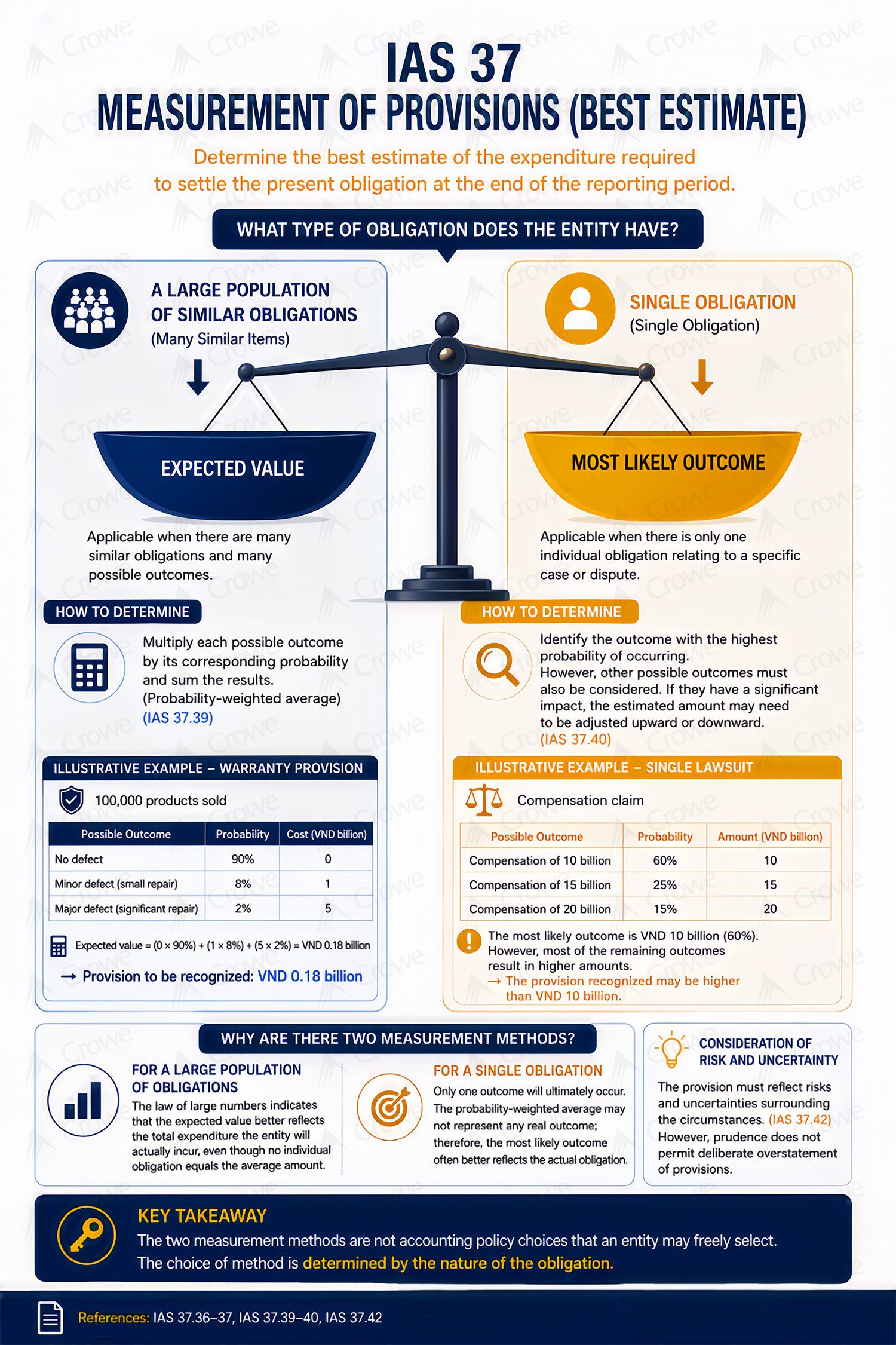
The amount recognised is the best estimate of the expenditure required to settle the present obligation at the end of the reporting period. This may be understood as the amount that an entity would rationally pay to settle the obligation or to transfer it to a third party at that time (IAS 37.36–37). How the best estimate is determined depends on whether the obligation involves a large population of items or is a single obligation.
When a provision relates to a large population of similar obligations, the entity first assesses the probability of an outflow for the class of obligations as a whole, rather than for each item individually. For example, although the probability of a warranty defect arising in any individual product may be low, it may be probable that the entity will incur some warranty costs across all products sold. Once it has been determined that the recognition criteria are met, the obligation in this case is measured using the expected value: each possible outcome is multiplied by its associated probability and the results are summed, producing the probability-weighted average of the outcomes (IAS 37.39). A warranty provision is a typical example: for a large batch of products sold, each product has a different probability of failure and repair cost, so the reasonable amount for the population is the probability-weighted average rather than the cost of any single product.
When a single obligation is measured, the most likely outcome is normally the best estimate of the provision. Nevertheless, even in this case, the entity considers other possible outcomes. If the other outcomes are mostly higher or mostly lower than the most likely outcome, the best estimate is adjusted upwards or downwards to reflect the full range of possible outcomes appropriately (IAS 37.40). For example, for a single lawsuit, an entity may assess that the most likely outcome is compensation of VND 10 billion. However, if most of the other outcomes result in higher compensation, such as VND 15 billion or VND 20 billion, the entity should not automatically recognise a provision of exactly VND 10 billion. Instead, it must consider the probabilities and the effect of the other outcomes to determine a provision above VND 10 billion if that amount is the best estimate of the obligation at the reporting date.
The key point is that the two methods are not discretionary accounting policy choices available to the entity; the appropriate method is determined by the nature of the obligation. The rationale lies in the measurement objective. For a large population, the law of large numbers means that the expected value most closely reflects the aggregate expenditure that the entity will actually bear, even though no individual product will incur exactly the average amount. By contrast, for a single obligation where only one outcome will occur, a probability-weighted average may be an amount that does not correspond to any possible outcome, so the most likely outcome normally provides a closer representation of the actual obligation. Nevertheless, the entity must still consider the other possible outcomes as discussed above. Risks and uncertainties surrounding the circumstances must also be taken into account in measuring a provision (IAS 37.42), but this prudence does not permit the deliberate overstatement of provisions.
Discounting long-term provisions and determining the discount rate
Where the effect of the time value of money is material, the amount of a provision is the present value of the expenditures expected to be required to settle the obligation (IAS 37.45). This requirement applies primarily to obligations with settlement dates well into the future—environmental restoration, asset decommissioning and certain long-term compensation payments. For short-term provisions, such as most warranty provisions settled within one year, the effect of discounting is generally immaterial and discounting is therefore unnecessary.
IAS 37.47 specifies that the discount rate is a pre-tax rate that reflects current market assessments of the time value of money and the risks specific to the liability, and that it must not reflect risks for which future cash flow estimates have already been adjusted. The requirements to reflect risks specific to the liability and to avoid double-counting risk are critical: an entity’s general borrowing rate may not accurately reflect the risk profile of a particular environmental restoration obligation, and if that risk has already been incorporated into the estimated cash outflows, an additional risk premium must not be included in the discount rate.
When a provision is recognised at present value, its carrying amount increases in each period as the settlement date approaches due to the unwinding of the discount. This increase reflects the passage of time and is recognised as a borrowing cost (IAS 37.60)—presented as a finance cost in profit or loss, separately from the operating expense arising when the provision is established or adjusted.
Reviewing and updating estimates in subsequent periods
A provision is an accounting estimate, not an amount fixed at initial recognition. At the end of each reporting period, provisions are reviewed and adjusted to reflect the current best estimate. If it is no longer probable that an outflow of resources will be required to settle the obligation, the provision is reversed (IAS 37.59).
A change in an estimate is accounted for prospectively—recognised in the period of the change rather than applied retrospectively to prior periods—in accordance with the IAS 8 requirements for changes in accounting estimates. For a discounted provision, the increase in the carrying amount arising from the passage of time (the unwinding of the discount) is recognised as a borrowing cost in accordance with IAS 37.60. Accounting for a change in a provision resulting from a change in the amount or timing of settlement or in the discount rate depends on the nature of the obligation and the applicable Standard. For a decommissioning or restoration obligation associated with an asset, IFRIC 1 may require an adjustment to the carrying amount of the asset or recognition in OCI or profit or loss, depending on the measurement model applied.
Comparison between VAS and IFRS
| Criterion | Vietnamese accounting requirements | IFRS requirements | Transition implications |
| Recognition criteria for provisions | VAS 18 and Circular 99/2025 prescribe three recognition criteria: a present obligation from a past event, a probable outflow and a reliable estimate. | Consistent with the three criteria in IAS 37.14. | Generally, no adjustment arises if VAS 18 has been properly applied. |
| Measurement method | VAS 18 requires measurement at the best estimate and distinguishes obligations by their nature: expected value is generally used for a large population, while the most likely outcome is generally used for a single obligation. | IAS 37.39–40 likewise requires measurement at the best estimate and distinguishes obligations by their nature: expected value is generally used for a large population, while the most likely outcome is generally used for a single obligation. | An adjustment arises only if the entity applied the wrong method. |
| Discounting and basis for the discount rate | VAS 18 requires a pre-tax rate that reflects the risks specific to the liability and does not double-count risks already incorporated in the cash flows. Circular 99/2025 does not explicitly require provisions to be discounted, but it has begun to prescribe how the rate used to discount cash flows is determined, by reference to market rates, commercial bank rates or the entity’s borrowing rate. |
Consistent with the guidance in IAS 37.47 (a pre-tax rate that reflects the risks specific to the liability and does not double-count risks already incorporated in the cash flows). | Generally, no adjustment arises if VAS 18 has been properly applied. |
| Unwinding of the discount | Recognised as a borrowing cost in each period (VAS 18.56). | Recognised as a borrowing cost in each period (IAS 37.60). | The presentation of the unwinding should be reassessed for consistency with IAS 37.60; this may affect classification between finance costs and operating expenses. |
| Review and update of estimates | Provisions must be reassessed at the end of each period (with additional recognition or reversal of the difference). | Reviewed and adjusted at the end of each reporting period; reversed when an outflow is no longer probable (IAS 37.59). | The review mechanism is broadly similar. |
| Disclosures about provisions | Circular 99/2025 enhances the requirements to disclose significant assumptions and estimates (including the selected discount rate), the nature of the legal/constructive obligation, the basis of estimation, specific types of provisions, measures to mitigate effects, and a reconciliation of movements in the balance of each class of provision. | IAS 37.84–85: the nature of the obligation, expected timing, uncertainties, and a reconciliation of movements in the balance of each class of provision. | The disclosure gap has broadly narrowed; the entity should collect and retain documentation supporting its estimates to satisfy both frameworks. |
Illustrative examples: warranty provision and litigation provision
Example A - Warranty provision measured using expected value
Company A is an electronics manufacturer that sells 100,000 products during the year with a 12-month warranty. Based on historical defect data, the entity estimates the probability of failure and repair costs as follows:
| Scenario | Probability | Repair cost per product |
| No defect | 90% | VND 0 |
| Minor defect | 7% | VND 200,000 |
| Major defect | 3% | VND 1,000,000 |
Because the warranty obligation relates to a large population of products, the best estimate is determined using the expected value—multiplying each level of cost by the corresponding probability and summing the results:
Expected cost per product = (0 × 90%) + (VND 200,000 × 7%) + (VND 1,000,000 × 3%) = 0 + VND 14,000 + VND 30,000 = VND 44,000.
Total provision = 100,000 products × VND 44,000 = VND 4,400 million.
VND 44,000 is not the cost attributable to any individual product; it is a reasonable average for the entire batch of products. Because the warranty period is within one year, the effect of the time value of money is not material and no discounting is required.
Recognition entry (unit: VND million):
Dr Warranty expense (P/L) 4,400
Cr Provision for warranties (B/S) 4,400
Example B - Litigation provision measured using the most likely outcome
Company B is a chemical manufacturer and a defendant in litigation concerning environmental damage. At the end of the reporting period, after considering all available evidence, the Company concludes that the recognition criteria for a provision under IAS 37 are met.
The legal adviser identifies the following three scenarios for the amount of compensation, which is expected to be paid in three years.
| Scenario | Compensation (VND million) | Probability |
| Favourable | 15,000 | 20% |
| Base case | 20,000 | 65% |
| Adverse | 30,000 | 15% |
This is a single obligation, so the most likely outcome is normally the best estimate. In the scenarios above, compensation of VND 20,000 million is the most likely outcome because it is the individual scenario with the highest probability, at 65%. However, the Company may not automatically recognise a provision of VND 20,000 million solely because this is the outcome with the highest probability; it must still consider the other possible outcomes. In this case, the VND 20,000 million outcome is clearly predominant, with a probability of 65%. The other outcomes fall on both the lower and higher sides of this amount, and their combined probability is only 35%. Accordingly, in the absence of further evidence indicating that the obligation is significantly skewed towards a higher or lower amount, the Company may conclude that VND 20,000 million is the best estimate of the obligation at the reporting date under IAS 37.40.
The compensation is expected to be paid after three years. Accordingly, because the effect of the time value of money is material, the provision must be recognised at the present value of the expenditure expected to be required to settle the obligation.
The Company applies a pre-tax discount rate of 10% per annum. The Company determines this rate by reference to the yield curve and current market rates for Vietnamese dong-denominated instruments with a term of approximately three years, and then adjusts it to reflect the risks specific to the obligation.
Present value at initial recognition:
Provision = 20,000 / (1.10)³ = 20,000 / 1.331 = VND 15,026 million.
Initial recognition entry:
Dr Provision expense (P/L) 15,026
Cr Litigation provision (B/S) 15,026
Unwinding of the discount over the periods: Each year, the carrying amount increases as the settlement date approaches; the increase is recognised as a finance cost:
| Date | Opening balance | Unwinding (10%) | Change in estimate | Closing balance |
| Initial recognition | — | — | — | 15,026 |
| End of Year 1 | 15,026 | 1,503 | — | 16,529 |
| End of Year 2 | 16,529 | 1,653 | 1,818 | 20,000 |
| End of Year 3 | 20,000 | 2,000 | — | 22,000 |
Note: the “Change in estimate” column in the row for the end of Year 2 reflects a change in estimate arising during the period, as explained immediately below; the other rows include only the unwinding of the discount.
Entry for the unwinding of the discount in Year 1:
Dr Finance costs (P/L) 1,503
Cr Litigation provision (B/S) 1,503
Change in estimate in a subsequent period:
Assume that at the end of Year 2, after recognising the unwinding of the discount of VND 1,653 million (bringing the balance to VND 18,182 million), developments in the litigation indicate that the most likely outcome has increased to VND 22,000 million, still expected to be paid at the end of Year 3 (one year remaining). The present value of the obligation at the end of Year 2 is VND 22,000 / 1.10 = VND 20,000 million. The entity prospectively increases the provision:
Adjustment = VND 20,000 million − VND 18,182 million = VND 1,818 million.
Dr Provision expense (P/L) 1,818
Cr Litigation provision (B/S) 1,818
In Year 3, the discount is unwound on the revised balance: VND 20,000 million × 10% = VND 2,000 million, bringing the balance to exactly VND 22,000 million at the settlement date.
Dr Finance costs (P/L) 2,000
Cr Litigation provision (B/S) 2,000
The two examples demonstrate the difference in nature: a warranty provision normally uses expected value because it relates to a large population and is generally short-term; a litigation provision normally uses the most likely outcome and, because it is a single, long-term obligation, requires discounting and updating over the periods.
Adjustments on transition from VAS to IFRS and deferred tax
General principle: On transition, for amounts relating to prior periods, the difference between the provision measured under IFRS and the amount recognised under Vietnamese accounting regulations is adjusted against retained earnings at the date of transition, or against another component of equity if required by the applicable Standard. In subsequent periods, the effect of the adjustment may be recognised in profit or loss, OCI, the carrying amount of the related asset or equity, depending on the applicable Standard.
Key point in Vietnam: the corporate income tax base is not currently determined under IFRS. Consequently, most IFRS adjustments generally give rise to temporary differences between IFRS carrying amounts and tax bases, resulting in deferred tax—one of the most frequently overlooked issues.
Continuing Example B, assume that the entity previously applied Circular 200 and recognised a litigation provision at the undiscounted nominal amount of VND 20,000 million. On transition to IFRS, the provision is discounted to VND 15,026 million, resulting in a difference of VND 4,974 million that must be adjusted on transition.
Discounting adjustment entry at the date of transition (decrease in the provision and increase in retained earnings):
Dr Litigation provision (B/S) 4,974
Cr Retained earnings (B/S) 4,974
Tax base assumption: Assume that the tax authority allows a deduction for the litigation provision only when the expenditure is actually incurred, so the tax base of the provision is nil. Under this assumption, the provision (a liability) has a carrying amount greater than its tax base, giving rise to a deductible temporary difference and a deferred tax asset (at a corporate income tax rate of 20%). Under Vietnamese accounting regulations before transition, the provision of VND 20,000 million gave rise to a deferred tax asset of VND 4,000 million (VND 20,000 million × 20%), and the Company recognised that deferred tax asset in its VAS financial statements. When the provision under IFRS decreases to VND 15,026 million, the deductible temporary difference decreases accordingly, and the deferred tax asset therefore decreases to VND 3,005 million (VND 15,026 million × 20%), a reduction of VND 995 million.
Adjustment entry:
Dr Retained earnings (B/S) 995
Cr Deferred tax asset (B/S) 995
As a result, the transition adjustments produce a net increase in retained earnings of VND 4,974 million − VND 995 million = VND 3,979 million.
Long-term provisions are discounted to present value in accordance with the principles of VAS 18. Circular 99/2025 provides further support by specifying how the effective interest rate used in discounting cash flows is determined and by enhancing disclosure requirements to ensure transparency in the financial statements. Accordingly, where an entity has consistently applied discounting under VAS 18 and the effective interest rate under Circular 99/2025, the provision will, in substance, already have been recognised at present value before transition, and any transition difference in the principal amount will generally not be material. Any remaining difference will arise mainly from differences between Circular 99 and IAS 37.47 in the basis for determining the discount rate and may be in either direction, depending on which rate is higher.
Common errors and implementation challenges in Vietnam
Selecting an inappropriate discount rate. Under the new requirements of Circular 99/2025, the practical challenge has shifted from not discounting to discounting using an inappropriate rate. Two common errors are using the entity’s general borrowing rate without adjusting it for the risks specific to the liability as required by IAS 37.47, and double-counting risk—incorporating a risk premium in the rate when that risk has already been reflected in the estimated cash flows.
Failing to distinguish between the two measurement methods. Applying the most likely outcome to a large population (such as warranties), or conversely applying a probability-weighted average to a single obligation (such as a lawsuit), results in an incorrect best estimate because the two methods are linked to the nature of the obligation and are not discretionary choices.
Confusing provisions with accruals. Classifying an item for which the timing and amount are highly certain as a provision, or vice versa, results in both incorrect presentation and failure to apply the separate disclosure requirements for provisions in IAS 37.84–85.
Recognising a contingent liability as a provision. A provision is recognised only when an outflow is probable. If the likelihood is merely possible, the item is a contingent liability that is not recognised but is disclosed.
Frequently asked questions
If an entity has determined a discount rate under Circular 99, can it automatically use that rate for IFRS purposes?
Not necessarily. Circular 99 permits reference to market rates, commercial bank rates or the entity’s borrowing rate, whereas IAS 37.47 requires a pre-tax rate that reflects the risks specific to the liability and does not double-count risks already incorporated in the cash flows. The selected rate must be reviewed to ensure that it meets the requirements of IAS 37 and adjusted if necessary.
When does litigation move from a contingent liability to a provision?
When the likelihood of losing the case and having to make a payment changes from possible to probable and the amount can be estimated reliably. New legal developments, updated advice from legal counsel or an unfavourable first-instance judgment may mark the point of transition.
Is a provision recognised for an onerous contract under IAS 37?
Yes. When the unavoidable costs of meeting the obligations under the contract exceed the economic benefits expected to be received, the present obligation is recognised and measured as a provision under IAS 37.66–68. Before a separate provision for an onerous contract is recognised, the entity recognises any impairment losses on assets used in fulfilling the contract. In addition, the scope of other Standards must be considered before IAS 37 is applied.
Determining the appropriate measurement method, establishing the discount rate and quantifying the deferred tax effects on transition involve professional judgements specific to each entity. Our IFRS transition advisory team is ready to assist entities in reviewing and developing an appropriate model for estimating provisions.
This article has been prepared to provide general information and technical guidance and does not constitute accounting, auditing, tax or legal advice in relation to any particular transaction or entity. The figures, assumptions and journal entries in this article are illustrative only and should be tailored to each entity’s actual circumstances, professional judgements and supporting documentation. We accept no responsibility for any loss arising from the use of the information in this article without appropriate professional advice. For assistance with a specific matter, please contact our IFRS transition advisory team.
