Classification of financial assets under IFRS 9: when to measure at amortised cost, at fair value through profit or loss (FVTPL), or at fair value through other comprehensive income (FVOCI)?

Vietnamese enterprises currently classify financial investments based on the purpose for which they are held, in accordance with the applicable Vietnamese accounting regulations: trading securities, held-to-maturity investments, and equity investments in other entities, measured predominantly at cost less provision for devaluation or provision for doubtful debts. IFRS 9 replaces this entire classification basis with two sets of criteria applied simultaneously - the business model within which the entity manages the financial assets, and the contractual cash flow characteristics of the asset - which together determine one of three measurement categories.This difference in the classification basis may result in significant reclassification of the financial asset portfolio on transition, particularly for bond portfolios, loans with special terms, and unlisted shares.
Key conclusions
- IFRS 9 classifies financial assets into three measurement categories: amortised cost (AC), fair value through other comprehensive income (FVOCI), and fair value through profit or loss (FVTPL).
- The classification of a debt instrument is based on two criteria that are assessed together: (i) the entity’s business model for managing the financial assets, and (ii) the result of the assessment of the contractual cash flow characteristics - whether the cash flows are solely payments of principal and interest on the principal amount outstanding (the SPPI test).
- Only when an asset passes the SPPI test does the business model determine the measurement category: hold to collect contractual cash flows leads to amortised cost; hold to collect contractual cash flows and sell leads to fair value through other comprehensive income; all others lead to fair value through profit or loss.
- Equity instruments (investments in shares, capital contributions in other entities) within the scope of IFRS 9 are not subject to the SPPI test and are measured by default at fair value through profit or loss; an entity may make an irrevocable election at initial recognition, on an instrument-by-instrument basis, to present subsequent changes in fair value in other comprehensive income.
- There is no longer a cost basis of measurement for investments in unlisted shares; every equity instrument within the scope of IFRS 9 must be measured at fair value.
- An entity may designate a financial asset as measured at fair value through profit or loss at initial recognition if doing so eliminates or significantly reduces a measurement inconsistency (the fair value option).
Classification basis: the business model and the contractual cash flow characteristics
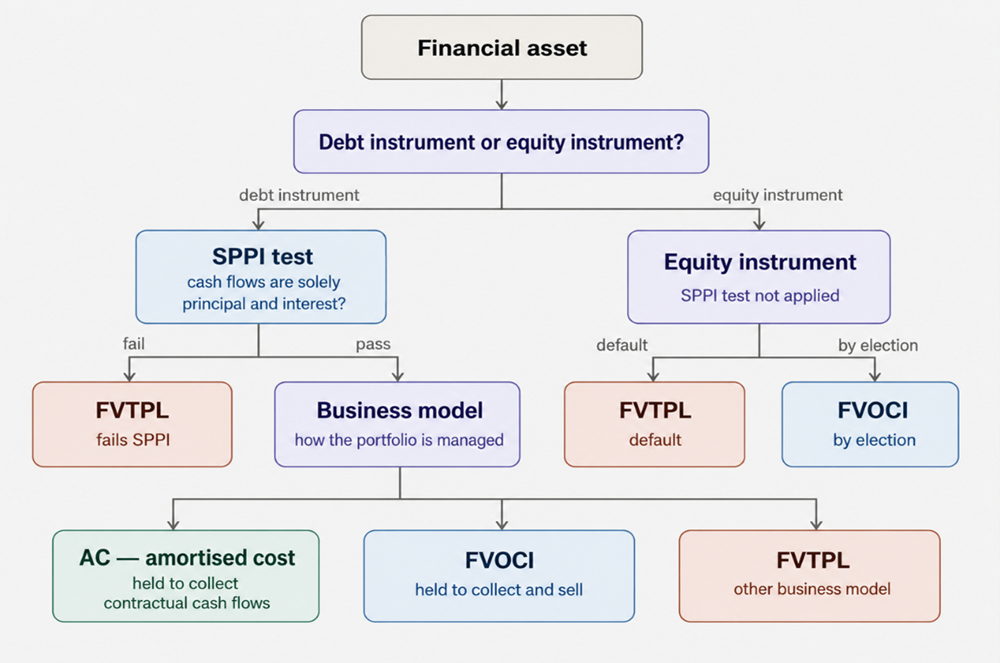
Decision tree for classifying financial assets under IFRS 9
IFRS 9 requires financial assets to be classified on the basis of both the business model within which the entity manages the financial assets and the contractual cash flow characteristics of the financial asset (IFRS 9.4.1.1).
The business model indicates how the entity expects to realise the value of the asset - by collecting contractual cash flows, selling the asset, or a combination of both. The contractual cash flow characteristics indicate whether the asset is a basic lending arrangement.
The three business models
The business model is determined at the level of a portfolio or group of assets, reflecting how the entity actually manages the assets to generate cash flows, rather than the intention for each individual instrument (IFRS 9.B4.1.2). This is a matter of observable facts, not a subjective assertion.
The reason IFRS 9 uses the business model as a classification criterion lies in the principle that the measurement basis should reflect how the entity realises the value of the asset. A financial asset can generate value for the entity in two ways: collecting contractual cash flows until maturity, or selling the asset to realise changes in fair value. The accounting information most useful to users of the financial statements differs depending on which route is predominant. When the entity realises value through contractual cash flows, changes in fair value during the holding period do not reflect the economic outcome the entity actually obtains, so amortised cost under the effective interest method gives a more faithful picture. Conversely, when the entity realises value through buying and selling, the fair value at each point in time is the decisive figure, so fair value measurement reflects the substance. The three business models are precisely three answers to the question of how the entity realises the value of the asset, and each answer leads to a compatible measurement basis.
The first model is holding assets to collect contractual cash flows (hold to collect). Under this model the entity realises value mainly by receiving principal and interest according to the contractual schedule, so interim changes in fair value are not decisive and amortised cost is the appropriate measurement basis. Selling a financial asset does not necessarily defeat the hold-to-collect business model if those sales do not change the fact that the predominant source of realising value remains the contractual cash flows (IFRS 9.B4.1.3A–B4.1.3B). Sales made because of an increase in the asset's credit risk may be consistent with this model regardless of their frequency and value. For sales made for other reasons, they may still be consistent if they are infrequent even though significant in value, or if they are insignificant in value both individually and in aggregate even though frequent. Sales made close to maturity may also be consistent if the proceeds approximate the remaining contractual cash flows. The entity must assess sales activity as a whole in terms of frequency, value, timing and reason for the sales, rather than considering in isolation whether any sale has occurred
The second model is holding assets both to collect contractual cash flows and to sell the assets (hold to collect and sell). Under this model, both collecting cash flows and selling are integral to achieving the portfolio management objective, and the frequency and value of sales are typically higher than in the first model (IFRS 9.B4.1.4A–B4.1.4B). Because both routes of realising value are material, the standard requires a measurement basis that reflects both at the same time: fair value through other comprehensive income presents the asset at fair value in the statement of financial position while still recognising interest under the effective interest method and credit losses in profit or loss as though the asset were measured at amortised cost, with the cumulative fair value difference in other comprehensive income being reclassified to profit or loss on sale.
The third model comprises the remaining models, including holding assets for trading purposes, profiting from changes in fair value (IFRS 9.B4.1.5). Under this model, financial assets are typically managed principally on a fair value basis or through buying and selling, for example assets held for trading or a portfolio managed and whose performance is evaluated on a fair value basis (IFRS 9.B4.1.5). The entity may still collect some contractual cash flows during the period it holds the asset; however, collecting these cash flows is only incidental and is not the predominant or integral factor in achieving the objective of the business model. Because the outcome of managing the portfolio depends principally on changes in fair value and on selling activity, measurement at fair value through profit or loss best reflects how the entity manages and realises value from those assets, whereby all changes in fair value are recognised in profit or loss for the period.
The contractual cash flow characteristics assessment (the SPPI test)
The SPPI test determines whether the contractual cash flows of the asset, on specified dates, are solely payments of principal and interest on the principal amount outstanding (IFRS 9.4.1.2(b), 4.1.2A(b)). In this context, interest is consideration for the time value of money, for the credit risk associated with the principal amount outstanding over a period of time, and for other basic lending risks and costs together with a profit margin (IFRS 9.B4.1.7A).
The essence of the test is to determine whether the asset is consistent with a basic lending arrangement. Where the contract introduces terms that expose the cash flows to risks or volatility that do not belong to a basic lending arrangement — for example cash flows linked to changes in share prices, commodity prices, or to the borrower's business performance - the asset fails the SPPI test and must be measured at fair value through profit or loss, regardless of the business model (IFRS 9.B4.1.7–B4.1.9).
Classification outcomes for debt instruments
Combining the two criteria produces three measurement categories for debt instruments. An asset that passes the SPPI test and is held within a hold-to-collect model is measured at amortised cost (IFRS 9.4.1.2). An asset that passes the SPPI test and is held within a hold-to-collect-and-sell model is measured at fair value through other comprehensive income (IFRS 9.4.1.2A). All remaining assets — those that fail the SPPI test, or that fall within another business model - are measured at fair value through profit or loss (IFRS 9.4.1.4).
Equity instruments and the designation options
An investment in the equity instruments of another entity does not have cash flows in the form of principal and interest, so the SPPI test does not apply and it is measured by default at fair value through profit or loss (IFRS 9.4.1.4). For an investment in an equity instrument within the scope of IFRS 9 that is not held for trading and is not contingent consideration recognised by an acquirer in a business combination within IFRS 3, at initial recognition the entity may make an irrevocable election, on an instrument-by-instrument basis, to present changes in fair value in other comprehensive income (IFRS 9.5.7.5). When this election is applied, only dividends are recognised in profit or loss (except where the dividend clearly represents a recovery of part of the cost of the investment); fair value gains and losses are recognised in other comprehensive income and are not reclassified to profit or loss on disposal (IFRS 9.B5.7.1).
This is a fundamental difference from a debt instrument measured at fair value through other comprehensive income - where the cumulative gain or loss recognised in OCI is reclassified to profit or loss on derecognition. For a designated equity instrument, the difference arising from changes in fair value is never recognised through profit or loss. The reason for this difference is that the election to present changes through other comprehensive income is a deliberate exception in the standard; the IASB designed this election for cases in which presenting changes in fair value in profit or loss may not appropriately reflect the entity's performance, for example it is often elected where the investment is strategic and long-term, held to obtain non-contractual benefits rather than principally to profit from an increase in the value of the investment, and therefore the value changes of these equity investments are separated from profit or loss for the period to avoid distorting the operating profit-or-loss picture. The objective of the exception is to keep all value changes outside profit or loss throughout the life of the investment; if reclassification on disposal were permitted, the entity could actively choose the timing of a sale to bring the cumulative gain or loss into profit or loss, defeating the very objective the exception seeks to achieve. The standard therefore provides that the difference is never reclassified to profit or loss, even on disposal; the entity may transfer the cumulative gain or loss between components of equity (IFRS 9.B5.7.1).
In addition, at initial recognition, an entity may irrevocably designate a financial asset as measured at fair value through profit or loss if doing so eliminates or significantly reduces a measurement or recognition inconsistency arising from measuring assets or liabilities on different bases (IFRS 9.4.1.5).
Reclassification
An entity reclassifies financial assets if, and only if, it changes the business model within which it manages those assets - an event expected to be very infrequent (IFRS 9.4.4.1). A change in the assessment of contractual cash flow characteristics does not, in itself, result in reclassification under IFRS 9. Amendments to contractual terms must instead be assessed under the applicable modification and derecognition requirements. The designation of an equity instrument at fair value through other comprehensive income and the fair value option are both irrevocable and cannot be changed after initial recognition.
Guidance on the contractual cash flow characteristics assessment (the SPPI test)
The essence of the test
The core principle is to determine whether the asset is consistent with a basic lending arrangement. In a basic lending arrangement, the time value of money and credit risk are typically the two most significant components of interest. Where the contract introduces terms that expose the cash flows to risks or a degree of volatility that does not belong to a basic lending arrangement - for example cash flows linked to changes in share prices, commodity prices, or to the borrower's business performance — the asset fails the SPPI test and must be measured at fair value through profit or loss, regardless of the business model (IFRS 9.B4.1.7–B4.1.9).
The time value of money component and the benchmark comparison
The time value of money is the component of interest that reflects only the passage of time, and not other risks or costs. In some cases, the time element is modified - for example where the interest rate is periodically reset but the reset period does not match the tenor of the reference rate (a rate reset monthly but referencing a long-tenor rate). In that case the entity must assess the modified time value of money component by comparison with the cash flows of a benchmark instrument — an instrument with equivalent terms but without the modifying element. If the contractual cash flows could differ significantly from those of the benchmark instrument, the asset fails the SPPI test (IFRS 9.B4.1.9B–B4.1.9D).
Prepayment features, extension features and other special terms
Where a contractual term could change the timing or amount of the contractual cash flows, the entity must assess the cash flows that could arise both before and after the change occurs. Prepayment features and extension features are assessed against their own criteria. A prepayment feature may be consistent with the SPPI test if the prepayment amount substantially represents unpaid principal and interest on the principal amount outstanding; this amount may include reasonable compensation that one party pays or receives for early termination of the contract (IFRS 9.B4.1.11(b)). For an extension feature, an extension option may be consistent with the SPPI test if the terms applying during the extension period give rise to cash flows that are solely payments of principal and interest on the principal amount outstanding, which may include reasonable additional compensation for extending the contract (IFRS 9.B4.1.11(c)).
For a non-recourse loan whose source of repayment is limited to the cash flows of a specific asset or project, the entity must look through to the underlying asset or cash flows to determine whether the cash flows are genuinely principal and interest or are in substance a sharing of the risks and rewards of the underlying asset (IFRS 9.B4.1.16–B4.1.17).
New requirements effective from 01/01/2026: assets with contingent features
The amendments to IFRS 9 issued by the IASB in May 2024, effective for annual reporting periods beginning on or after 01/01/2026 (with early application permitted), add guidance on the SPPI assessment for financial assets with terms that change the timing or amount of contractual cash flows when an event that gives rise to an adjustment to the contractual cash flows occurs. These amendments were introduced mainly to address the increasingly common loans and bonds linked to environmental, social and governance (ESG) targets (IFRS 9.B4.1.10A).
The amended requirements involve a two-step assessment:
First, the cash flows must be principal and interest in every scenario, both before and after the event occurs. If in any scenario the cash flows are no longer principal and interest, the asset fails the test.
Second, for a contingent feature not directly related to a change in basic lending risks or costs - typically a feature linked to the borrower's ESG targets - the asset may still pass the SPPI test if the contractual cash flows in each scenario do not differ significantly from the cash flows of a similar asset without that contingent feature.
A key practical distinction is between a feature linked to an event specific to the borrower from a feature linked to a market variable. A loan with a term that increases or decreases the interest rate when the borrower meets or fails to meet the borrower's own emission-reduction targets, with a small adjustment margin, may still pass the SPPI test. Conversely, a loan whose interest rate is linked to a market price index - for example a carbon price index - fails the test, because the cash flows then depend on a variable unrelated to basic lending risk.
The accompanying amendments also add IFRS 7 disclosure requirements for contractual terms that could change the cash flows on the occurrence or non-occurrence of a contingent event that is not directly related to a change in basic lending risks or costs. For each class of financial asset measured at amortised cost or at fair value through other comprehensive income, and each class of financial liability measured at amortised cost, the entity must disclose: (i) a qualitative description of the nature of the contingent event; (ii) quantitative information about the possible changes to the contractual cash flows, such as the range of changes; and (iii) the gross carrying amount of the financial assets and the amortised cost of the financial liabilities subject to those terms.
Table illustrating common cases that pass and fail the SPPI test
| Case | Conclusion | Reason |
| Ordinary fixed-rate bond, with principal repaid at maturity | Typically passes | Cash flows are purely principal and fixed interest |
| Floating-rate loan at a market reference rate plus a fixed margin | Typically passes | Interest reflects the time value of money and credit risk |
| Loan with an interest rate cap or floor (cap/floor) | Typically passes | The cap or floor only limits the range of basic interest and does not add risk beyond lending |
| Loan with an interest rate adjustment based on the borrower's credit rating | Typically passes | The adjustment reflects a change in credit risk - a basic lending risk |
| Loan with a prepayment feature of remaining principal and interest plus reasonable compensation | Typically passes | The prepayment amount reflects principal, interest and reasonable compensation for early termination |
| Sustainability-linked loan that increases/decreases the interest rate based on the borrower's own emission-reduction targets, with a small adjustment margin (cash flows not significantly different from the benchmark instrument) | Typically passes | The term is linked to an event specific to the borrower; the cash flows do not differ significantly from a similar loan without this term (IFRS 9.B4.1.10A) |
| Loan with an interest rate linked to the borrower's revenue or profit | Fails | The cash flows have the characteristic of sharing business performance, similar to an equity return, and are not basic interest |
| Convertible bond issued by another entity, held by the entity | Fails | The conversion option links the cash flows to the issuer's equity value |
| Instrument whose principal or interest is linked to commodity prices, the gold price or an equity index | Fails | The cash flows depend on a variable that does not belong to a basic lending arrangement |
| Loan with an interest rate equal to a multiple of a reference rate (leverage) | Fails | The leverage element amplifies volatility, removing the basic lending characteristic |
| Loan with an interest rate linked to a market carbon price index | Fails | The cash flows depend on a market variable unrelated to basic lending risk |
| Non-recourse loan whose cash flows depend solely on the outcome of a specific project | Look-through required | The fact that a loan is non-recourse does not automatically lead to a conclusion that it fails SPPI. The entity must look through to the underlying asset or cash flows to determine whether the lender is principally bearing the credit risk of the borrower or is directly sharing the operating risk and value changes of the underlying asset; if the substance is a sharing of the asset's risks and rewards, it fails SPPI. |
VAS vs IFRS comparison table
| Criterion | Vietnamese accounting regulations | IFRS requirements | Consequences upon transition |
| Classification basis | By holding purpose: trading securities, held-to-maturity investments, equity investments (Circular 99/2025/TT-BTC) | By business model combined with the SPPI contractual cash flow test (IFRS 9.4.1.1) | Reassess the entire portfolio on the new basis; some items may change measurement category, with no one-to-one mapping from the old categories to the new ones |
| Number of measurement categories | Classified by holding purpose, measured predominantly at cost less provision for devaluation or provision for doubtful debts | Three categories: amortised cost, fair value through other comprehensive income, fair value through profit or loss | A mandatory fair value measurement category appears that Vietnamese practice previously did not have |
| Loans with special terms | Measured at cost less allowance for doubtful debts | Terms linking the cash flows to a non-credit variable cause the asset to fail the SPPI test, so it must be measured at fair value through profit or loss (IFRS 9.B4.1.7–B4.1.9) | Some loans and bonds with terms linked to business performance move to fair value measurement |
| Reclassification | Classification relies heavily on holding purpose and the guidance for each account; any transfer between categories must follow the specific guidance for the related transaction. | Reclassify only when the business model changes, which is expected to be very infrequent (IFRS 9.4.4.1) | Sharply reduces the frequency of transfers between categories; requires documentation of the business model from the outset |
Illustrative example: classifying the financial asset portfolio of a manufacturing enterprise
Company A JSC is a packaging manufacturer preparing to transition its financial statements to IFRS. At the date of transition, the entity's financial asset portfolio comprises the items below. The entity applies three business models: Portfolio A comprises debt instrument investments to collect contractual cash flows; portfolio B comprises bond investments both to collect cash flows and to sell to meet liquidity needs; a short-term securities trading operation is managed separately to profit from price movements.
Classification table for each item
Each item is considered in turn through two steps: the contractual cash flow characteristics assessment (applied only to debt instruments), then determining the business model.
| Item | Nature of the instrument | Assumed result of the contractual cash flow assessment | Assumed business model | Classification outcome |
| 12-month term deposit at a bank | Debt instrument | Passes — fixed principal and interest | Hold to collect contractual cash flows | Amortised cost |
| Corporate bond held to collect coupon interest until maturity | Debt instrument | Passes — principal and interest on the principal amount outstanding | Hold to collect contractual cash flows | Amortised cost |
| Trade receivables from the sale of packaging | Debt instrument | Passes — a contractual right to receive a fixed or determinable amount of cash from the sale of goods; the cash flows are consistent with a basic lending arrangement | Hold to collect contractual cash flows | Amortised cost |
| Loan to a counterparty with an interest rate linked to the borrower's revenue | Debt instrument | Fails — cash flows linked to business performance, not basic interest | Not assessed further | Fair value through profit or loss |
| Government bond portfolio managed both to collect and to sell for liquidity | Debt instrument | Passes — principal and interest on the principal amount outstanding | Hold to collect and sell | Fair value through other comprehensive income |
| Listed shares held for short-term trading | Equity instrument | Not applicable | Trading to profit from price movements | Fair value through profit or loss |
| Strategic investment of 8% of the shares of an unlisted company, expected to be held long-term (no significant influence, control or joint control) |
Equity instrument | Not applicable | Not held for trading; the entity designates it through other comprehensive income | Fair value through other comprehensive income (by election) |
| Units in an open-ended bond fund | A financial asset whose entitlement depends on the net asset value of the fund; the redemption terms and IAS 32 need to be considered | Fails — an entitlement to the net assets of the fund, not principal and interest | Not assessed further | Fair value through profit or loss |
| Convertible bond issued by another entity, held by the entity | Debt instrument with a conversion option | Fails — the conversion option links the cash flows to the issuer's equity value | Not assessed further | Fair value through profit or loss |
Three conclusions are worth noting from the table above. First, the loan with an interest rate linked to the borrower's revenue and the convertible bond held both fail the contractual cash flow assessment, even though in form they are debt instruments; the result is measurement at fair value through profit or loss, independent of the business model. Second, the bond fund units are not a debt instrument from the perspective of the investor holding them, because the entitlement is a share of the fund's net asset value rather than principal and interest. Third, the strategic investment in the unlisted company is measured at fair value through other comprehensive income only where the entity proactively makes the irrevocable election; otherwise, this investment is measured by default at fair value through profit or loss.
Common errors and practical difficulties when implementing in vietnam
Skipping the contractual cash flow characteristics assessment for loans and bonds with special terms. Intragroup loans or loans to counterparties with an interest rate linked to the borrower's business performance, revenue, or a non-financial index typically fail the SPPI test and must be measured at fair value through profit or loss. This is easy to overlook because Vietnamese practice previously measured all loans at cost.
Continuing to measure investments in unlisted shares at cost. IFRS 9 does not permit equity instruments to be measured at cost; every investment in shares within the scope of IFRS 9 must be measured at fair value. For unlisted shares without a quoted price in an active market, the entity must develop an appropriate valuation technique, typically a Level 3 valuation under IFRS 13, and prepare resources for determining fair value periodically.
Confusing the reclassification mechanism between debt instruments and equity instruments both measured at fair value through other comprehensive income. For debt instruments, the cumulative gain or loss recognised in other comprehensive income is reclassified to profit or loss on derecognition; for a designated equity instrument, the difference is never reclassified to profit or loss. Presenting this mechanism incorrectly leads to incorrect recognition of profit or loss on disposal of the investment.
Failing to document the business model at initial recognition and at the date of transition. Because reclassification is only carried out when the business model changes and is expected to be very infrequent, determining and documenting the business model from the outset is decisive. Insufficient documentation is commonly challenged by auditors when reviewing the classification basis.
Frequently asked questions
Is a detailed SPPI assessment required for ordinary trade receivables?
An ordinary trade receivable is a contractual right to receive a fixed or determinable amount of cash arising from the sale of goods or services. Accordingly, the cash flows are typically consistent with a basic lending arrangement and pass SPPI.
How are demand bank deposits and term deposits classified?
Both are debt instruments with principal-and-interest cash flows, held to collect, so they are measured at amortised cost. Cash and cash equivalents are presented separately in the statement of financial position under the separate presentation requirements, but the measurement basis remains amortised cost.
If a bond both passes the contractual cash flow test and is held to collect, but the entity wishes to measure it at fair value through profit or loss, is that allowed?
Yes, but only where the designation eliminates or significantly reduces a measurement inconsistency arising from measuring the related assets and liabilities on different bases. This fair value option is irrevocable and must be made at initial recognition.
Can the FVOCI election for equity instruments be made on a portfolio-wide basis?
No. The election is made on an instrument-by-instrument basis at initial recognition, not on a portfolio basis. The entity may make the FVOCI election for some eligible equity instruments, while other equity instruments remain measured at FVTPL.
Classification of financial assets is the foundational step of the entire process of applying IFRS 9, determining the measurement basis, how value changes are recognised, and the scope of the expected credit loss model applied to each item. Our IFRS conversion advisory team is always ready to help enterprises review their financial asset portfolio, establish and document the business model, and perform the contractual cash flow characteristics assessment for each item according to the entity's actual circumstances.
This article has been prepared solely to provide general information and technical guidance, and does not constitute accounting, audit, tax or legal advice for any specific transaction or entity. The figures, assumptions and journal entries in the article are illustrative only and should be adjusted to actual circumstances, professional judgement and the records of each enterprise. We accept no responsibility for any loss arising from the use of the information in this article without appropriate professional advice. For support with a specific situation, please contact our IFRS conversion advisory team.
